


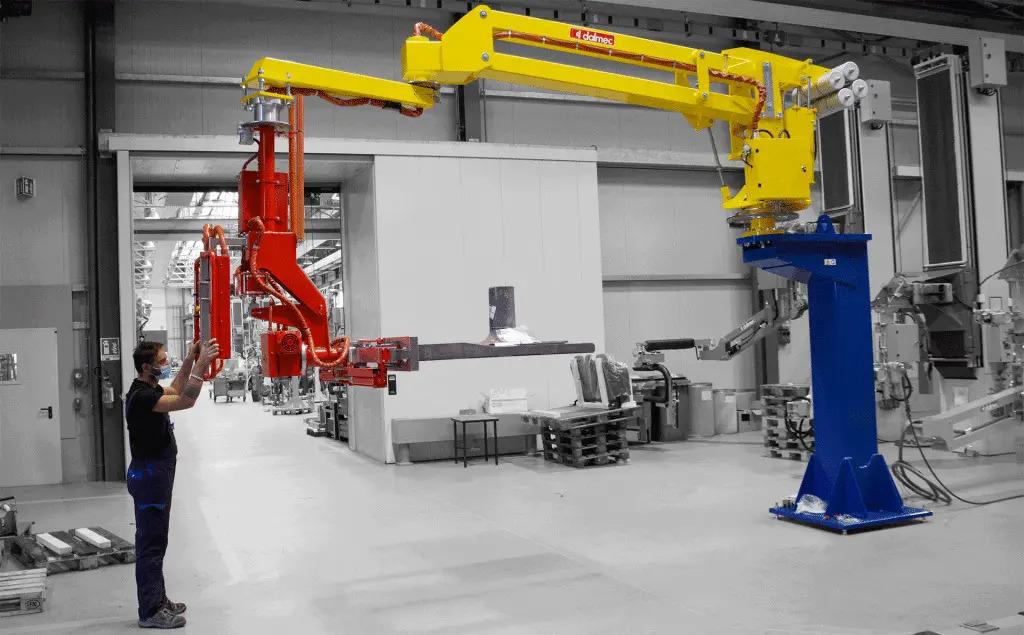
In today's fast-paced industrial landscape, the efficient and safe movement of heavy loads is a cornerstone of operational success. From automotive manufacturing and food processing to warehousing and logistics, businesses are constantly seeking ways to improve productivity while safeguarding their most valuable asset—their workforce. The search for the best Material Handling Solutions is no longer just about moving items from point A to point B; it's about integrating ergonomic, safe, and highly efficient systems that streamline entire workflows. This article explores the critical aspects of modern material handling, the challenges of manual lifting, and the innovative technologies that are setting new standards for safety and efficiency.
The High Cost of Manual Heavy Lifting
For decades, many industries have relied on manual labor to handle heavy, bulky, or repetitive loads. However, this practice comes at a significant cost. Manual handling is a leading cause of workplace injuries, particularly musculoskeletal disorders (MSDs), which result in lost workdays, reduced productivity, and substantial financial burdens. In Australia, for instance, body stressing accounts for a significant portion of serious workers' compensation claims .
-
Worker Safety and Health: The physical strain of lifting, pushing, and pulling heavy items leads to operator fatigue and an increased risk of back, shoulder, and joint injuries. This not only affects employee well-being but also impacts long-term workforce stability.
-
Operational Inefficiency: Manual handling is inherently slow and inconsistent. As workers tire, their output decreases, creating bottlenecks in production and logistics lines. A task that requires two or three people can tie up valuable human resources that could be better utilized elsewhere.
-
Regulatory Compliance: Governments and workplace safety authorities are tightening regulations around manual handling. In Australia, the Work Health and Safety Act requires employers to eliminate or minimize risks associated with hazardous manual tasks, making it a legal and ethical obligation to invest in safer, mechanical alternatives .
Understanding Modern Material Handling Equipment
To overcome these challenges, businesses are turning to a new generation of sophisticated equipment. These are not just simple machines; they are engineered systems designed to integrate seamlessly into complex production environments. Among the most effective of these are lift assist devices and industrial manipulators.
What is an Industrial Manipulator?
An industrial manipulator is a pneumatic lift-assist device that allows a single operator to handle heavy, awkward, or repetitive loads with virtually no physical effort . Unlike a traditional hoist or crane that provides only vertical movement, a manipulator offers full three-dimensional control. It creates a "zero gravity" state where the load is suspended, and the operator can guide it through lifting, lowering, rotation, and precise placement without bearing its weight.
The best Material Handling Solutions in this category are often custom-engineered. Systems like those provided by Dalmec Australia are pneumatic, powered entirely by compressed air, making them reliable in harsh environments where electrical components could pose a risk .
-
Enhanced Productivity and Cost Efficiency: By transforming a two-person task into a one-person operation, these devices significantly boost efficiency. This reduces labor costs and frees up skilled employees for more complex roles .
-
Elevated Safety and Job Satisfaction: By removing the physical burden of heavy lifting, these systems minimize work-related fatigue and stress. This leads to higher job satisfaction, lower turnover, and a safer, more positive work environment .
Key Features of High-Performance Systems
When selecting equipment for handling heavy loads, several key features distinguish a superior solution from an average one.
Customization and Application-Specific Engineering
The "one-size-fits-all" approach does not work for complex material handling tasks. Leading providers, such as Dalmec, are known for custom-building equipment to the exact specifications of the job . This includes designing specialized gripping tools (end-effectors) tailored to the specific geometry of the product, whether it is a vehicle component, a roll of material, a heavy carton, or a chemical drum.
Reach, Capacity, and Control
The ability to handle a wide range of weights and sizes is crucial. Modern pneumatic manipulators can lift products from as little as 6 kg up to a staggering 1500 kg . Furthermore, systems like those from Combilift highlight the importance of maneuverability, designing forklifts that can navigate narrow aisles and confined spaces while handling long, awkward, and heavy loads .
Integration with Workplace Safety Regulations
Modern equipment is designed to be a documented engineering control as part of the hierarchy of controls under workplace safety legislation . By installing mechanical arms and manipulators, businesses can effectively eliminate the risk of manual handling injuries, moving beyond simply reducing risk to completely removing the physical hazard.
Choosing the Right Equipment for Your Needs
Selecting the right solution requires a careful assessment of your operation. Here is a brief guide based on common handling scenarios:
-
For Light, Standard-Shaped Items (Under 90 kg): A cable balancer is an excellent and cost-effective option for vertical lifting and lowering of items like boxes or components that are uniform in shape .
-
For Heavy, Awkward, or Bulky Loads (Up to 1500 kg): An industrial manipulator with a rigid arm is the superior choice. It provides the necessary control for complex movements, such as tilting, rotating, and precisely positioning heavy drums, machinery parts, or irregularly shaped goods .
-
For High-Volume, Precision Tasks: Advanced systems with integrated gripping and rotational capabilities allow operators to work faster, with less fatigue and greater accuracy, making tasks like palletizing or machine feeding more efficient and reliable.
Conclusion: The Path to a Safer, More Productive Future
The shift towards advanced Material Handling Solutions is a strategic investment in the future of any organization that deals with heavy loads. By moving away from manual lifting, companies can protect their employees, reduce costs associated with injuries and downtime, and achieve new levels of operational efficiency.
Choosing the right partner, like Dalmec, which brings over five decades of global experience and a proven track record of over 650 installations in Australia alone, is essential for success . With nationwide support and a commitment to custom-engineered solutions, the path to a more ergonomic, productive, and safe workplace is clear. It's time to move beyond the limitations of manual labor and embrace the power of intelligent, purpose-built material handling equipment.

 English
 Arabic
 Français
 Español
 Deutsch
 Türkçe
 Dutch
Dutch
 Italiano
 Russian
 Romaian