


SAP Artificial Intelligence: The Competitive Advantage Modern Enterprises Cannot Ignore
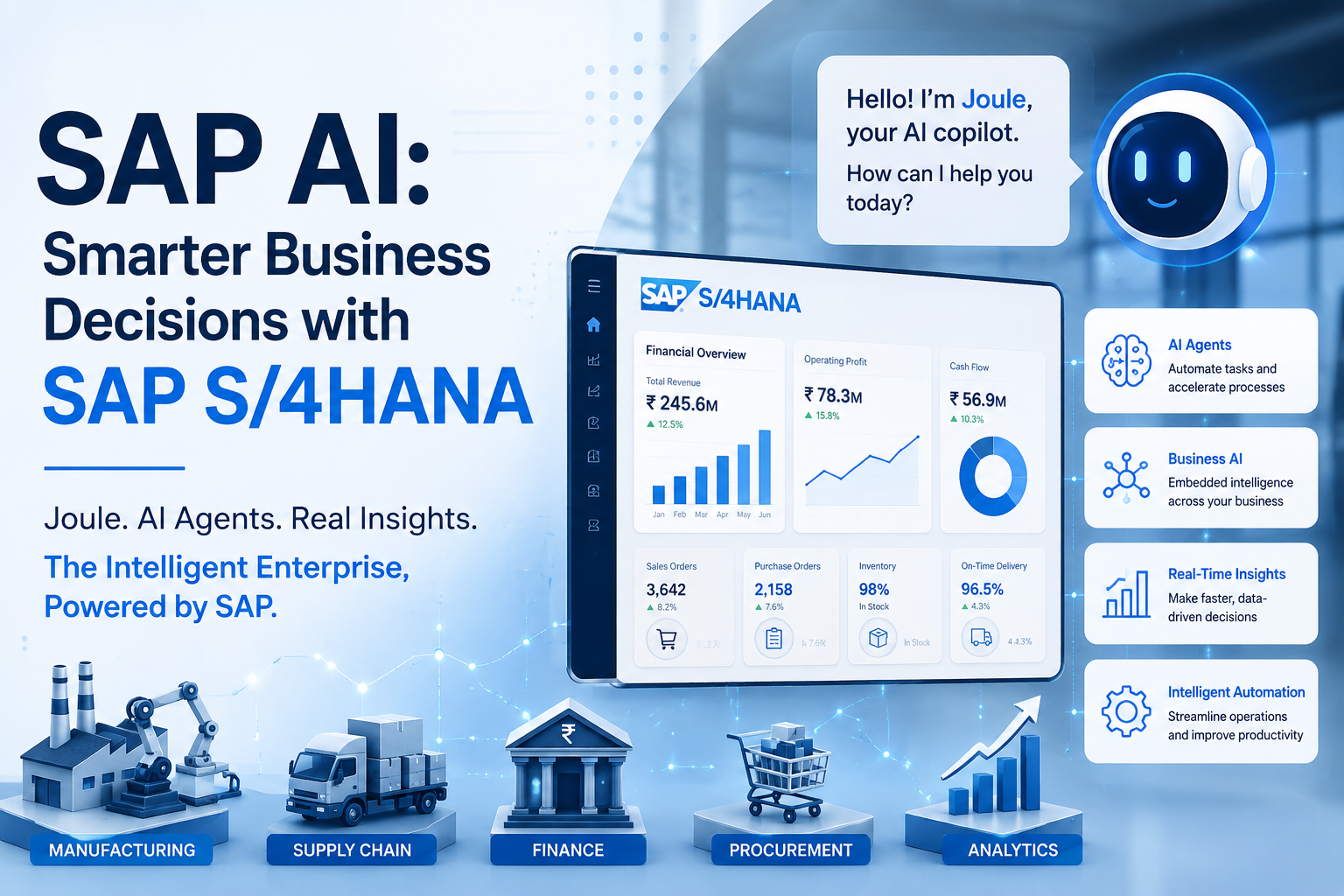
Why Intelligent ERP Is Redefining Business Success
SAP artificial intelligence is changing the way organizations manage operations, make decisions, and respond to business challenges. Companies are no longer looking at ERP systems as platforms that simply record transactions. They expect them to provide insights, automate repetitive work, and support better decisions using enterprise-wide data.
As businesses expand, managing finance, procurement, manufacturing, sales, and customer service through manual processes becomes increasingly difficult. Delayed reporting, disconnected systems, and inefficient workflows create operational bottlenecks that limit growth. By embedding AI into enterprise applications, SAP enables organizations to move from reactive management to proactive decision-making.
The result is an ERP environment that not only supports business operations but also contributes directly to business performance.
Making Every Business Decision More Intelligent
SAP artificial intelligence brings intelligence directly into everyday business processes instead of treating AI as a separate technology initiative. Employees receive recommendations while working, managers gain predictive insights before issues arise, and executives can monitor organizational performance with greater confidence.
Rather than spending hours reviewing reports from multiple systems, decision-makers have access to meaningful information presented in context. This helps businesses respond faster to changing customer expectations, supply chain disruptions, and market opportunities.
The availability of real-time data in SAP ensures every business function works with accurate and up-to-date information instead of relying on outdated reports.
From Data Collection to Business Intelligence
Every organization generates enormous amounts of operational data. The real challenge is transforming that information into actions that improve performance.
Traditional reporting often answers what happened yesterday. AI focuses on what is happening now and what is likely to happen next. This shift enables organizations to become more agile while reducing uncertainty in decision-making.
Too Much Data, Too Few Insights
Business leaders frequently receive dozens of reports without gaining meaningful clarity. Employees spend valuable time searching for information rather than solving business problems.
AI simplifies this process by identifying trends, highlighting exceptions, and presenting recommendations based on business priorities.
Turning Information into Action
The real value of enterprise data comes from using it to improve planning, reduce operational risks, and optimize resources. Intelligent ERP helps organizations convert data into measurable business outcomes instead of static reports.
Smarter Automation Across Every Department
Organizations adopting SAP automation are discovering that automation is no longer limited to simple workflow approvals. AI allows businesses to automate increasingly complex operational processes while maintaining governance and compliance.
Routine administrative activities often consume significant employee time. Removing these repetitive responsibilities enables teams to concentrate on innovation, customer relationships, and strategic planning.
Business areas commonly benefiting from SAP automation include:
- Financial reconciliation, invoice processing, procurement approvals, inventory management, production scheduling, compliance monitoring, customer inquiries, forecasting, and operational reporting.
Automation also improves consistency by reducing manual errors that can affect financial reporting and operational efficiency.
Enhancing Business Performance with SAP S/4HANA
The integration of SAP Artificial Intelligence in S/4HANA allows organizations to bring intelligent capabilities directly into their ERP environment. Users no longer need to rely solely on manual analysis to identify operational issues.
Finance teams receive alerts about unusual transactions before financial closing. Procurement professionals identify supplier performance trends automatically. Manufacturing managers receive production recommendations based on changing demand patterns.
These intelligent capabilities reduce response times while helping organizations improve business outcomes across departments.
Improving Financial Operations
AI continuously reviews financial activities, helping organizations detect anomalies, monitor spending trends, and improve forecasting accuracy without increasing manual effort.
Optimizing Supply Chain Performance
Supply chain teams benefit from predictive inventory planning, demand forecasting, and logistics optimization that adapt to changing business conditions using intelligent recommendations.
Why Real-Time Information Matters More Than Ever
Modern businesses cannot afford to make decisions based on outdated information. Markets change quickly, customer expectations evolve constantly, and operational disruptions can occur without warning.
Access to real-time data in SAP enables organizations to identify issues as they develop rather than after they impact business performance.
For example, a manufacturer noticing an unexpected increase in customer orders can immediately adjust production schedules and procurement activities. Retail businesses can monitor inventory availability continuously and respond before stock shortages affect sales.
Real-time visibility allows organizations to become more responsive while reducing operational uncertainty.
Accelerating Growth with SAP AI Business Services
Implementing enterprise AI does not always require extensive custom development. SAP AI business services provide organizations with ready-to-use intelligent capabilities that simplify adoption while delivering measurable business value.
These services support document processing, predictive forecasting, recommendation engines, conversational AI, image recognition, and intelligent workflow optimization. Businesses can modernize individual processes without disrupting existing operations.
This flexible approach enables organizations to expand AI adoption gradually while focusing on the areas that generate the greatest operational impact.
Creating Better Employee Experiences
Successful digital transformation is not only about improving technology. It is also about improving how employees perform their work.
When repetitive activities are automated and information becomes easier to access, employees spend less time searching for answers and more time solving business problems. This creates a more productive work environment while reducing operational frustration.
AI also supports new employees by providing contextual recommendations, making onboarding faster and reducing dependence on manual guidance.
Reducing Administrative Work
Administrative tasks often limit employee productivity. Intelligent automation removes unnecessary manual work while maintaining business accuracy and compliance.
Supporting Better Collaboration
Departments that previously worked independently can collaborate more effectively because AI delivers shared insights based on enterprise-wide information.
Preparing for Future Business Challenges
Organizations investing in AI today are building capabilities that extend beyond operational efficiency. They are creating systems capable of adapting as business conditions evolve.
Whether responding to market fluctuations, changing customer demand, or regulatory requirements, intelligent ERP provides organizations with greater flexibility and resilience.
Businesses that delay AI adoption may eventually find themselves struggling to compete with organizations capable of making faster, data-driven decisions.
Final Thoughts
The future of enterprise management depends on combining operational excellence with intelligent decision-making. SAP artificial intelligence empowers organizations to automate routine processes, improve forecasting, leverage real-time data in SAP, and deliver meaningful insights through SAP Artificial Intelligence in S/4HANA. Combined with SAP AI business services, these capabilities enable businesses to improve efficiency, strengthen collaboration, and build scalable operations that support long-term growth.
Organizations that embrace intelligent ERP today are positioning themselves for a future where faster decisions, smarter automation, and continuous innovation become everyday business advantages.
FAQs
1. Why are enterprises investing in SAP artificial intelligence?
Organizations invest in SAP artificial intelligence to improve operational efficiency, automate repetitive tasks, enhance decision-making, and gain predictive insights using enterprise data.
2. How does SAP automation improve employee productivity?
SAP automation eliminates repetitive administrative work, allowing employees to focus on strategic planning, customer engagement, and business innovation while reducing manual errors.
3. What advantages does SAP Artificial Intelligence in S/4HANA provide?
It delivers embedded AI capabilities such as predictive analytics, anomaly detection, intelligent recommendations, and workflow automation within everyday ERP processes.
4. How do SAP AI business services simplify AI adoption?
SAP AI business services provide pre-built intelligent capabilities that reduce implementation complexity while enabling organizations to introduce AI into business operations more quickly.
5. Why is real-time data in SAP valuable for business leaders?
Real-time data helps leaders monitor operations continuously, respond faster to business changes, improve forecasting, and make informed decisions based on current information.

 English
 Arabic
 Français
 Español
 Português
 Deutsch
 Türkçe
 Dutch
Dutch
 Italiano
 Russian