


The Long Tail Cast On: Stop Guessing, Start Measuring
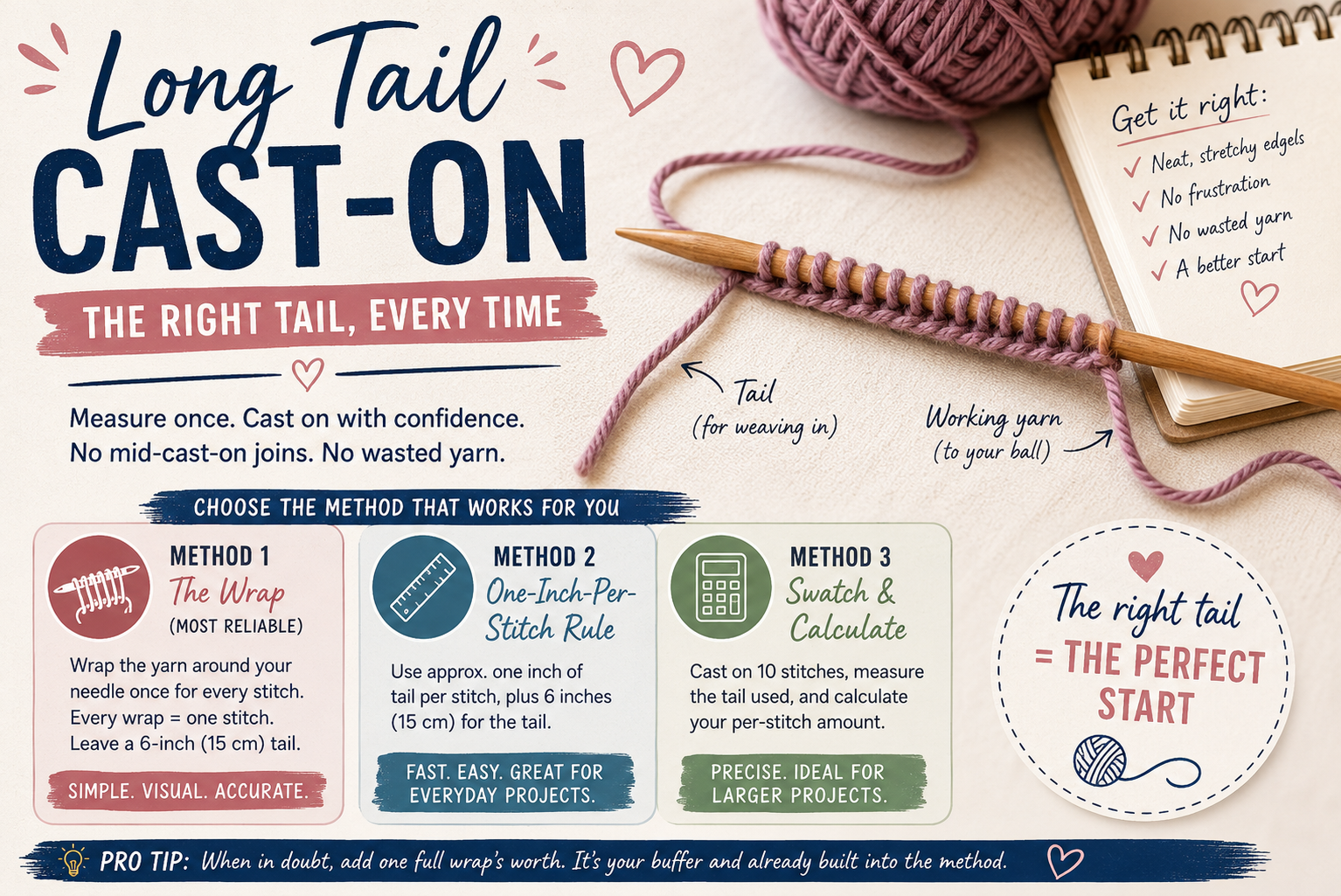
Remember the struggle you went through with the long-tail cast-on? Like counting stitches, feeling confident, and at the end, the yarn tail runs out. You were left holding knitting needles with dangling thread, and frustration to start the whole thing again.
Or maybe you finish your cast on and find yourself with what looks like enough leftover yarn to knit a second hat. Neither is ideal, and neither has to happen to you again.
This cast-on is a popular knitting method because it creates neat, stretchy edges. But knowing the right tail length is what some knitters might get confused about. This guide will fix that — for good.
Long Tail Cast-On: A Traditional Approach
Before we technically start measuring the right length, let's understand what the long tail is.
This method uses a single strand of yarn that you pre-measure (the "long tail") along with the working yarn attached to your ball. Both strands work together to create each stitch. The tail sits over your thumb, the working yarn over your index finger. One scoop motion forms the cast-on loop and the base of the first row simultaneously — setup and first row in a single step.
This makes the long tail method popular among knitters. It's a versatile cast on that suits everything from sweater hems to sock cuffs, producing a neat, slightly elastic edge that holds its shape well.
Why Does Getting the Right Length Matter?
Most knitters treat measuring the yarn tail casually — 'a few extra inches, just to be safe' — but this comes with real consequences either way.
Too Short: Suppose you run out of yarn before finishing your cast-on. If you know how to join a second strand mid-cast-on, you can recover — but with hand-dyed yarn or any yarn where a join would show, it's a frustrating setback.
Too Long: You finish with a tail so generous it could knit a second swatch. That's wasted yarn — and if you're working with premium Merino or hand-dyed skeins, wasted money too.
Getting it right means no mid-cast-on joins, no wasted yarn, and a cleaner edge from the very first stitch.
How to Measure — Choose What Works For You
Here is the solution for all the knitters to save themselves from frustration:
Method 1- The Wrap (Most Reliable)
If you'd rather skip the maths, this is the one to reach for — especially if you're newer to the cast on.
Firstly, wrap the yarn around your knitting needle once for every stitch you need to cast on. Every wrap=one stitch. After wrapping all your stitches, leave a 6-inch (15 cm) tail for weaving in — no more, no less.
That point where your wraps end? That's where you start your long tail cast on. Simple, visual, and surprisingly accurate.
This method works beautifully because it handles your specific yarn weight, needle sizes, and even the way you personally tension your cast on — all things that a generic formula can't fully capture.
If wrapping feels fiddly, there's a quicker mental shortcut that works well for most everyday yarns.
Method 2 - The One-Inch-Per-Stitch Rule
In this, you can start with approximately one inch of tail per stitch, plus 6 inches (15 cm) for the tail.
This rule works well for DK or worsted weight yarn on needles between US 4 and US 9 (3.5–5.5 mm) — the sweet spot for most everyday knitting.
Move to bulky yarn or needles above US 10 (6 mm), and you'll need roughly 20–25% more tail per stitch. Drop to laceweight or needles below US 3 (3.25 mm), and you can trim that estimate by about 15%.
For a big sweater or an heirloom project where every inch counts, it's worth taking five minutes to do this properly.
Method 3- Swatch and Calculate Method
If you love mathematical calculation, then this gives you a precise result. The method is best for larger projects, where wrong calculations cost a lot.
Cast on 10 stitches using the long tail method, then measure how much tail you used. Divide that number by 10 to get your per-stitch usage, then multiply by your full stitch count and add your tail allowance.
For example: Tail Inch/ stitches = 9/10 = 0.9 inches
For 120 stitches: 0.9x120= 108
Plus 6 extra inches = 108 + 6 = 114 inches total.
Pro Tips:
-
Go generous the first time you work with a new yarn. Every yarn behaves a little differently. Loosely spun singles and textured yarns tend to use 10–15% more tail than a smooth equivalent — they grip and bulk slightly as they pass through your fingers. Slippery fibres like silk or bamboo blends do the opposite: they compress and slide, so your wraps may measure shorter than they knit up. Add 10% for those, too, just from the other direction.
-
Mark your starting point with a slip knot, not a guess. Once you've measured your tail using the wrap method or your calculation, place a slip knot at that exact point. This becomes your anchor — your cast-on stitches go on the needle, your tail hangs on one side, your working yarn on the other.
-
Running short, don't panic. If you are a few stitches away from the end, join the second length of yarn for the tail. Hold both together briefly and continue. The join will be barely visible once the project is blocked, especially on a cast-on edge.
Summary
The long tail cast on is worth learning — tail estimates and all. Once you understand one reliable method, it stops being stressful and becomes one of the easiest ways to start your project.
Use the wrap method for everyday projects. Use the swatch-and-calculate approach when the stakes are high. If you're ever unsure, add one full wrap's worth — that's your buffer, and it's already accounted for in the method.
The next time you work a long tail cast on, you won't be guessing. You'll measure once, cast on with confidence, and finish with just enough tail to weave in — exactly the way it's supposed to feel.

 English
 Arabic
 Français
 Español
 Português
 Deutsch
 Türkçe
 Dutch
Dutch
 Italiano
 Romaian