


Generative Engine Optimization Best Practices: A Strategic Framework for Optimizing Content in AI-Powered Search
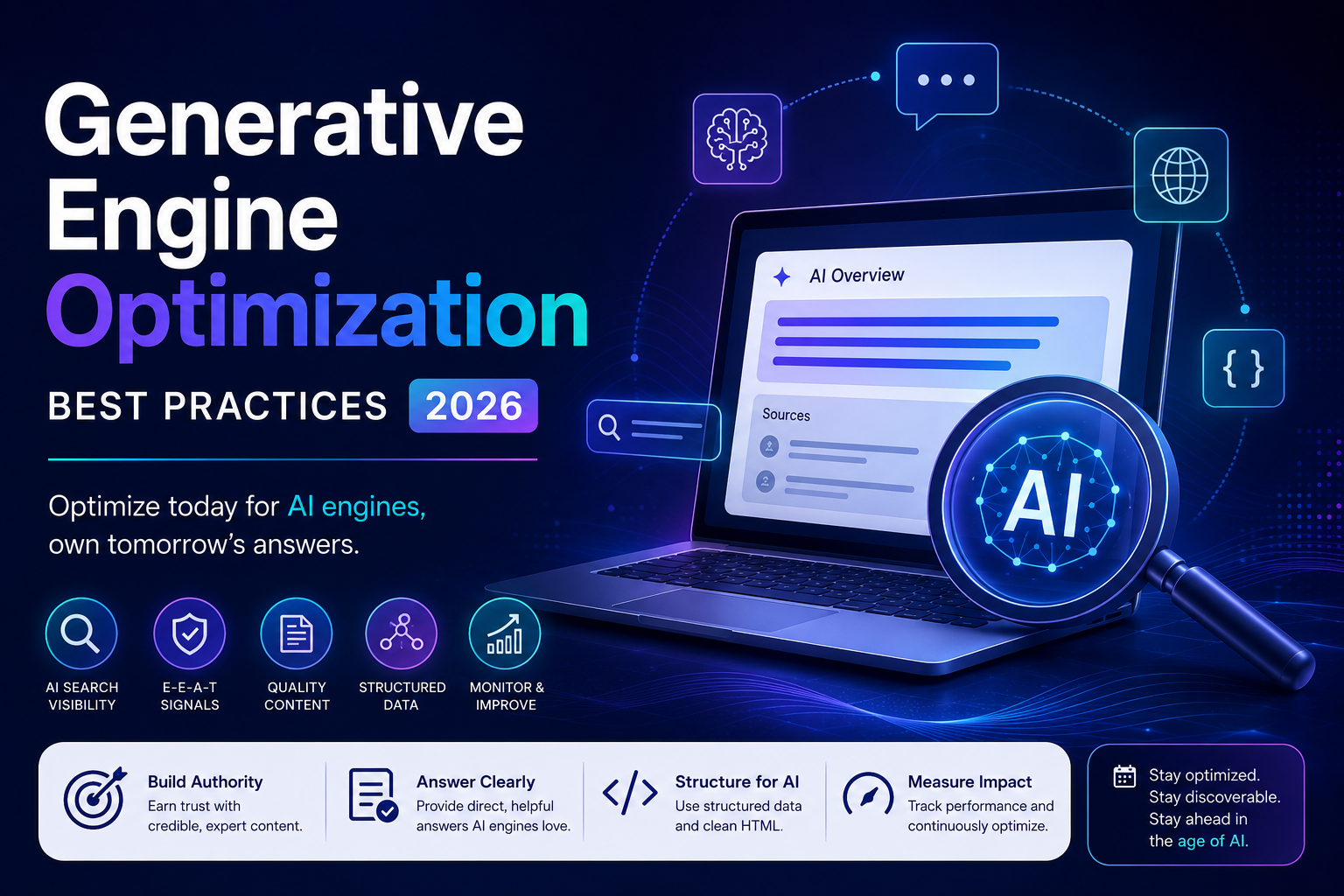
Why Content Optimization Is Entering a New Phase
Digital content has traditionally been optimized with one objective in mind: achieving higher rankings on search engine results pages. While this objective remains relevant, the growing adoption of generative AI has introduced a second layer of optimization. Businesses must now create content that not only satisfies search engine algorithms but also enables AI systems to accurately interpret, contextualize, and reference information.
Generative AI platforms do not simply retrieve webpages. They process information, identify relationships between concepts, and generate responses based on the quality and credibility of available content. This shift makes generative engine optimization best practices an essential consideration for organizations seeking long-term digital visibility.
Rather than viewing GEO as a replacement for SEO, businesses should recognize it as the next stage in the evolution of content optimization.
AI Systems Prioritize Information, Not Individual Pages
One of the most significant differences between traditional search and AI-powered search is the unit of evaluation.
Search engines typically evaluate entire webpages to determine where they should appear within search results. AI systems, however, often evaluate individual sections, explanations, definitions, and supporting context before incorporating that information into generated responses.
This means every section of an article should provide independent value while contributing to the overall discussion.
Applying generative engine optimization best practices requires businesses to think beyond page-level optimization and focus on the quality of information contained within each section.
Context Is Becoming More Valuable Than Keyword Frequency
Early SEO strategies often relied heavily on keyword placement and repetition. Modern AI systems are considerably more sophisticated.
Large language models interpret the meaning behind words by analyzing surrounding context, related concepts, and semantic relationships. Repeating a keyword excessively provides little value if the surrounding information lacks depth or clarity.
For example, an article discussing Generative Engine Optimization should naturally explain concepts such as AI retrieval, semantic relevance, entity recognition, structured content, and conversational search. Together, these related concepts help AI understand the complete subject instead of isolated phrases.
Contextual relevance has become one of the defining characteristics of effective GEO.
Create Information That Can Stand Alone
AI-generated responses frequently extract information from specific sections rather than entire articles.
As a result, every heading should introduce a clearly defined topic, and every paragraph should provide enough context to remain meaningful when interpreted independently.
For instance, if a section discusses semantic search, it should define the concept before explaining its relationship with Generative Engine Optimization. Avoid assuming that readers or AI systems have already processed information from earlier sections.
This approach improves clarity while increasing the likelihood that individual content segments can be referenced accurately.
Strengthen Entity Relationships Throughout the Content
Entity optimization has become increasingly important within AI-powered search.
Entities include organizations, technologies, products, concepts, locations, and other identifiable subjects. AI models use relationships between these entities to develop a contextual understanding of information.
Instead of discussing SEO, AI, structured data, and semantic search separately, businesses should explain how these concepts influence one another.
Establishing these relationships enables AI systems to interpret content more accurately while reinforcing topical relevance.
Developing strong entity relationships is one of the most valuable GEO best practices organizations can implement.
Prioritize Original Analysis Over Rewritten Information
The internet already contains thousands of articles explaining basic SEO concepts. Simply rewriting existing information offers limited value to users and AI systems alike.
Businesses should contribute original perspectives, industry observations, implementation strategies, and practical recommendations whenever possible.
For example, rather than stating that structured content improves AI visibility, explain how clearly defined sections reduce ambiguity during AI retrieval and improve contextual accuracy.
Unique analysis distinguishes authoritative resources from generic informational pages.
Reduce Ambiguity in Technical Explanations
Technical subjects often introduce terminology that can be interpreted differently depending on the context.
Businesses should therefore define specialized concepts before exploring advanced discussions. Explaining technical terminology consistently reduces ambiguity for readers while improving AI comprehension.
Well-defined concepts also increase the reliability of generated summaries because AI systems encounter fewer conflicting interpretations within the content.
Precision has become an important characteristic of authoritative digital publishing.
Build Internal Knowledge Networks
Modern content strategies should resemble knowledge networks rather than isolated collections of articles.
Instead of publishing unrelated blog posts, businesses should connect complementary resources through logical internal linking and consistent topical coverage.
An article discussing Generative Engine Optimization could naturally connect with resources covering AI search behavior, structured data implementation, semantic SEO, content architecture, entity optimization, and information retrieval.
This interconnected structure strengthens topical authority while providing AI systems with a broader understanding of the organization's expertise.
Optimize Content for Long-Term Relevance
Artificial intelligence continues to evolve rapidly, making continuous content refinement increasingly important.
Businesses should periodically review cornerstone articles to improve explanations, expand topic coverage, and incorporate emerging industry developments.
Rather than replacing older resources entirely, strategic updates preserve accumulated authority while ensuring the information remains accurate.
Maintaining evergreen content supported by periodic enhancements represents a sustainable long-term GEO strategy.
Evaluate Content Through an AI Perspective
Before publishing an article, businesses should evaluate it from the perspective of an AI retrieval system rather than solely through conventional SEO metrics.
Key questions include:
- Does each section explain a single concept clearly?
- Are technical terms properly defined?
- Does the article establish meaningful relationships between topics?
- Is every heading supported by substantial information?
- Would an AI system confidently use this content to answer a user's question?
These considerations encourage higher-quality content that serves both readers and AI platforms effectively.
Final Thoughts
The increasing influence of generative AI is changing how information is discovered, interpreted, and delivered across digital platforms. Organizations that adopt generative engine optimization best practices can create content that is not only discoverable but also understandable, trustworthy, and suitable for AI-powered retrieval.
Similarly, implementing comprehensive GEO best practices enables businesses to move beyond traditional keyword optimization toward strategies built on semantic understanding, entity relationships, contextual relevance, and authoritative knowledge. As AI continues to redefine digital discovery, organizations that prioritize information quality over keyword quantity will establish a stronger and more sustainable competitive advantage.
FAQs
1. Why are generative engine optimization best practices becoming increasingly important?
As AI-powered search platforms become more widely adopted, businesses need content that AI systems can accurately interpret, evaluate, and reference when generating responses.
2. How does contextual relevance influence GEO?
Contextual relevance helps AI understand how concepts relate to one another, allowing it to interpret content more accurately than keyword matching alone.
3. What is entity optimization in Generative Engine Optimization?
Entity optimization involves strengthening relationships between identifiable concepts such as technologies, organizations, products, and topics to improve AI comprehension.
4. Why should businesses build content clusters?
Content clusters demonstrate subject expertise by covering related topics comprehensively, strengthening topical authority for both search engines and AI systems.
5. How should businesses evaluate AI-ready content?
Businesses should assess whether the content is well-structured, contextually complete, technically accurate, semantically connected, and capable of answering user questions clearly without relying on additional context.

 English
 Arabic
 Français
 Español
 Português
 Deutsch
 Türkçe
 Dutch
Dutch
 Russian
 Romaian