


What to Actually Check Before Hiring a Liquid Injection Manufacturer
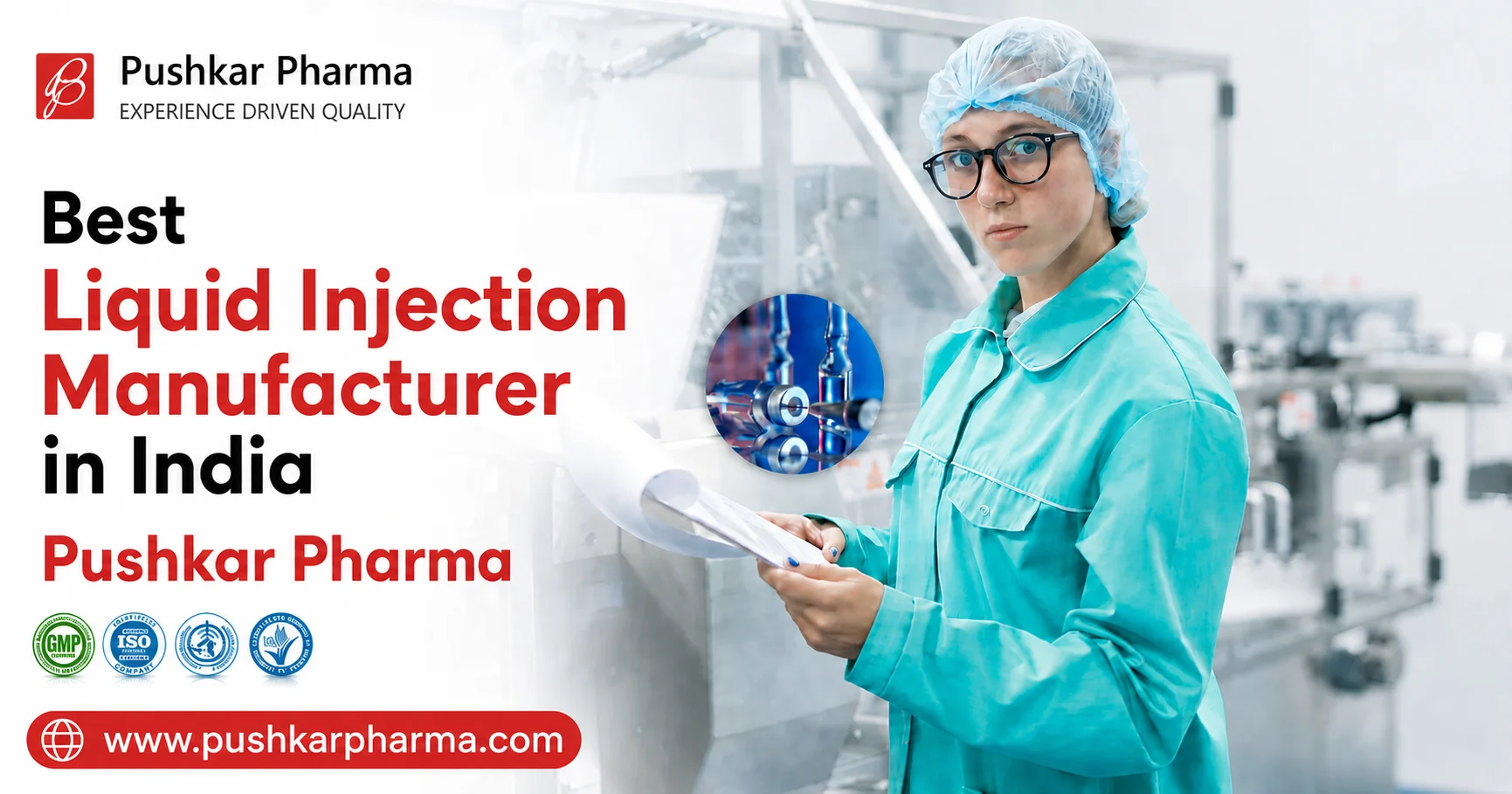
Launching an injectable brand sounds simple until you price out a sterile plant. Autoclaves, ISO Class 5 cleanrooms, validated air handling, effluent treatment — the bill routinely crosses ₹1.5 crore before a single vial is filled. That single number explains why most emerging pharma brands never build their own facility and instead partner with an established liquid injection manufacturer to get to market.
Why the Manufacturing Partner You Pick Matters More Than the Formula
A good formulation means nothing if it's filled in a facility that can't hold sterility. The real differentiators between a serious liquid injection manufacturing company and a shortcut operation are the boring-sounding details: validated water-for-injection loops, particle-count logs for the filling suite, and batch-to-batch endotoxin testing that's actually documented, not just claimed.
Pushkar Pharma, operating out of Kala Amb, Himachal Pradesh, lays out exactly this kind of detail — WHO-GMP certification, ISO Class 5 automated filling lines, and in-house stability chambers — in its guide to what a reliable liquid injection manufacturer in India should offer. It's a useful checklist to hold any facility against before signing an agreement.
Third-Party Manufacturing: The Practical Route for New Brands
Contract manufacturing lets a brand skip the capital burden entirely and start with pilot batches instead of a full production line. This is especially relevant in Himachal Pradesh's pharma belt, where excise-free industrial zones already host a dense cluster of GMP-certified units. Pushkar Pharma's overview of being a third-party injection manufacturer in Himachal Pradesh breaks down why the region has become a default choice for cost-efficient, compliant liquid injection manufacturing.
For brands weighing liquid versus lyophilized formats, it's also worth understanding the alternative production route — dry powder injection manufacturing — since some molecules are simply more stable as a reconstitutable powder than as a ready-to-use liquid.
Hormonal and Specialty Liquid Injectables Need Separate Handling
Not every liquid injectable can run on the same line. Hormonal formulations, in particular, require dedicated air handling systems to prevent cross-contamination with non-hormonal products — a requirement regulators check closely during inspection. Pushkar Pharma's hormonal parenteral (dry and liquid) production line is built around isolated blocks specifically for this reason, and it's a detail worth confirming with any manufacturer handling steroidal or hormonal injectables.
More broadly, the full range of sterile parenteral dry and liquid formulations — antibiotics, analgesics, vitamins, and critical care solutions — gives a sense of the breadth a genuinely capable liquid injection manufacturing company should be able to support under one roof.
Export-Ready Manufacturing Is a Different Bar
If the goal is exporting liquid injectables beyond India, the manufacturer needs more than a domestic drug license. Export markets across Africa, Central Asia, and the CIS region typically require WHO-GMP documentation and country-specific registration dossiers. Pushkar Pharma's work as a top injectable manufacturer supplying Kazakhstan is a decent reference point for what export-grade compliance actually looks like in practice, beyond domestic Schedule M requirements.
The Regulatory Baseline Nobody Should Skip
Whatever the scale, three regulatory frameworks anchor legitimate injectable manufacturing: India's revised Schedule M provisions under CDSCO, the WHO's Good Manufacturing Practice standards for international recognition, and — for anything export-bound to the US — FDA's current Good Manufacturing Practice (cGMP) regulations. A manufacturer that can't speak fluently to all three isn't ready for a serious partnership.
What a Realistic Timeline and Budget Look Like
Brands new to third-party manufacturing are often surprised by how fast a compliant partner can move. Once formulation approval and packaging design are locked, a first commercial batch from a well-run liquid injection manufacturing company typically ships within 30–45 days — covering raw material quarantine, aseptic filling, and lab release testing. On the cost side, pilot runs can start as low as ₹1.5 lakh, which is a fraction of what a self-owned facility would demand just to break ground.
It's also worth clarifying intellectual property terms upfront. In most legitimate contract manufacturing agreements, the brand retains full ownership of its custom formulation once development costs are cleared — this should be written explicitly into the contract, not left as a verbal assurance.
Bottom Line
Whether you're a PCD franchise partner looking to add injectables to your portfolio or a brand planning an export push, the choice of liquid injection manufacturer decides your ceiling. Verify the certifications, ask to see the cleanroom classification in writing, and confirm minimum batch costs before committing capital anywhere else.
For the complete breakdown of facilities, certifications, and product range, read the full page: Best Liquid Injection Manufacturer in India — Pushkar Pharma. You can also learn more about Pushkar Pharma's 33-year manufacturing history or get in touch directly to discuss a pilot batch.

 Arabic
 Français
 Español
 Português
 Deutsch
 Türkçe
 Dutch
Dutch
 Italiano
 Russian
 Romaian