


Japan AI Data Centers: Building the Digital Infrastructure for the AI Era
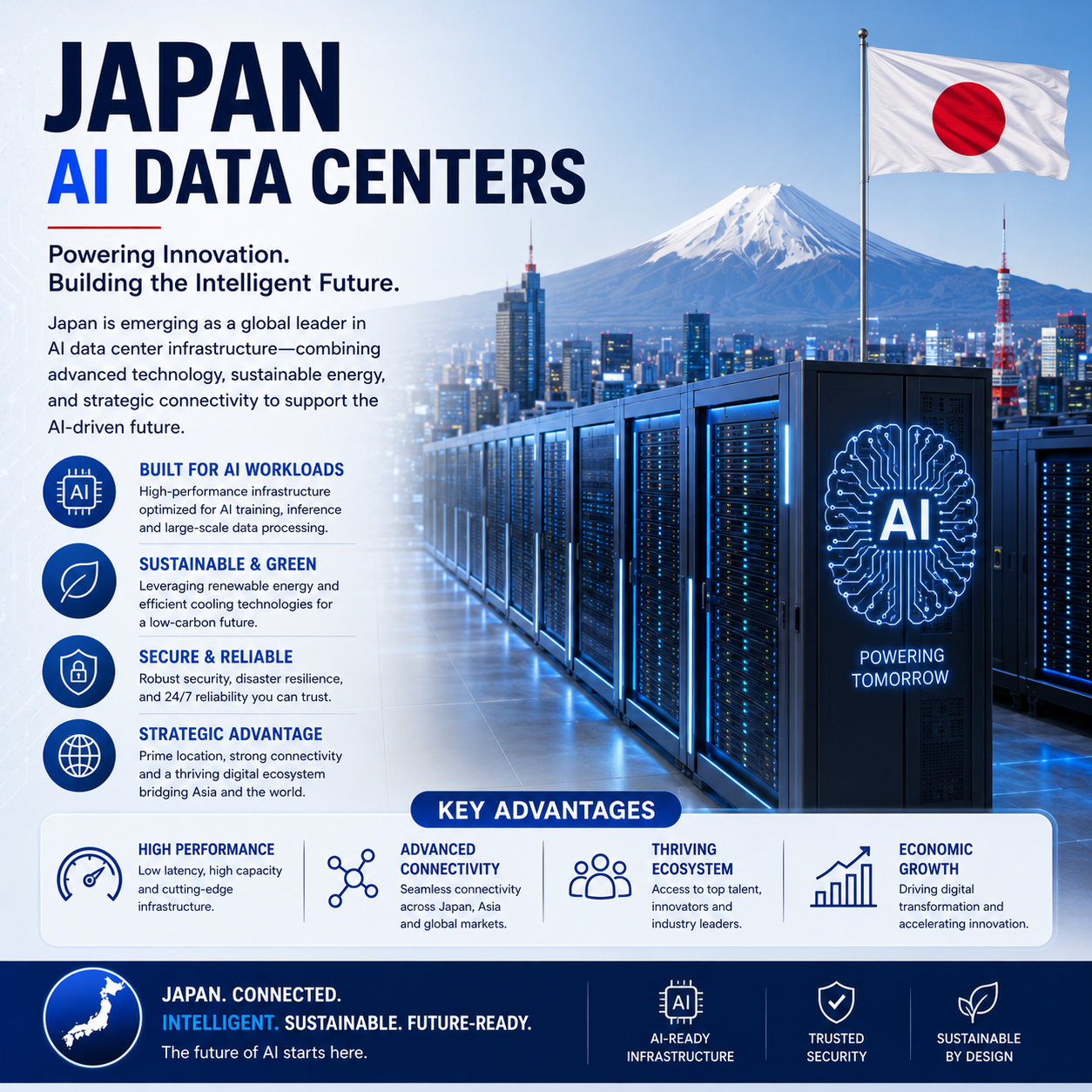
Artificial intelligence has become one of the primary drivers of global digital transformation. As organizations increasingly adopt generative AI, machine learning, and high-performance computing, the demand for advanced digital infrastructure continues to accelerate. Among Asia-Pacific countries, Japan is steadily strengthening its position as a strategic destination for AI-focused data centers by combining technological innovation, reliable infrastructure, and sustainable development initiatives.
Understanding Japan AI Data Centers
AI data centers differ significantly from conventional enterprise facilities. Traditional data centers primarily support business applications, storage, and cloud services, whereas AI data centers are specifically designed to process computationally intensive workloads such as deep learning, large language models, computer vision, robotics, and predictive analytics.
Japan AI data centers increasingly integrate:
• GPU-based computing platforms
• High-density server racks
• Advanced liquid cooling systems
• High-speed optical networking
Why Japan Is Becoming an Important AI Data Center Hub
Several factors contribute to Japan's growing importance in the AI infrastructure landscape.
Japan possesses one of the world's most mature digital ecosystems supported by reliable telecommunications, extensive fiber networks, and advanced cloud infrastructure. These advantages reduce latency and improve connectivity for enterprise AI applications.
Major Technologies Supporting Japan AI Data Centers
Modern AI facilities depend on several emerging technologies that maximize computational performance.
GPU Computing
Graphics Processing Units enable parallel processing required for large AI models, making them essential for generative AI, machine learning, and scientific computing.
High-Performance Computing
HPC clusters allow organizations to perform simulations, AI training, pharmaceutical research, weather forecasting, and industrial modeling more efficiently.
Liquid Cooling
As AI servers consume significantly more power than traditional hardware, liquid cooling helps maintain optimal temperatures while improving overall energy efficiency.
Edge Computing
Edge infrastructure enables AI applications to process information closer to users, reducing latency for autonomous systems, smart factories, healthcare, and transportation.
Key Features of Japan AI Data Centers
• High-density GPU infrastructure
• AI-ready server architecture
• Advanced cybersecurity systems
• Energy-efficient cooling technologies
• High-speed fiber connectivity
Common Uses of Japan AI Data Centers
AI data centers support a wide variety of industries and research activities.
Manufacturing
Factories utilize AI for predictive maintenance, robotics, quality inspection, and process optimization.
Healthcare
Medical researchers employ AI computing for drug discovery, medical imaging, genomics, and disease prediction.
Automotive
Automotive companies process autonomous driving data, vehicle simulations, and connected mobility applications.
Financial Services
Banks and financial institutions use AI for fraud detection, risk management, customer analytics, and algorithmic trading.
Benefits of Japan AI Data Centers
Organizations adopting AI-ready infrastructure experience several operational advantages.
• Faster AI model training
• Improved computing performance
• Greater scalability
• Reduced processing time
Business Opportunities
The expansion of Japan AI data centers is generating opportunities across multiple technology sectors.
Growing investments in semiconductor manufacturing increase demand for specialized computing facilities capable of supporting advanced chip development
Emerging Market Concepts
Several technology trends are expected to shape the future development of Japan AI data centers.
• Green AI Infrastructure
• Carbon-neutral operations
• AI-powered facility management
Conclusion
Japan AI data centers represent a significant evolution in digital infrastructure, supporting the computational demands of artificial intelligence, cloud computing, and high-performance workloads. Their combination of advanced technologies, sustainable design, resilient infrastructure, and growing investment reflects the broader transformation of the global digital economy. As AI adoption accelerates across industries, Japan's continued investment in scalable, efficient, and secure data center ecosystems is expected to play an important role in supporting future technological innovation.


 English
 Arabic
 Français
 Español
 Português
 Deutsch
 Türkçe
 Dutch
Dutch
 Russian
 Romaian