


Quantum Computing in Financial Services Industry Outlook
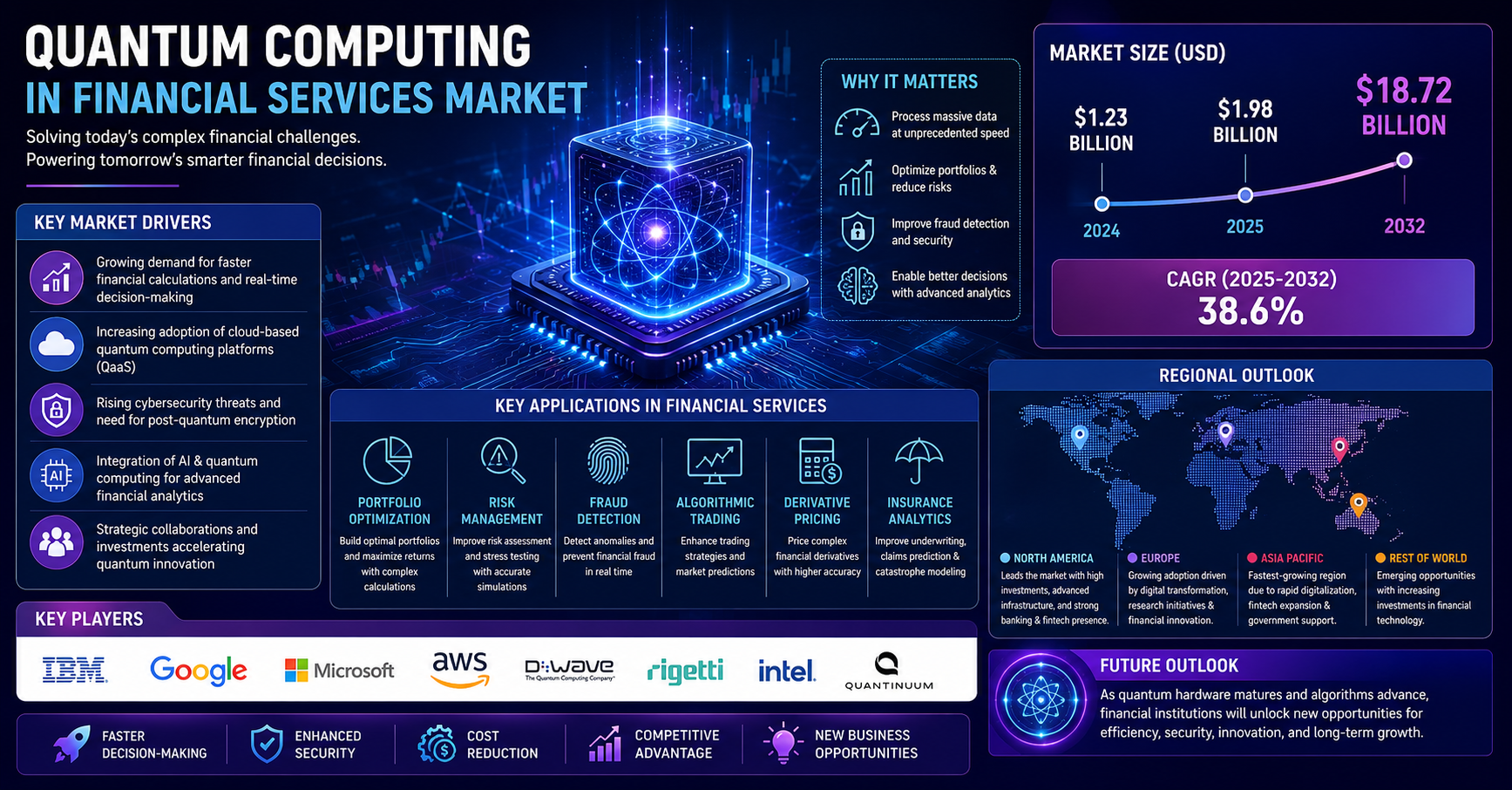
The financial services industry has always been one of the earliest adopters of emerging technologies. From electronic trading and artificial intelligence to blockchain and cloud computing, innovation has continuously reshaped how financial institutions operate. Today, Quantum computing is emerging as the next technological breakthrough with the potential to revolutionize banking, insurance, capital markets, and investment management.
Unlike traditional computers that process information using bits (0s and 1s), quantum computers use qubits, enabling them to perform multiple calculations simultaneously. This unique capability allows quantum systems to solve highly complex optimization and simulation problems that would take conventional supercomputers years to complete.
As financial institutions increasingly deal with enormous datasets, sophisticated risk models, cybersecurity threats, and real-time trading decisions, quantum computing is becoming a strategic investment. Banks, fintech companies, hedge funds, and insurance providers are actively exploring quantum technologies to improve efficiency, reduce costs, strengthen security, and gain a competitive advantage.
The Quantum Computing in Financial Services Market is expected to witness significant expansion over the coming years as technological advancements, cloud-based quantum platforms, and strategic collaborations accelerate commercialization.
What Is Quantum Computing?
Quantum computing is a new generation of computing technology that leverages the principles of quantum mechanics. Unlike classical computers, which process one calculation at a time, quantum computers can evaluate multiple possibilities simultaneously.
The technology relies on three major concepts:
- Superposition
- Entanglement
- Quantum interference
These capabilities enable quantum systems to solve optimization, simulation, machine learning, and cryptography problems at unprecedented speeds.
For the financial industry, this means solving problems that were previously impossible or economically impractical.
Why Financial Institutions Are Investing in Quantum Computing
Banks and financial organizations generate massive volumes of structured and unstructured data every second. Traditional computing infrastructures often struggle with complex portfolio optimization, fraud detection, derivative pricing, and enterprise risk management.
Quantum computing offers several advantages:
- Faster decision-making
- Better investment strategies
- Enhanced fraud prevention
- Improved portfolio optimization
- Advanced financial modeling
- Reduced operational costs
- Stronger cybersecurity
- Higher computational efficiency
Major financial institutions recognize that early adoption could provide a substantial competitive advantage in increasingly digital financial markets.
Market Drivers
Growing Need for Faster Financial Calculations
Financial markets operate in milliseconds. Portfolio optimization, derivative pricing, risk calculations, and algorithmic trading require enormous computational resources.
Quantum computing significantly accelerates these calculations, enabling institutions to respond to market changes almost instantly.
Increasing Investment in Quantum Technologies
Technology companies, governments, venture capital firms, and financial institutions are investing billions of dollars in quantum computing research.
Cloud-based quantum computing platforms have also made the technology more accessible for banks and fintech companies without requiring expensive infrastructure investments.
Rising Cybersecurity Concerns
Financial organizations are prime targets for cyberattacks.
Quantum technologies enable the development of next-generation encryption methods while simultaneously encouraging institutions to prepare for post-quantum cybersecurity standards.
Growth of Artificial Intelligence
AI models require massive computing capabilities.
Quantum computing can significantly improve machine learning algorithms used in:
- Credit scoring
- Customer analytics
- Fraud detection
- Investment forecasting
- Personalized banking
Digital Transformation Across Banking
Banks worldwide continue investing in digital transformation initiatives.
Quantum computing complements cloud computing, AI, blockchain, and advanced analytics to build smarter financial ecosystems.
Emerging Market Trends
Several technological trends are shaping the Quantum Computing in Financial Services Market.
Hybrid Quantum-Classical Computing
Most financial organizations are combining quantum processors with classical computing infrastructure to maximize efficiency.
Quantum-as-a-Service (QaaS)
Cloud providers now offer access to quantum processors through subscription-based platforms, reducing implementation costs for enterprises.
AI and Quantum Integration
Artificial intelligence and quantum computing together are enabling faster predictive analytics and better investment models.
Post-Quantum Cryptography
Banks are preparing encryption systems capable of resisting future quantum cyber threats.
Strategic Partnerships
Technology providers, banks, universities, and research organizations continue forming partnerships to accelerate commercial quantum applications.
Applications in Financial Services
Portfolio Optimization
Investment firms analyze thousands of variables when constructing investment portfolios.
Quantum computing helps identify optimal investment combinations faster while minimizing risk.
Fraud Detection
Modern banking fraud evolves rapidly.
Quantum algorithms improve anomaly detection by analyzing enormous transaction datasets in real time.
Risk Management
Banks constantly assess:
- Credit risk
- Liquidity risk
- Operational risk
- Market risk
Quantum computing enables more accurate simulations and predictive risk models.
Algorithmic Trading
Trading firms depend on high-speed data analysis.
Quantum computing enables:
- Faster trade execution
- Better pricing models
- Market prediction
- Pattern recognition
Credit Scoring
Traditional credit scoring often relies on limited variables.
Quantum AI models analyze significantly larger datasets, improving lending decisions.
Insurance Analytics
Insurance providers use quantum simulations for:
- Premium calculations
- Claims forecasting
- Catastrophe modeling
- Customer segmentation
Financial Forecasting
Banks process enormous economic datasets.
Quantum systems improve forecasting accuracy by evaluating multiple market scenarios simultaneously.
Market Opportunities
The growing commercialization of quantum computing creates opportunities across multiple sectors.
Commercial Banking
Banks can automate operations while improving customer experiences.
Investment Banking
Investment firms benefit from advanced portfolio optimization and financial modeling.
Asset Management
Quantum technologies improve investment strategies using faster predictive analytics.
FinTech
Startups are developing innovative quantum-powered financial software platforms.
Insurance
Quantum simulation improves underwriting accuracy and claims management.
Payment Systems
Real-time fraud detection and secure digital payment processing represent significant growth opportunities.
Market Challenges
Despite promising growth prospects, several challenges continue to influence market adoption.
High Development Costs
Building scalable quantum computers requires substantial investments in hardware, research, and specialized infrastructure.
Limited Skilled Workforce
The shortage of quantum physicists, engineers, software developers, and quantum algorithm specialists remains a significant industry challenge.
Hardware Limitations
Current quantum computers still face issues related to qubit stability, error correction, and scalability.
Integration Complexity
Financial institutions must integrate quantum systems with existing IT infrastructure while ensuring regulatory compliance and operational continuity.
Regulatory and Security Concerns
The emergence of quantum computing introduces new cybersecurity challenges, requiring organizations to prepare for quantum-resistant encryption standards.
Future Outlook
The future of the Quantum Computing in Financial Services Market appears highly promising as advancements in quantum hardware, cloud computing, artificial intelligence, and cybersecurity continue to accelerate commercialization. Over the coming decade, financial institutions are expected to expand quantum applications across investment management, fraud detection, portfolio optimization, credit risk assessment, derivative pricing, customer analytics, and cybersecurity.
Hybrid quantum-classical computing environments are likely to become the preferred enterprise model, enabling organizations to leverage quantum capabilities while maintaining compatibility with traditional computing systems. Increased collaboration between financial institutions, technology providers, governments, and research organizations will further drive innovation and accelerate real-world adoption.
As quantum computing matures, it has the potential to redefine financial decision-making, improve operational efficiency, and create entirely new business models across the global financial ecosystem.
Conclusion
Quantum computing is rapidly evolving from a research-driven concept into a transformative technology for the financial services industry. Its ability to process massive datasets, solve complex optimization problems, strengthen cybersecurity, and improve predictive analytics positions it as one of the most disruptive innovations in modern finance.
Banks, investment firms, insurers, fintech companies, and technology providers are actively investing in quantum research to gain competitive advantages and prepare for the next generation of financial computing. While challenges such as hardware scalability, development costs, and workforce shortages remain, continuous innovation and increasing commercial investment are expected to accelerate adoption.
Organizations that begin exploring quantum computing today will be better positioned to capitalize on future opportunities, improve decision-making, reduce operational risks, and drive long-term business growth. As the technology matures, the Quantum Computing in Financial Services Market is expected to become a cornerstone of the future digital financial ecosystem.

 English
 Français
 Español
 Português
 Deutsch
 Türkçe
 Dutch
Dutch
 Italiano
 Russian
 Romaian