


Agentic AI vs Traditional Automation: What’s the Real Difference?
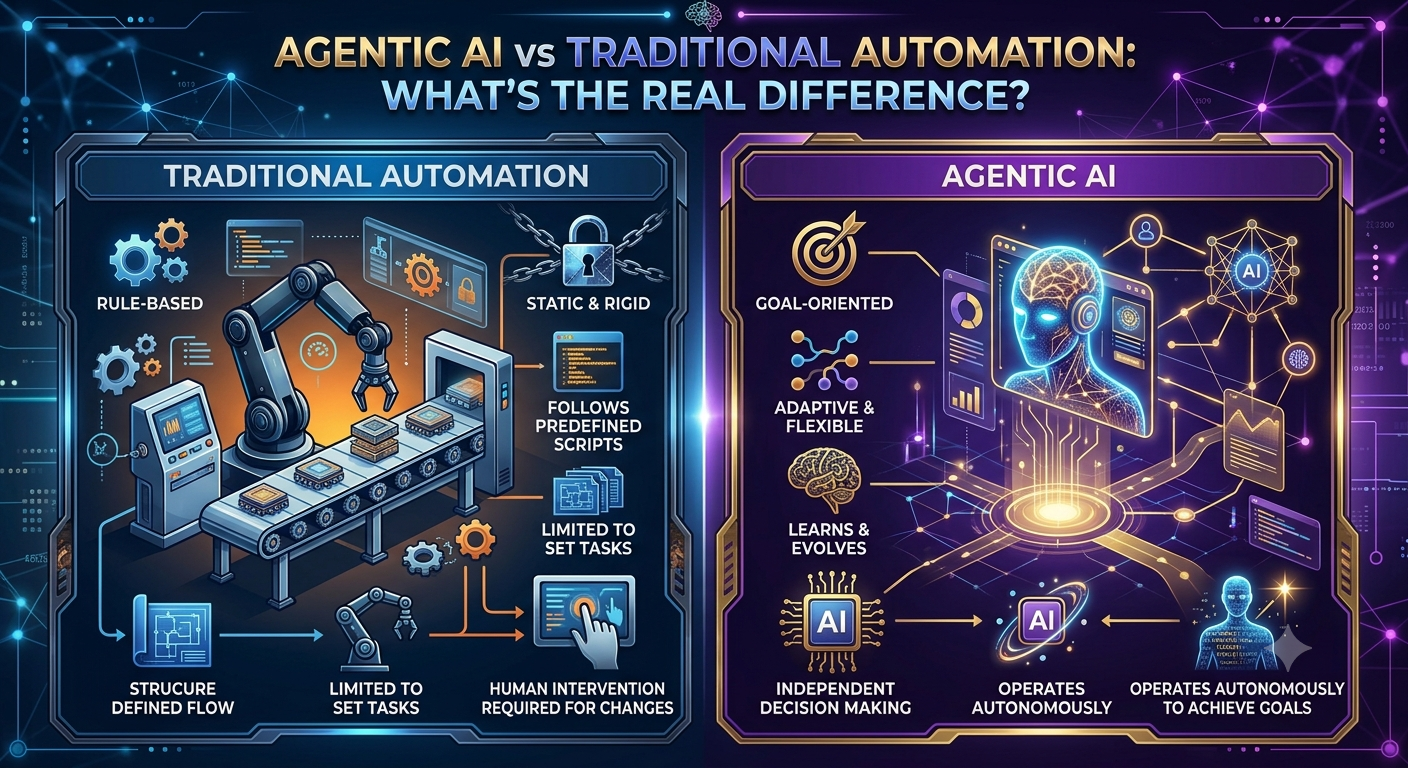
Agentic AI vs Traditional Automation: What’s the Real Difference?
Introduction
Businesses have relied on automation for decades to streamline repetitive tasks and improve efficiency. From rule-based bots to workflow management tools, traditional automation has delivered measurable operational improvements. However, a new paradigm is emerging one that goes beyond static instructions and predefined scripts. Understanding the Benefits of Agentic AI requires comparing it directly with traditional automation to see how intelligent, goal-driven systems are transforming enterprise operations.
While automation executes tasks, Agentic AI systems reason, plan, decide, and adapt. This distinction is not incremental — it is foundational. Organizations exploring digital transformation must understand what truly separates these two technologies before investing in next-generation AI systems.
What Is Traditional Automation?
Traditional automation relies on predefined rules and structured workflows. These systems operate based on “if-this-then-that” logic. Robotic Process Automation (RPA) tools, macros, and scripted bots fall into this category.
Key characteristics of traditional automation include:
-
Fixed workflows
-
No contextual reasoning
-
Limited adaptability
-
Dependency on structured data
-
Manual intervention for exceptions
For example, an automated invoice processing bot extracts data from invoices and enters it into accounting software. However, if the invoice format changes or contains unexpected anomalies, the bot may fail.
Traditional automation improves efficiency but lacks intelligence. It executes tasks but does not interpret broader goals.
What Is Agentic AI?
Agentic AI represents systems designed to operate autonomously toward defined objectives. Instead of following static rules, these systems:
-
Understand goals
-
Plan multi-step actions
-
Evaluate outcomes
-
Adapt based on feedback
-
Interact with tools and environments
Agentic AI systems can analyze complex data, coordinate across platforms, and make decisions dynamically. They behave more like digital agents than simple task executors.
For example, instead of merely processing invoices, an Agentic AI system could:
-
Detect billing inconsistencies
-
Flag potential fraud
-
Communicate with vendors
-
Adjust payment schedules
-
Provide financial forecasting insights
The difference lies in autonomy and decision-making capability.
Core Differences Between Agentic AI and Traditional Automation
1. Rule-Based vs Goal-Oriented
Traditional automation follows predefined instructions. Agentic systems pursue outcomes.
Automation asks:
“What step comes next?”
Agentic AI asks:
“What action best achieves the objective?”
2. Static Logic vs Dynamic Reasoning
Automation workflows must be redesigned when conditions change. Agentic AI systems can adapt by analyzing context and adjusting strategies in real time.
3. Task Execution vs Strategic Contribution
Automation improves efficiency at the task level. Agentic AI contributes at the strategic level by optimizing processes and identifying opportunities.
4. Human Dependency
Automation often requires oversight when exceptions occur. Agentic AI reduces intervention by managing uncertainties more effectively.
Where Traditional Automation Still Works Best
Despite its limitations, traditional automation remains valuable for:
-
High-volume repetitive tasks
-
Structured environments
-
Predictable workflows
-
Low-risk operations
It is cost-effective and relatively easy to implement. Organizations with stable processes can still gain strong returns from automation tools.
However, as complexity increases, rule-based systems struggle to scale.
When Agentic AI Becomes Essential
Enterprises facing dynamic environments benefit significantly from intelligent, goal-driven systems.
Examples include:
-
Customer service with complex queries
-
Supply chain optimization
-
Fraud detection
-
Financial forecasting
-
Workforce planning
At this stage of digital transformation, many organizations begin recognizing the operational and strategic Benefits of Agentic AI across multiple business functions.
These systems can:
-
Reduce decision latency
-
Improve cross-department coordination
-
Increase predictive accuracy
-
Enhance customer personalization
-
Strengthen risk management
The shift from automation to agentic systems is not about replacing tools — it’s about evolving capabilities.
ROI Comparison: Automation vs Agentic AI
Traditional automation typically delivers ROI through:
-
Labor cost reduction
-
Faster task execution
-
Error minimization
Agentic AI expands ROI dimensions by adding:
-
Strategic optimization
-
Predictive intelligence
-
Risk mitigation
-
Adaptive scaling
While automation cuts costs, Agentic AI creates value.
Organizations that adopt goal-driven AI systems often report improvements in:
-
Operational resilience
-
Decision quality
-
Business agility
-
Long-term competitiveness
The financial impact extends beyond efficiency into transformation.
Implementation Complexity
Traditional automation projects are typically:
-
Shorter in duration
-
Lower in upfront cost
-
Easier to deploy
Agentic AI implementations require:
-
Strong governance frameworks
-
Data integration strategies
-
Clear objective definitions
-
Monitoring and feedback systems
This complexity makes professional expertise critical. Many technology leaders pursue an Agentic AI Course to understand architecture, governance, and real-world deployment models before initiating enterprise projects.
Proper training ensures systems are deployed responsibly and aligned with measurable outcomes.
Governance and Risk Considerations
Automation risks are relatively straightforward — mostly operational failures or process errors.
Agentic AI introduces broader considerations:
-
Ethical decision-making
-
Bias management
-
Auditability
-
Security controls
-
Human-in-the-loop frameworks
Without governance, autonomous systems may produce unintended consequences. Therefore, organizations must implement:
-
Clear objective constraints
-
Performance monitoring
-
Escalation protocols
-
Compliance tracking
Professional validation through Agentic AI Certification programs can help IT leaders establish standardized implementation practices and ensure enterprise readiness.
Certification frameworks often cover:
-
System architecture
-
Risk assessment
-
Lifecycle monitoring
-
Regulatory alignment
-
Scalable deployment patterns
This structured approach reduces uncertainty and improves stakeholder confidence.
Future Outlook: From Automation to Autonomy
The next wave of enterprise transformation will not eliminate automation but build upon it.
We are moving from:
Task Automation → Process Automation → Intelligent Orchestration → Autonomous Systems
Agentic AI sits at the top of this evolution.
As organizations handle increasingly complex digital ecosystems, static workflows will struggle to meet expectations. Businesses that integrate goal-driven AI systems will gain a competitive edge in:
-
Speed of innovation
-
Market responsiveness
-
Customer experience
-
Operational intelligence
The question is no longer whether enterprises will adopt Agentic AI — but how quickly and strategically they will do so.
Conclusion
Traditional automation remains a powerful tool for predictable, structured tasks. It delivers efficiency and cost savings in stable environments. However, modern enterprises require systems that can reason, adapt, and pursue objectives autonomously.
The true Benefits of Agentic AI lie in its ability to transform automation from task execution into strategic intelligence. Organizations that invest in skill development through an Agentic AI Course and validate expertise with Agentic AI Certification will be better positioned to deploy scalable, governed, and measurable AI systems.
The difference between automation and Agentic AI is not just technological, it is transformational. Businesses that understand this shift today will lead tomorrow.

 English
 Arabic
 Français
 Español
 Português
 Deutsch
 Türkçe
 Dutch
Dutch
 Russian
 Romaian