


Why Template-Based ISO Implementation Fails Dubai Businesses
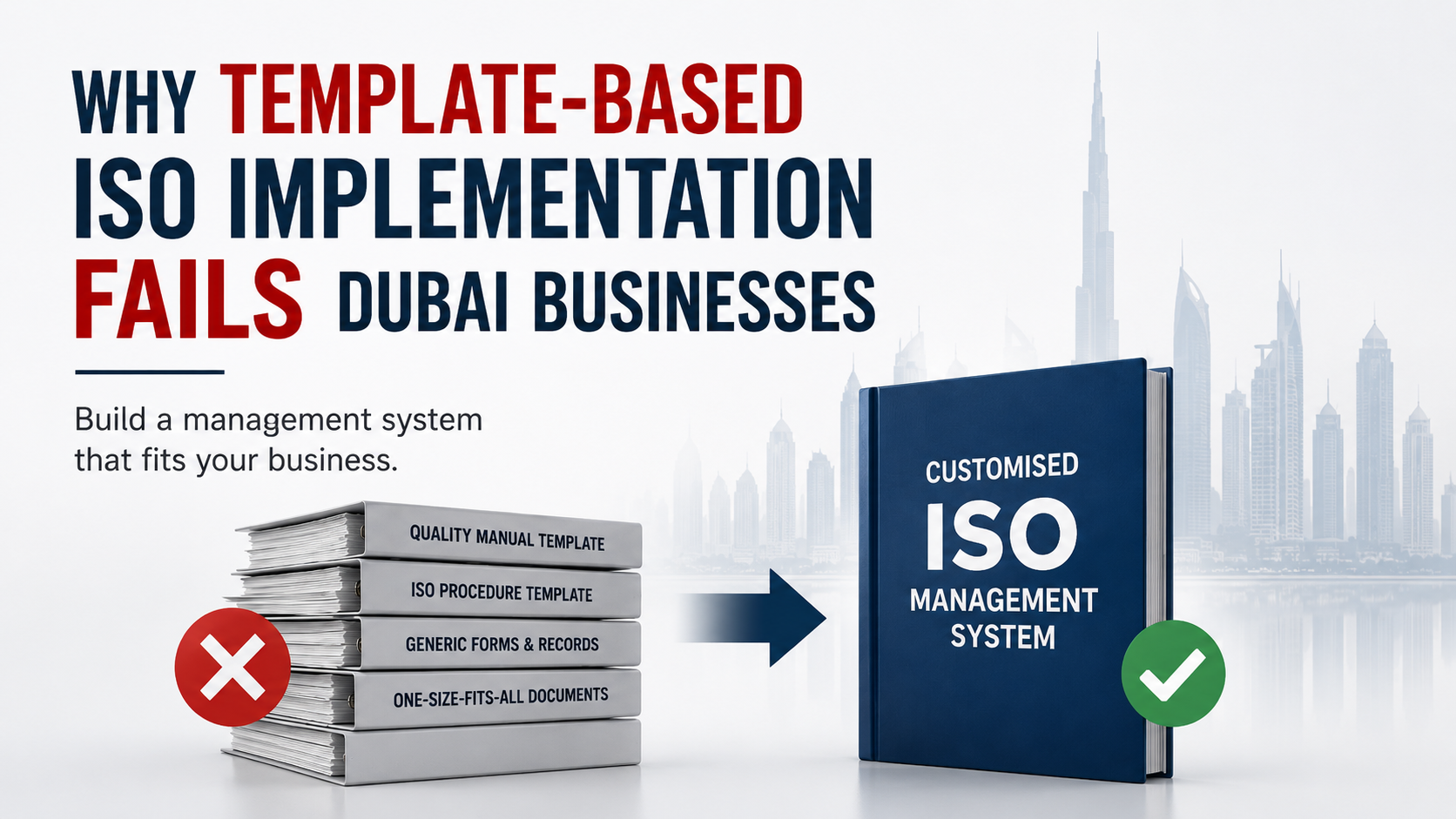
ISO implementation often begins with a search for policies, procedures, forms and manuals. For businesses working under tight deadlines, purchasing a ready-made documentation package can appear to be the fastest route to certification.
The templates may contain professional language, clause references and dozens of forms. On the surface, the organization appears to have everything required for an ISO management system.
The problem becomes visible when employees try to use those documents.
A procedure written for a manufacturing company may not fit a consulting business. Responsibilities may be assigned to departments that do not exist. Forms may request information that employees never collect. During an audit, the documented process may be completely different from what actually happens.
Templates can provide useful examples, but they cannot replace a management system designed around the organization's real operations.
Templates Do Not Understand the Business
Every organization has its own structure, services, risks, customers and working methods.
Two companies may implement the same ISO standard but require very different controls. A logistics company may focus on delivery accuracy, vehicle availability and supplier performance. A construction business may need stronger controls for site activities, subcontractors and workplace safety. A technology company may depend on access control, information security and service continuity.
A standard template cannot understand these differences.
When the documentation is not based on actual activities, employees are asked to follow processes that were designed for another type of organization. This creates confusion and encourages teams to continue using informal methods.
Generic Procedures Create Audit Contradictions
ISO auditors compare documented arrangements with actual practices and available evidence.
Suppose a purchasing procedure states that every supplier is evaluated before approval. During the audit, the procurement team explains that suppliers are selected mainly through previous experience and price comparisons. There are no completed evaluation records.
The problem is not necessarily that the company lacks supplier controls. The problem is that the written procedure does not accurately describe them.
Similar contradictions can appear in customer complaint handling, employee training, document approval, equipment maintenance, risk assessment and corrective action.
A management system becomes credible when documents, employee explanations and records tell the same story. Generic templates often create gaps between these three areas.
Unnecessary Documents Increase the Workload
Template packages frequently contain more documents than an organization actually needs.
Employees may be given numerous registers, checklists and forms without understanding their purpose. Process owners then complete records only because they believe an auditor may ask for them.
This creates administrative work without improving control.
Overdocumentation can also make the system difficult to maintain. When a business process changes, several related procedures and forms may need to be updated. If document ownership is unclear, outdated versions continue circulating between departments.
Effective ISO documentation should provide enough structure to control risks and maintain evidence without creating paperwork that adds no operational value.
Templates Often Assign the Wrong Responsibilities
A template may assign quality-related activities to a quality manager, human resources department, procurement manager or management representative.
However, the organization may use different job titles or divide responsibilities differently.
For example, a smaller Dubai business may not have a dedicated quality department. Department managers may share responsibility for objectives, risks, complaints and corrective actions. In another organization, quality responsibilities may be managed centrally while operational evidence is maintained at individual branches or project sites.
If responsibilities are copied without adjustment, employees may assume that someone else owns the task. Internal audits are delayed, records remain incomplete and corrective actions receive no follow-up.
Every responsibility should be assigned to an actual role with the authority and resources to carry it out.
Employees Cannot Implement What They Do Not Recognise
Employees are more likely to follow a procedure when it reflects the work they already understand.
A copied procedure may use unfamiliar terminology or describe approval stages that are not part of the company’s workflow. Employees may attend an awareness session, acknowledge the document and then return to their previous working methods.
The organization becomes certified on paper while the real business continues operating outside the management system.
Practical implementation requires employee participation. Process owners should explain how activities are performed, where problems occur and which records already exist. The documented process can then be improved without becoming disconnected from reality.
Training should also use examples from the organization rather than simply explaining clauses from the ISO standard.
One Template Cannot Fit Every Dubai Location
Businesses operating through several branches, warehouses, offices or project sites may require both central controls and location-specific instructions.
A standard document package may assume that every site performs the same activities. In practice, one location may handle customer communication, another may manage storage and distribution, while the head office controls finance, procurement and human resources.
Using identical procedures everywhere can create irrelevant requirements. Allowing each location to develop unrelated documents creates a different problem: inconsistency.
The organization needs to identify which controls should be standardized and where controlled local variation is necessary. That decision can only be made after reviewing the scope, process interactions and responsibilities of each site.
Templates Do Not Identify Existing Gaps
Documentation should be developed after the organization understands its current position.
A gap analysis can identify existing controls, missing requirements, weak records and processes that need improvement. Without this assessment, the company may replace working practices unnecessarily while failing to address genuine risks.
For example, a business may already have an effective customer complaint process but lack a method for analyzing complaint trends. A template may replace the entire process instead of strengthening the missing performance-analysis step.
Starting with documents rather than an assessment reverses the correct order of implementation.
What a Practical Implementation Approach Should Include
A useful ISO management system should begin with the organization's scope, activities, interested parties, operational risks and existing processes.
Documentation can then be developed around real workflows. Employees should receive role-specific guidance, process owners should maintain relevant evidence and internal audits should test whether the controls are working.
Businesses that do not have sufficient internal expertise may use customized ISO consultancy support in Dubai to conduct a gap analysis, develop practical documentation, guide implementation and evaluate readiness before the external certification audit.
The consultant’s role should not be limited to changing a company name inside a standard template. Effective consultancy translates ISO requirements into controls that employees can understand, apply and maintain.
Final Thoughts
Templates are not automatically harmful. They can help organization's understand common document structures and provide a starting point for discussion.
They become a problem when they are treated as a complete management system.
ISO implementation requires more than policies and procedures. It requires clear responsibilities, employee participation, reliable records, performance monitoring and evidence that processes are being followed.
For Dubai businesses, the goal should not be to create the largest documentation package or reach the audit as quickly as possible. The goal should be to build a management system that accurately reflects the organization and continues to support it after certification.
A customized system may require more effort at the beginning, but it is easier to implement, explain, audit and improve over time.

 Arabic
 Français
 Español
 Português
 Deutsch
 Türkçe
 Dutch
Dutch
 Italiano
 Russian
 Romaian