


Custom Prediction Market Software Solutions UK
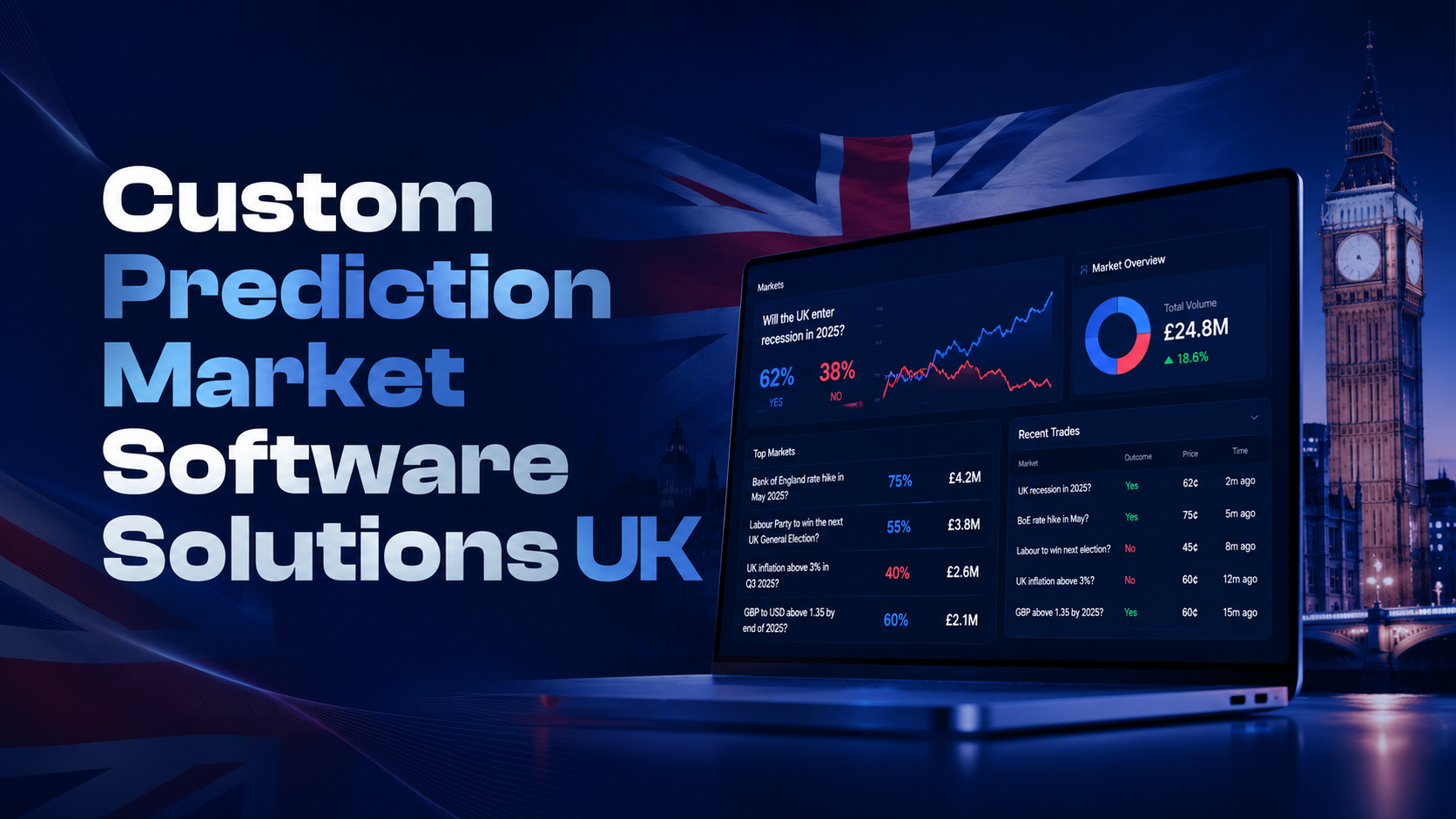
Prediction markets have moved from a niche academic curiosity into a genuine product category. What started as economists' experiments in forecasting elections and sports outcomes has turned into a fast-growing corner of fintech, with platforms letting users trade on everything from political events to macroeconomic data releases. For UK-based founders, product teams, and established trading businesses, the question is no longer "should we build one?" but "how do we build one that actually works, holds up under scrutiny, and fits within the country's regulatory reality?"
This guide walks through what custom prediction market software actually involves, why off-the-shelf clones tend to fall short, and what a serious UK development effort needs to get right.
What a Prediction Market Platform Actually Does
At its core, a prediction market is a trading venue where the "asset" being traded is a claim about a future event — will interest rates rise, will a particular bill pass, will a football match end in a draw. Traders buy and sell shares tied to possible outcomes, and the price of each share reflects the market's collective estimate of that outcome's probability. When the event resolves, correct shares pay out and incorrect ones don't.
Building this from scratch means solving several distinct engineering problems at once:
-
Market creation and lifecycle management how new markets get proposed, listed, and eventually closed or resolved
-
Order matching or automated market-making the mechanism that sets prices and executes trades
-
Outcome resolution and oracles how the platform determines, verifiably, what actually happened
-
Custody and settlement how funds move in and out, and how winnings get paid
-
Compliance tooling identity checks, geofencing, transaction monitoring, and audit trails
Each of these pieces has genuine complexity. A platform that gets the matching engine right but has a weak oracle system will be vulnerable to disputed outcomes. One that nails resolution but skips compliance groundwork will struggle the moment it tries to operate for real users in the UK.
Why Off-the-Shelf Rarely Hold Up
There's no shortage of template scripts and "Polymarket clone" packages floating around developer marketplaces. They're tempting because they promise a working product in days rather than months. In practice, most of them create more problems than they solve.
Generic clone scripts are typically built for a single blockchain, a single resolution mechanism, and a single regulatory assumption usually one that has nothing to do with UK rules around gambling, financial promotions, or derivatives trading. Retrofitting compliance onto a rigid codebase after the fact is far harder than designing it from day one. Security is another sore spot: many of these scripts are copied and re-copied without proper audits, meaning smart contract vulnerabilities or oracle manipulation risks get inherited silently.
There's also the matter of differentiation. If a platform runs on the same unmodified template as a dozen competitors, there's little reason for traders to choose it over an established player. Custom development exists precisely to avoid that trap — building a system whose market mechanics, user experience, and resolution logic are shaped around a specific audience and use case rather than a generic template.
The UK Regulatory Landscape Founders Need to Understand
This is the part that separates serious builders from people who'll end up in a difficult conversation with a regulator. The UK doesn't have a single, dedicated "prediction markets" statute. Instead, depending on how a platform is structured, it can fall under several different regimes:
-
Gambling Act 2005, enforced by the Gambling Commission, may apply if outcomes resemble betting on chance events
-
Financial Services and Markets Act 2000 (FSMA), overseen by the Financial Conduct Authority, may apply if contracts resemble derivatives or specified investments
-
Money laundering regulations, requiring KYC/AML processes for platforms handling real funds
-
Advertising and financial promotions rules, which govern how these products can be marketed to UK consumers
Where a specific platform lands depends heavily on its structure what's being traded, how outcomes are resolved, whether real money or points are used, and how the platform is marketed. This is genuinely a legal question, not just a technical one, and it needs input from a solicitor with financial services or gambling law experience before a single line of production code gets shipped. A development partner who understands this landscape can architect the system to make compliance additions straightforward later, but they shouldn't be treated as a substitute for proper legal counsel.
Core Architecture of a Well-Built Platform
Market Mechanism Design
Two broad approaches dominate: order book systems, where buyers and sellers post limit orders that get matched directly, and automated market makers (AMMs), which use a pricing formula (commonly a variant of constant product or logarithmic market scoring rules) to provide continuous liquidity without needing a counterparty for every trade. AMMs tend to suit platforms expecting many small, casual traders and thin liquidity in niche markets, while order books suit platforms targeting more sophisticated, higher-volume users. A serious build often supports both, letting different market categories use whichever mechanism fits.
Resolution and Oracle Infrastructure
This is arguably the single most important trust component of the entire product. If users can't be confident that outcomes will be resolved fairly and verifiably, no amount of polished UI will save the platform. Common approaches include:
-
Decentralized oracle networks, where multiple independent parties report and vote on outcomes, with economic penalties for dishonest reporting
-
Optimistic oracles, where a proposed outcome is accepted unless someone disputes it within a challenge window
-
Curated/manual resolution, where a trusted internal or third-party committee determines outcomes for specific market categories
Hybrid models are increasingly common — using decentralized oracles for objective, verifiable events like sports scores or election results, while reserving manual review for ambiguous or subjective questions.
Wallet, Custody, and Settlement
Whether a platform is built on-chain, off-chain, or in a hybrid model changes almost everything downstream, from transaction costs to auditability to how quickly trades settle. On-chain systems using smart contracts offer transparency and non-custodial trading but come with gas cost and throughput considerations. Off-chain systems can be faster and cheaper to operate but require the platform to take on custodial responsibility, which brings its own compliance weight.
Security and Auditing
Smart contract exploits, oracle manipulation, and front-running are well-documented risks in this space. A responsible build includes independent smart contract audits, bug bounty programs, rate limiting on market creation to prevent spam or manipulation, and monitoring systems that flag unusual trading patterns before they become a real problem.
Features That Set Serious Platforms Apart
Beyond the core trading engine, a handful of features consistently separate platforms that retain users from those that don't:
-
Category-specific market templates for politics, sports, finance, entertainment, and current events, each with resolution logic tailored to that category
-
Real-time probability charts showing how market sentiment shifts over time
-
Liquidity incentive programs that reward early market makers and reduce slippage
-
Social and community layers, including comment threads, market creator reputation scores, and leaderboards
-
Mobile-first design, since a large share of prediction market activity now happens on phones
-
API access for algorithmic traders and third-party integrations
-
Transparent audit logs so any user can independently verify how and why a market resolved the way it did
Choosing a Development Partner in the UK
When evaluating a development team for this kind of build, a few questions tend to reveal a lot:
Do they understand the difference between gambling-adjacent and investment-adjacent product structures, and can they explain how that distinction affects architecture decisions? Have they worked with oracle networks before, or would this be their first attempt? Can they show evidence of smart contract audits on previous work, rather than just claiming security best practices? And critically — do they treat UK compliance as a first-class design constraint, not an afterthought bolted on before launch?
A team with genuine experience in this space will ask as many questions as they answer. They'll want to know what categories of markets are planned, what the target user base looks like, whether real currency or an alternative token/points system is intended, and how outcomes will be sourced and verified. Vague, generic answers to those questions from a vendor are usually a warning sign.
Common Questions
Is a prediction market platform legal to operate in the UK? It depends entirely on the structure of what's traded, how it's resolved, and how funds move. Some structures fall under gambling law, others under financial services law, and some may require both gambling and FCA-related permissions. Independent legal advice specific to the planned model is essential before launch.
What's the difference between an AMM and an order book model? An AMM sets prices algorithmically and provides constant liquidity through a pricing formula, which suits low-volume or niche markets. An order book matches buyers and sellers directly, which tends to work better for high-volume, actively traded markets with sophisticated participants.
How is market outcome resolution typically handled? Through decentralized oracle voting, optimistic oracle systems with dispute windows, curated manual review, or a hybrid combining automated resolution for objective events with human review for subjective ones.
Can a prediction market platform be built without blockchain? Yes. Off-chain, database-driven architectures are entirely possible and can simplify certain compliance and settlement questions, though they trade away some of the transparency benefits that on-chain systems offer.
Final Thoughts
Building a custom prediction market platform in the UK isn't primarily a coding challenge, it's a systems design challenge that touches market mechanics, trust infrastructure, and regulatory reality all at once. The platforms that succeed long-term are the ones where legal structuring, oracle design, and security auditing happened alongside the engineering work, not after it. Anyone serious about entering this space should treat compliance conversations and architecture decisions as the same conversation, not two separate ones happening on different timelines.

 English
 Arabic
 Français
 Español
 Português
 Deutsch
 Türkçe
 Italiano
 Russian
 Romaian