


How Parametric Insurance Supports Faster Financial Recovery
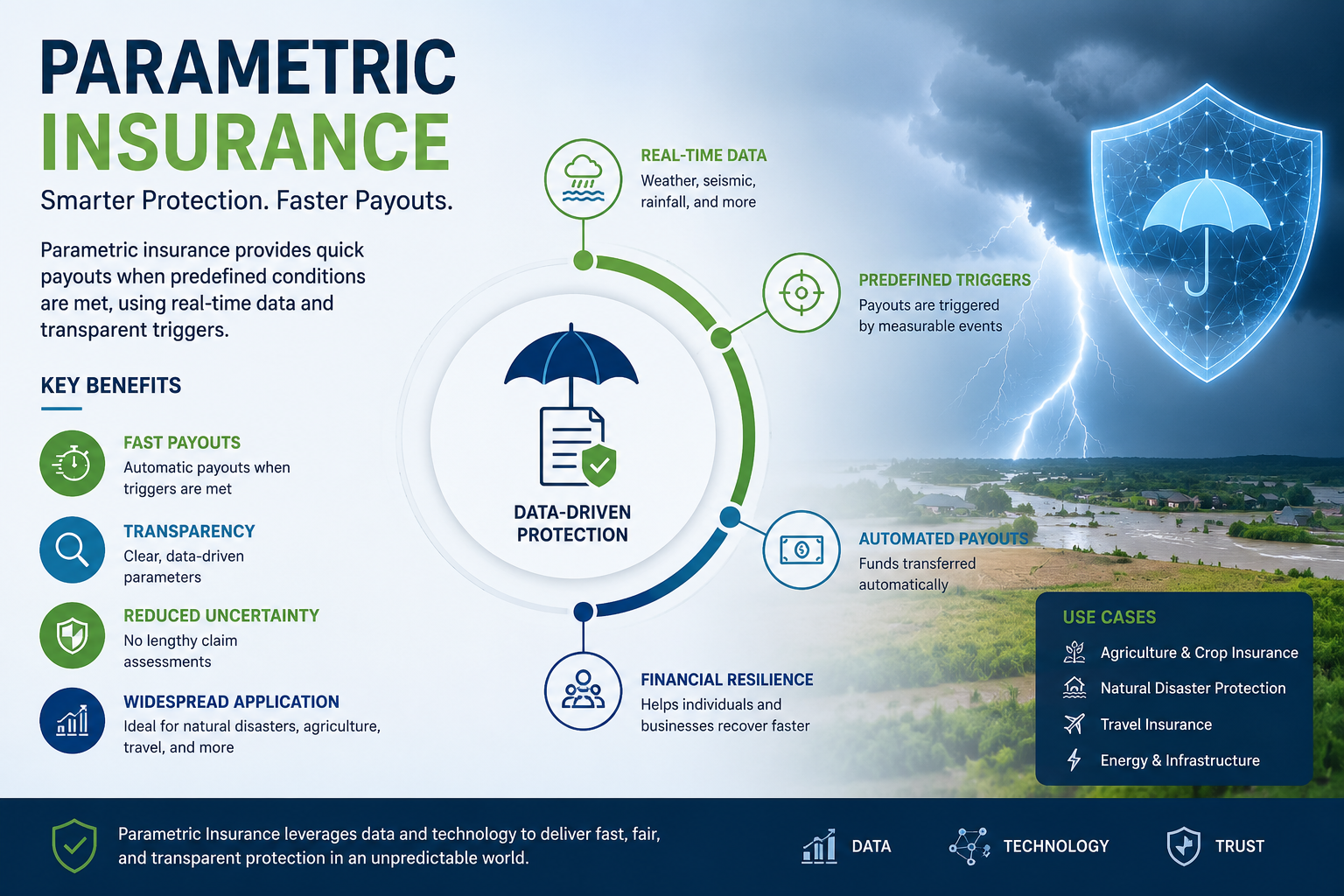
Climate change, extreme weather events, and increasing economic uncertainty have transformed how organizations approach risk management. Traditional insurance has long provided financial protection against unexpected losses, but lengthy claims assessments and complex damage evaluations can delay recovery when businesses need immediate support.
Parametric insurance has emerged as an innovative solution designed to address these challenges. Instead of compensating based on measured losses, this insurance model issues payments when predefined parameters such as rainfall levels, wind speed, earthquake magnitude, or temperature thresholds are reached. This approach enables quicker financial assistance and improves resilience for industries operating in high-risk environments.
As weather-related disasters become more frequent worldwide, governments, insurers, infrastructure developers, agricultural producers, renewable energy operators, tourism businesses, and financial institutions are increasingly evaluating parametric insurance as part of broader climate adaptation and business continuity strategies.
Why Parametric Insurance Is Becoming Important
Several global trends are accelerating interest in parametric insurance.
• Increasing frequency of climate-related disasters
• Growing economic losses from floods, hurricanes, droughts, and wildfires
• Rising demand for faster disaster recovery
• Expansion of climate resilience initiatives
• Improvements in satellite monitoring and remote sensing
• Greater use of artificial intelligence for weather forecasting
• Advanced data analytics for risk modeling
• Digital transformation across the insurance industry
Unlike conventional insurance, parametric insurance minimizes uncertainty because policyholders know exactly under which conditions a payout will occur before purchasing coverage.
𝐃𝐨𝐰𝐧𝐥𝐨𝐚𝐝 𝐒𝐚𝐦𝐩𝐥𝐞 𝐇𝐞𝐫𝐞-
https://www.datamintelligence.com/download-sample/parametric-insurance-market
Understanding How Parametric Insurance Works
Every parametric insurance policy is built around measurable data.
Independent monitoring organizations continuously collect environmental information through weather stations, satellites, seismic monitoring systems, hydrological sensors, and climate observation networks.
When a predefined trigger is reached, the policy automatically initiates payment without requiring lengthy property inspections or damage verification.
For example:
A farming cooperative may receive compensation if seasonal rainfall falls below a specified level.
A renewable energy company may receive payment when wind speeds remain below operational thresholds for an extended period.
A coastal tourism business may receive support if a hurricane exceeds a predetermined wind speed near its location.
Because the trigger is objective and independently verified, the claims process becomes significantly faster.
Key Features of Parametric Insurance
• Predefined measurable triggers
• Rapid claim settlement
• Objective data verification
• Transparent policy conditions
• Reduced administrative complexity
• Faster access to recovery funds
• Flexible coverage structures
• Scalable for multiple industries
• Suitable for climate-related risks
• Integration with advanced weather analytics
These characteristics make parametric insurance particularly valuable where rapid liquidity is essential after disruptive events.
Benefits Across Multiple Industries
Parametric insurance is no longer limited to agriculture. Its applications continue expanding across numerous sectors.
Agriculture
Crop producers use rainfall, drought, and temperature indices to protect seasonal income and improve financial stability.
Renewable Energy
Wind farms and solar facilities manage weather variability that affects electricity generation and operational revenues.
Infrastructure
Large construction projects reduce financial exposure from severe weather interruptions.
Hospitality
Hotels and tourism operators mitigate revenue losses caused by hurricanes, excessive rainfall, or travel disruptions.
Transportation
Airlines, shipping companies, and logistics providers improve operational resilience against weather-related delays.
Governments
Public agencies use sovereign parametric insurance to strengthen disaster response and accelerate community recovery.
Financial Institutions
Banks and investment organizations use climate risk transfer mechanisms to improve portfolio resilience.
Major Advantages
• Faster financial recovery
• Predictable claim outcomes
• Reduced disputes
• Improved liquidity
• Enhanced disaster preparedness
• Better climate resilience
• Increased operational continuity
• Greater financial certainty
• Improved business planning
• Supports long-term sustainability initiatives
These advantages explain why parametric insurance is becoming an important component of enterprise risk management.
Technology Driving the Evolution
Modern technology has significantly expanded the effectiveness of parametric insurance.
Artificial intelligence improves weather prediction accuracy.
Machine learning enhances catastrophe modeling.
Satellite imagery provides continuous environmental monitoring.
Internet of Things sensors generate real-time environmental observations.
Geospatial analytics improves localized risk assessment.
Cloud computing enables rapid processing of massive climate datasets.
Blockchain technologies are also being explored to improve policy transparency and automate settlement processes through smart contracts.
Together, these innovations are making parametric insurance more accurate, scalable, and accessible.
Business Benefits
Organizations adopting parametric insurance often seek strategic advantages beyond direct financial protection.
• Faster business recovery
• Reduced operational interruptions
• Improved investor confidence
• Better financial planning
• Enhanced resilience strategies
• Stronger supply chain stability
• Lower uncertainty during disasters
• Improved emergency response capabilities
• Greater confidence in expansion projects
• Better integration with enterprise risk management frameworks
As climate uncertainty increases, financial resilience is becoming an important competitive advantage.
Important Concepts
Several concepts define how parametric insurance differs from traditional insurance.
Trigger Event
A measurable environmental condition that activates payment.
Index-Based Coverage
Compensation depends on predefined environmental indices rather than physical damage.
Objective Measurement
Independent scientific data determines policy activation.
Rapid Settlement
Claims are processed immediately after trigger confirmation.
Basis Risk
The possibility that actual losses differ from the payout because compensation depends on the predefined parameter rather than measured damages.
Understanding these concepts helps organizations evaluate whether parametric insurance aligns with their risk management objectives.
Industries Exploring Parametric Insurance
Growing adoption can be observed across diverse sectors.
• Agriculture
• Renewable Energy
• Water Management
• Infrastructure Development
• Mining
• Logistics
• Marine Transportation
• Aviation
• Hospitality
• Public Utilities
• Telecommunications
• Manufacturing
• Government Disaster Programs
• Financial Services
Each industry experiences unique climate-related risks that can be addressed using customized trigger mechanisms.
Future Outlook
Climate change is expected to increase the frequency and severity of many weather-related events. As organizations seek more resilient financial protection mechanisms, parametric insurance is likely to become increasingly integrated into comprehensive risk management strategies.
Advances in predictive analytics, Earth observation satellites, artificial intelligence, remote sensing technologies, and environmental monitoring networks will continue improving policy precision and expanding coverage options.
Greater collaboration among insurers, reinsurers, governments, technology providers, and climate scientists is expected to strengthen product innovation while improving accessibility for businesses of all sizes.
The evolution of climate finance, sustainability initiatives, and disaster resilience programs will further support broader adoption across developed and emerging economies.
Conclusion
Parametric insurance represents a significant evolution in risk management by shifting the focus from traditional loss assessment toward objective, data-driven event triggers. Faster payouts, improved transparency, simplified claims processes, and stronger financial resilience make it an increasingly relevant solution for organizations facing climate-related uncertainty.
As environmental risks continue to evolve, businesses and public institutions are seeking innovative approaches that enhance preparedness while supporting long-term operational continuity. Although parametric insurance does not replace every form of conventional coverage, it serves as a valuable complement for managing catastrophic events where rapid financial recovery is essential. With continued advances in climate science, digital technologies, and data analytics, parametric insurance is expected to play an increasingly important role in strengthening global resilience.
Benefits
• Faster claim payouts
• Greater transparency
• Improved financial resilience
• Better disaster preparedness
• Reduced claim disputes
• Supports climate adaptation
• Improved business continuity
• Predictable risk management
Profits
• Reduced recovery costs
• Faster return to operations
• Lower financial uncertainty
• Improved cash flow after disasters
• Better investment confidence
• Enhanced long-term resilience

 Arabic
 Français
 Español
 Português
 Deutsch
 Türkçe
 Dutch
Dutch
 Italiano
 Russian
 Romaian