


Interactive ADBOK® Companion Workbook Advances Professional Development in AI Data Operations
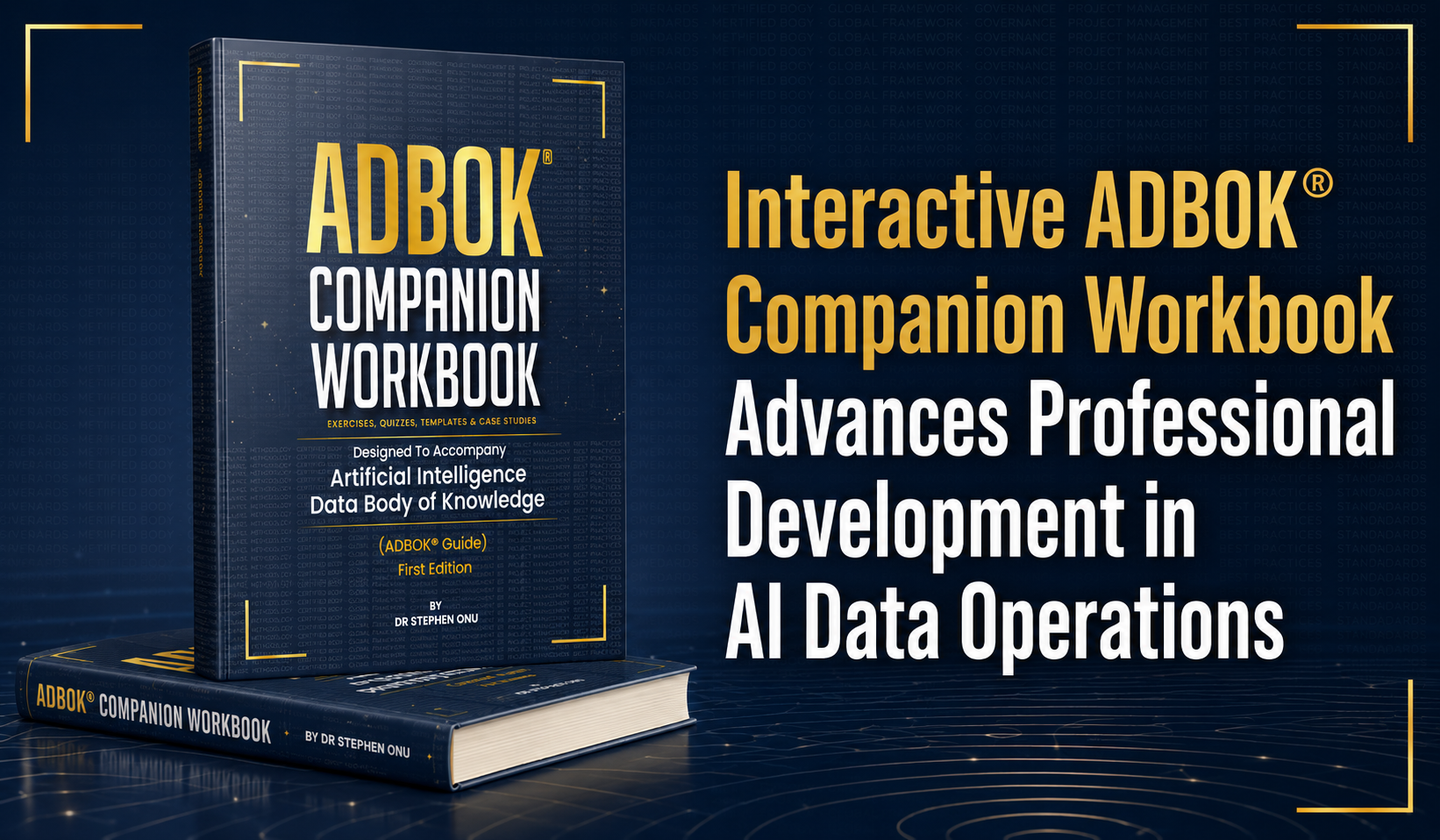
Comprehensive companion resource equips AI professionals with practical tools to improve governance, data quality, and operational maturity.
As artificial intelligence continues to reshape industries worldwide, organizations are investing significant resources into developing smarter models and expanding AI capabilities. Yet many of the challenges that limit AI performance originate not in the algorithms themselves, but in the way training data is collected, managed, reviewed, and governed. To address this growing need, the ADBOK® Companion Workbook: Exercises, Quizzes, Templates & Case Studies provides a structured, practical resource designed to strengthen professional AI data operations through hands-on learning and real-world application.
Created as the official companion to the Artificial Intelligence Data Body of Knowledge (ADBOK® Guide), the workbook transforms established AI data principles into interactive exercises that encourage readers to apply concepts within their own organizations. Rather than relying solely on theory, the publication combines educational content with worksheets, self-assessments, templates, reflection exercises, realistic case studies, and implementation activities that support both individual and organizational development.
The growing adoption of artificial intelligence has increased demand for consistent standards governing AI training data. Organizations today must balance innovation with accountability, ensuring that datasets remain reliable, ethically managed, and properly documented throughout every stage of development. The Companion Workbook responds to these evolving expectations by presenting AI data operations as a professional discipline supported by structured governance, quality management, and continuous improvement.
Throughout the workbook, readers explore the seven foundational principles that underpin the ADBOK® framework: Accountability, Integrity, Transparency, Safety, Fairness, Continuous Learning, and Reliability. These principles are integrated into every chapter, helping professionals evaluate existing practices while establishing stronger operational standards for future AI initiatives.
Each chapter follows a consistent learning format designed to reinforce understanding while encouraging practical implementation. Readers begin with clearly defined learning objectives before progressing through key concepts, guided reflection, self-assessment quizzes, implementation worksheets, operational case studies, and personal takeaways. This structured approach allows individuals and teams to build knowledge progressively while applying each lesson directly to their own projects and organizational environments.
Beyond individual learning, the Companion Workbook serves as a practical toolkit for organizations seeking to strengthen AI governance. Included throughout the publication are templates covering stakeholder benefit mapping, governance planning, lifecycle documentation, annotation workflows, quality assurance planning, risk management, compliance evidence inventories, operational monitoring, and organizational maturity assessments. These resources are designed to support real AI initiatives by promoting consistency, traceability, and effective collaboration across teams.
A defining feature of the workbook is its extensive use of realistic case studies that mirror challenges commonly encountered in AI development. Readers evaluate scenarios involving inconsistent annotation across geographically distributed teams, undocumented changes to labeling guidelines, governance gaps, quality assurance failures, licensing concerns, and operational decision-making under time pressure. Rather than providing predetermined solutions, these exercises encourage discussion, critical thinking, and evidence-based decision-making aligned with professional AI data standards.
The publication is suitable for a diverse professional audience, including AI engineers, data scientists, annotation specialists, governance professionals, compliance leaders, quality assurance teams, project managers, educators, and enterprise decision-makers. Whether used as an individual study companion or incorporated into organizational workshops and professional development programs, the workbook provides practical learning experiences that can support organizations at various stages of AI maturity.
Recognizing that AI governance is an ongoing process rather than a one-time initiative, the Companion Workbook begins with an organizational readiness assessment and concludes with a maturity reassessment, allowing readers to measure progress and identify future opportunities for improvement. This emphasis on continuous learning reinforces the importance of adapting AI data operations as technologies, regulations, and organizational needs continue to evolve.
As artificial intelligence becomes increasingly central to modern business strategy, organizations require practical resources that help translate governance principles into everyday operational practices. The ADBOK® Companion Workbook answers that need by combining structured education with implementation-focused tools that promote reliable data management, accountable decision-making, and sustainable AI development.
By equipping professionals with practical exercises, implementation templates, and realistic operational scenarios, the ADBOK® Companion Workbook supports the continued professionalization of AI data operations while helping organizations build more transparent, reliable, and trustworthy AI systems for the future.
Contact:
Author: Dr Stephen Onu
Amazon: Adbok(r) Companion Workbook: Exercises, Quizzes, Templates & Case Studies
https://www.facebook.com/people/ADBOK-AI-Data-Body-of-Knowledge/61591345796888/

 Arabic
 Français
 Español
 Português
 Deutsch
 Türkçe
 Dutch
Dutch
 Italiano
 Russian
 Romaian