


Build Production-Ready Deep Learning Engineering Skills
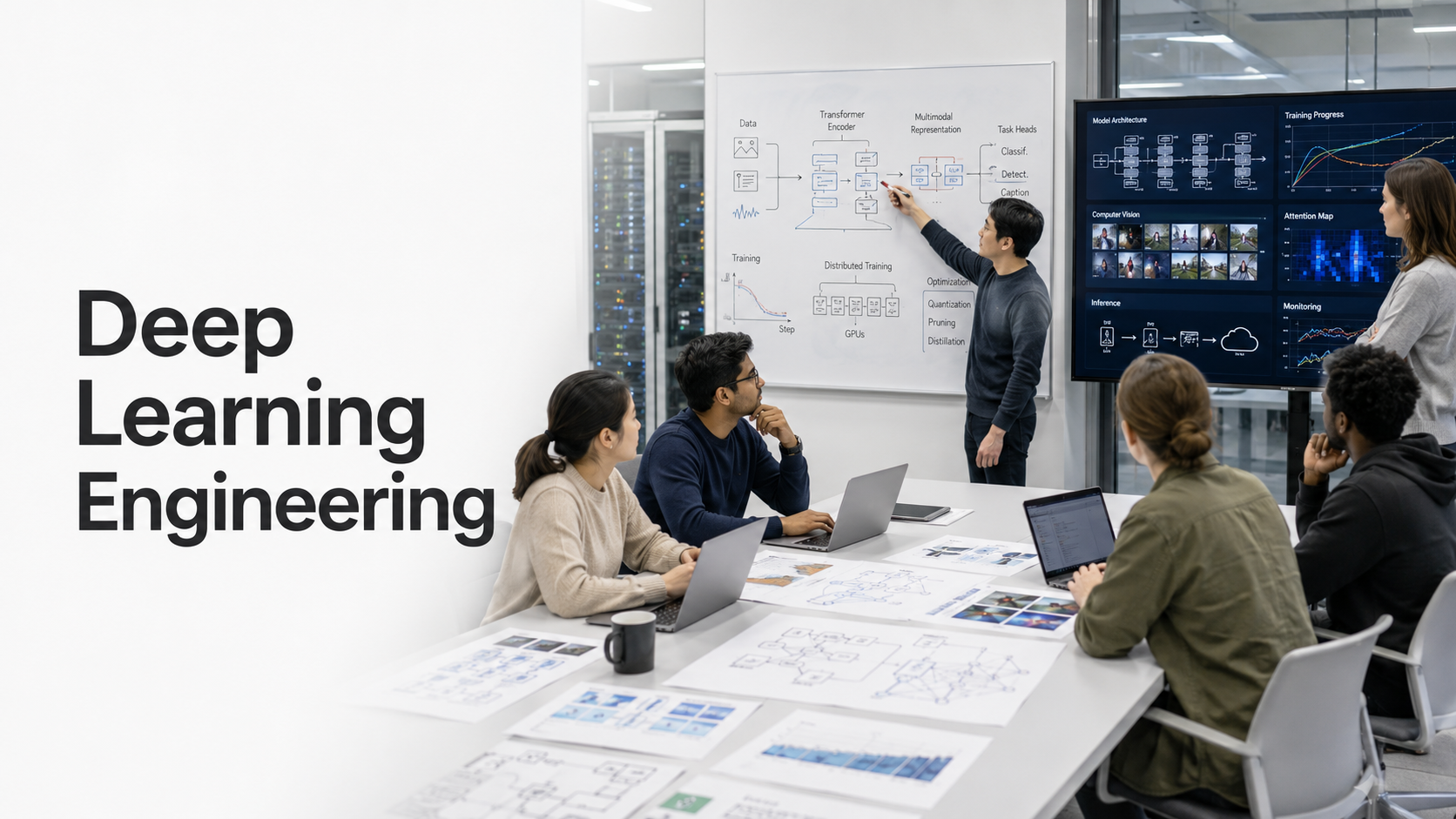
Artificial intelligence initiatives increasingly depend on teams that can do more than call a model through an API. Organisations need practitioners who understand how neural networks learn, why training fails, how modern architectures behave, and what it takes to move a model into production. A structured Deep Learning Practitioner Course can help software engineers, ML engineers, junior data scientists, and applied AI teams build that end-to-end capability.
The Skills Gap Behind Many AI Projects
Deep learning projects often stall between experimentation and deployment. A team may successfully run a notebook, yet struggle with unstable training, overfitting, slow inference, limited reproducibility, or high infrastructure costs. These challenges cannot be solved through theory alone.
Professionals need practical experience with PyTorch training, optimisation techniques, architecture selection, experiment tracking, and deployment workflows. They must also understand when deep learning is the right choice and when simpler machine learning methods may deliver better business value.
Build Engineering Depth with PyTorch
NovelVista’s 50-hour programme uses an intensive VILT bootcamp format supported by extensive PyTorch labs and a portfolio capstone. Its reference curriculum spans 13 modules, including tensors, autograd, neural-network training, convolutional networks, transformers, multimodal systems, distributed training, production optimisation, and model serving.
This PyTorch Deep Learning Course focuses on building and debugging training loops rather than relying only on high-level demonstrations. Learners work with optimisers, schedulers, mixed precision, loss functions, and practical techniques for diagnosing vanishing gradients, divergence, and overfitting.
Understand Transformers Instead of Only Using Them
Modern AI professionals frequently use pretrained models without fully understanding attention, positional encoding, or encoder-decoder design. A strong Transformers Training Course should close that gap.
The programme guides learners through implementing transformer architectures before progressing to the Hugging Face ecosystem, LoRA, and QLoRA fine-tuning. It also extends into Vision Transformers, CLIP, diffusion models, and multimodal architectures, helping teams connect foundational concepts with current enterprise AI applications.
Prepare Models for Enterprise Production
Training a model is only one stage of the lifecycle. Production teams must consider latency, cost, scalability, monitoring, and reproducibility. The course covers distributed deep learning, including DDP, FSDP, and DeepSpeed, alongside quantisation, ONNX, model optimisation, and serving technologies such as TorchServe, vLLM, and Triton.
These skills support teams building computer vision solutions, language applications, recommendation systems, multimodal products, and other GPU-intensive workloads.
Best Practices for Deep Learning Teams
To improve delivery outcomes, organisations should begin with a capability assessment, align labs with real project archetypes, and define measurable capstone outcomes. Learners should document experiments, compare baselines, track model versions, and evaluate performance against business constraints—not accuracy alone.
A portfolio-based Deep Learning Certification can strengthen accountability because learners must demonstrate working code, evaluation results, deployment decisions, and technical communication. NovelVista’s programme concludes with a public capstone intended to demonstrate research-to-production capability.
Build Teams That Can Ship Modern AI
Deep learning remains the technical foundation behind transformers, generative AI, computer vision, speech systems, and multimodal applications. Organisations that invest in corporate deep learning training can reduce dependence on isolated specialists and create teams capable of making stronger architecture, optimisation, and deployment decisions.
Explore NovelVista’s Deep Learning Practitioner Course to design a customised learning pathway for your technology stack, project goals, and AI engineering workforce.
Request the customised syllabus or schedule a scoping discussion with NovelVista to build a production-focused deep learning programme for your engineering team.

 English
 Arabic
 Français
 Español
 Português
 Deutsch
 Türkçe
 Dutch
Dutch
 Russian
 Romaian