


Why Enterprise Teams Need Advanced RAG Engineering Skills
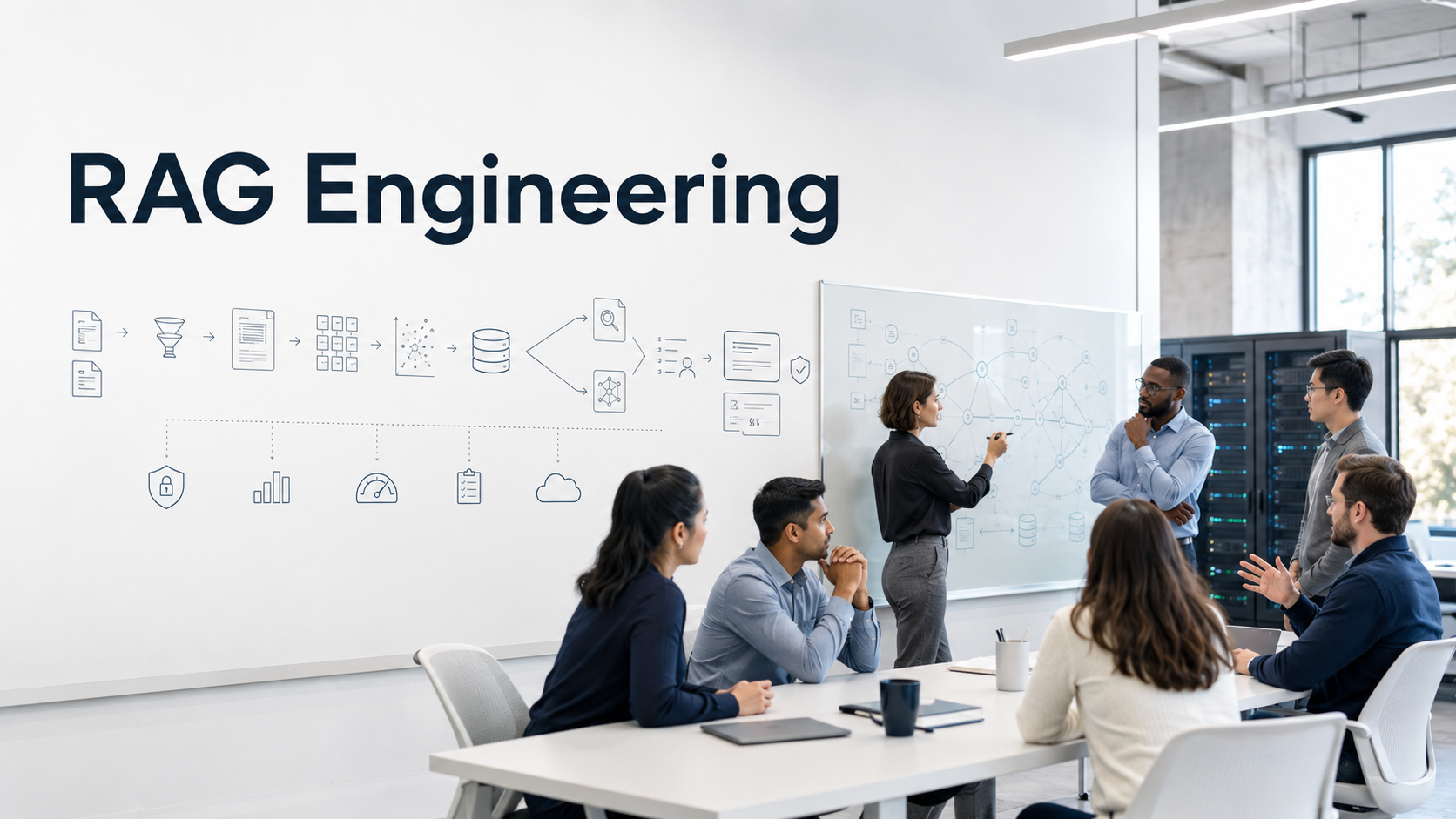
Large language models can write fluently, but fluency does not guarantee accuracy, relevance, or organisational context. A model may lack access to private policies, technical documentation, or current information. Retrieval-Augmented Generation engineering addresses this gap by connecting language models with trusted knowledge sources at query time, helping applications generate answers grounded in enterprise data.
Microsoft defines RAG as a pattern that retrieves relevant content, adds it to the model’s input, and produces a response based on that grounding information. It can also support citations back to source material, giving users visibility into where an answer originated.
Why Basic RAG Demonstrations Fail in Production
A prototype built with a few clean documents may appear convincing. Production environments are less forgiving. Enterprise information is distributed across databases, repositories, cloud storage, PDFs, and changing business systems. Retrieval pipelines must understand ambiguous questions, return concise evidence, protect restricted information, and respond within acceptable latency limits.
Poor parsing, arbitrary chunk sizes, weak metadata, or unsuitable embedding models can cause relevant information to disappear before the language model receives it. Replacing the model rarely solves the real problem. Teams need production RAG training that treats ingestion, indexing, retrieval, generation, security, and evaluation as one connected system.
Develop the Full RAG Engineering Stack
A practical Retrieval-Augmented Generation course should move beyond the familiar “vector database plus LLM” formula. Engineers need to understand document preprocessing, structure-aware chunking, embedding selection, metadata design, and vector-store trade-offs.
They also need hybrid retrieval training. Hybrid search combines keyword and vector techniques, while semantic ranking or reranking helps prioritise useful passages. Microsoft recommends hybrid queries when stronger recall is required because exact terminology and semantic similarity can complement one another.
Measure Quality Instead of Trusting Impressions
RAG systems should not be approved because a handful of answers look good. Teams need evaluation datasets, expected answers, failure categories, and regression checks. Metrics such as faithfulness, context precision, context recall, and answer relevance can expose weaknesses across retrieval and generation.
A structured RAGAS evaluation course helps engineers test pipeline changes before release. This creates a disciplined feedback loop for comparing chunking strategies, embedding models, retrieval parameters, rerankers, prompts, and model configurations.
Design for Security, Scale, and Observability
Enterprise RAG systems must preserve access boundaries. Users should retrieve only the documents and passages they are authorised to view. Modern platforms support document-level security trimming, identity-based permission metadata, query-time filters, and private network access.
Teams should also monitor retrieval quality, latency, token consumption, document freshness, unsupported answers, and citation coverage. These practices make enterprise RAG engineering observable and maintainable rather than leaving failures hidden inside confident responses.
Best Practices for Production RAG Systems
Begin with a defined use case and test questions. Clean and classify source content before embedding it. Compare chunking methods instead of accepting defaults. Combine dense retrieval with keyword search where appropriate. Add reranking, permission filters, citations, and safe refusal behaviour. Finally, test every major pipeline change against a repeatable benchmark.
Build Skills Around Real Enterprise Use Cases
NovelVista’s RAG Engineering Course is a 37-hour blended corporate programme with labs and a production capstone. Its 13-module reference curriculum covers ingestion, chunking, embeddings, vector stores, hybrid retrieval, query transformation, grounding, RAGAS evaluation, advanced RAG patterns, multi-tenancy, security, optimisation, and observability. It is designed for experienced AI engineers, ML engineers, software engineers, data engineers, solution architects, and technical leads.
Equip your team to move beyond fragile demonstrations and build secure, production-ready knowledge systems. Explore NovelVista’s Retrieval-Augmented Generation RAG Engineering training and request a customised proposal aligned with your data sources, technology stack, and business goals.
Strengthen your organisation’s ability to design accurate, secure, and scalable AI knowledge systems. Explore NovelVista’s Retrieval-Augmented Generation RAG Engineering training and request a customised corporate learning proposal today.

 English
 Arabic
 Español
 Português
 Deutsch
 Türkçe
 Dutch
Dutch
 Italiano
 Russian
 Romaian