


Infrared Detectors Explained: Types, Applications, and Future Trends
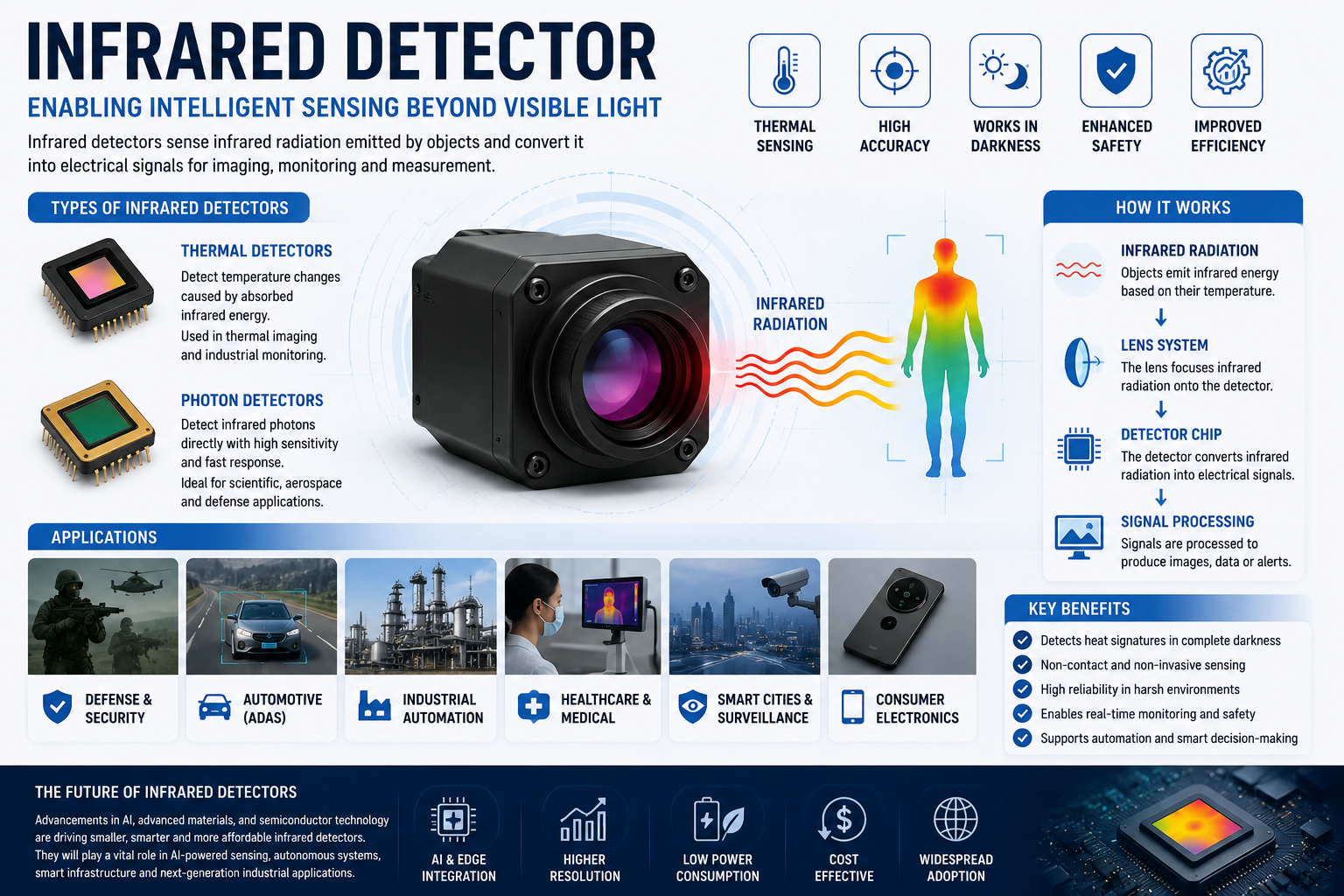
Infrared detectors are becoming an essential technology across industries as demand grows for advanced sensing, automation, and security solutions. These devices detect infrared (IR) radiation emitted by objects and convert it into electrical signals, enabling systems to identify heat signatures, monitor temperature, and capture images even in complete darkness. From defense and aerospace to healthcare, industrial automation, automotive, and consumer electronics, infrared detectors are driving innovation in modern sensing applications.
What Is an Infrared Detector?
An infrared detector is an electronic sensor designed to detect infrared radiation, which lies beyond the visible light spectrum. Every object with a temperature above absolute zero emits infrared energy. Infrared detectors measure this radiation to determine temperature differences, detect movement, or create thermal images.
Infrared detectors are commonly classified into two categories:
- Thermal Detectors: Measure temperature changes caused by absorbed infrared energy. They are widely used in thermal imaging and industrial monitoring.
- Photon Detectors: Detect infrared photons directly, offering higher sensitivity and faster response times for scientific, aerospace, and military applications.
Download PDF Brochure -https://www.marketsandmarkets.com/pdfdownloadNew.asp?id=161116561
Key Technologies Driving Innovation
Recent advancements in semiconductor manufacturing, artificial intelligence (AI), and sensor miniaturization are significantly improving infrared detector performance. Modern detectors deliver higher resolution, faster response times, lower power consumption, and enhanced reliability.
AI-powered image processing enables infrared cameras to automatically identify people, vehicles, equipment failures, and safety hazards. Additionally, uncooled infrared detectors have reduced system costs, making thermal imaging more accessible for commercial and industrial applications.
Applications Across Industries
Infrared detectors are transforming numerous industries by providing accurate, non-contact sensing capabilities.
Defense and Security: Thermal imaging cameras enable surveillance, target detection, border monitoring, and night vision operations.
Automotive: Advanced driver assistance systems (ADAS) use infrared sensors for pedestrian detection, driver monitoring, and improved night driving safety.
Healthcare: Infrared detectors support non-contact temperature screening, medical diagnostics, and thermal imaging for disease detection.
Industrial Automation: Manufacturers use infrared detectors for predictive maintenance, equipment inspection, quality control, and process monitoring.
Consumer Electronics: Smartphones, smart home devices, and wearable electronics increasingly integrate infrared sensors for facial recognition, gesture control, and environmental sensing.
Market Growth Drivers
Several factors are accelerating the adoption of infrared detector technology:
- Increasing demand for thermal imaging systems.
- Rising investments in defense modernization.
- Growth of autonomous vehicles and ADAS.
- Expansion of industrial automation and predictive maintenance.
- Advances in AI-powered image analysis.
- Growing adoption of smart cities and intelligent surveillance systems.
Future Outlook
The future of infrared detectors is closely linked to AI, edge computing, and next-generation semiconductor technologies. Smaller, more energy-efficient sensors with improved sensitivity will enable new applications in robotics, autonomous mobility, environmental monitoring, precision agriculture, and smart infrastructure.
As industries continue their digital transformation journey, infrared detectors will play a critical role in enabling intelligent sensing, real-time monitoring, and automated decision-making. Their ability to operate in challenging environments and provide accurate thermal information makes them indispensable for next-generation safety, security, and industrial applications.
With continuous innovation in detector materials, manufacturing processes, and AI integration, infrared detector technology is expected to become more affordable, powerful, and widely deployed across both commercial and industrial sectors in the coming years.

 English
 Arabic
 Français
 Español
 Português
 Deutsch
 Türkçe
 Dutch
Dutch
 Italiano
 Russian