


How a Smart Visitor Management System Is Changing Security for GCC Facilities
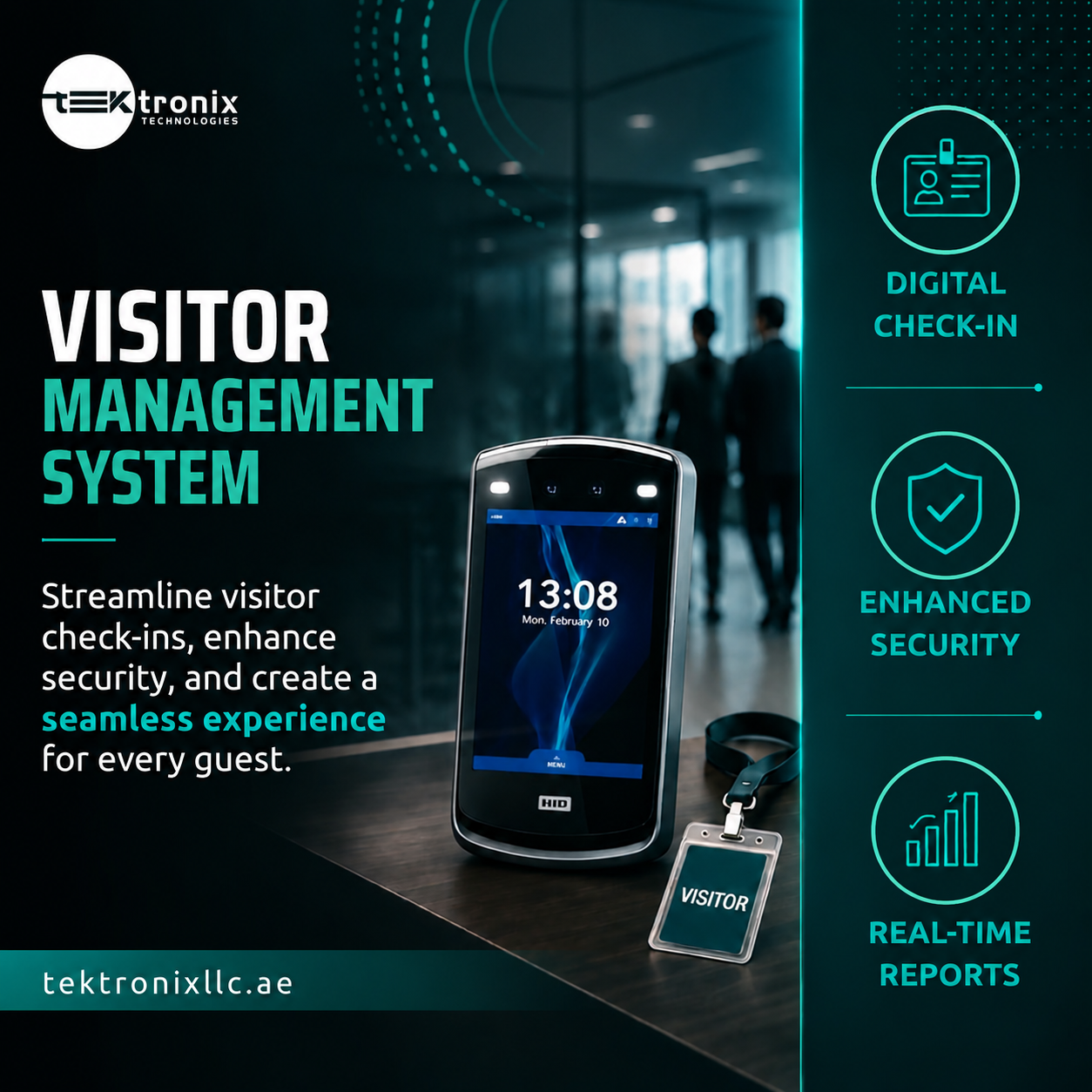
Walk into most corporate lobbies across the Gulf even a few years ago and you'd find the same thing: a paper logbook, a bored receptionist, and a visitor writing down a name and phone number that nobody would ever check again. That approach doesn't hold up anymore. Facilities across the UAE, Saudi Arabia, Qatar, Kuwait, Bahrain, and Oman are handling more foot traffic, more compliance requirements, and more security risk than ever, and a signature in a notebook doesn't answer basic questions like who is on-site right now, who they're visiting, or whether they should be let in at all.
That's the gap a modern Visitor Management System is built to close, and Tektronix Technology Systems has built one of the most complete versions of it currently available in the region.
What a Visitor Management System actually does
A Visitor Management System (VMS) replaces the paper logbook with a digital platform that handles the entire lifecycle of a visit: registration, identity verification, host notification, badge issuance, and audit reporting. Instead of a receptionist manually checking someone in, the system automates it, and instead of a stack of logbooks nobody can search, every visit is logged, timestamped, and instantly retrievable.
Tektronix's platform, TekVisit, takes this further by connecting natively with the security hardware many GCC facilities already have in place: access control systems, facial recognition cameras, CCTV, gate barriers, and turnstiles. Rather than bolting on a separate visitor app that lives in its own silo, TekVisit becomes the front door to a facility's entire security ecosystem.
How it functions, step by step
The visitor journey is built to be fast on the visitor's side and airtight on the security side:
- Pre-registration. A host sends an invite link. The visitor fills in their details, signs any required NDA, and uploads a photo in advance. The system issues a QR code by email or SMS.
2. Arrival and check-in. The visitor scans their QR code at a kiosk or checks in via facial recognition, the whole process takes under 20 seconds, with no queue and no contact.
3. Screening and verification. Before a badge is ever printed, the system automatically screens the visitor against internal blocklists and government watchlists, and cross-checks their ID against the pre-registration data. Any match triggers an instant alert to security.
4. Badge and access. A branded badge prints on the spot with the visitor's photo, name, host, authorized zones, and expiry time. Access-controlled doors and turnstiles unlock only for the zones that visitor is cleared to enter.
5. Host notification. The host gets an instant SMS and app alert the moment their guest arrives, and can track their location and dwell time on a live dashboard.
6. Check-out and logging. When the visitor leaves, the system closes out the record and retains a full, tamper-proof log for compliance and audit purposes.
Where it goes beyond a basic check-in app
A few capabilities stand out for facilities that need more than a digital guestbook. AI-powered facial recognition with liveness detection allows badge-free, QR-free check-in with sub-second verification against a database of over 50,000 faces, while dual-lens AI helps prevent spoofing. Self-service kiosks in English and Arabic cut front-desk workload by up to 80%, and dynamic workflows let a facility configure entirely different check-in flows for guests, contractors, vendors, VIPs, and delivery personnel, each with its own NDA, health declaration, or approval steps. Real-time watchlist and blocklist screening flags a match the instant someone tries to check in, and a live dashboard gives security teams occupancy data, visitor forecasts, and compliance reporting across multiple sites and countries.
Why it holds up better than competing systems in the GCC
Plenty of visitor management products exist globally, but most were built for markets outside the Gulf and treat Arabic support, local compliance, and regional hardware integration as an afterthought. Tektronix built its platform the other way around. The system offers full Arabic-language support across the kiosk, pre-registration portal, and admin dashboard, alongside English, Hindi, and Urdu, which matters for any GCC government office or enterprise with a multilingual workforce. It's built to comply with UAE and Saudi Personal Data Protection Law and GCC data residency rules, with both cloud and on-premise deployment options for organizations that need to keep data within the country.
Just as importantly, Tektronix is headquartered in Dubai with active teams across Saudi Arabia, Qatar, Kuwait, Bahrain, and Oman, rather than operating as a regional reseller for a foreign product. That means site assessments, installation, staff training, and ongoing support are handled locally, not routed through a support ticket in another time zone. The company's work has also been recognized directly by UAE authorities, including appreciation certificates from the Ministry of Infrastructure Development and the Supreme Council for Motherhood and Childhood, a level of institutional trust that's hard to build without a genuine regional track record.
Who it's built for
The same platform flexes across very different environments: corporate offices, government ministries, hospitals, hotels, universities, malls, oil and gas facilities, banks, industrial sites, residential communities, airports, construction sites, data centres, and embassies. Each sector gets configured workflows suited to its own compliance and security needs, rather than a one-size-fits-all check-in screen.
For any organization across the GCC still relying on a paper logbook, or a visitor system that wasn't designed for the region's languages, compliance rules, or security infrastructure, a proper Visitor Management System from a regionally based provider like Tektronix Technology is now a fairly straightforward upgrade, both for the security team's peace of mind and for the visitor walking through the door.

 English
 Arabic
 Français
 Português
 Deutsch
 Türkçe
 Dutch
Dutch
 Italiano
 Russian
 Romaian