


Performance Marketing AI Agent: Why Ecommerce Brands Need Intelligent Decision-Making, Not Just Automation
Performance marketing has always been about results. Marketers launch campaigns, monitor metrics, adjust budgets, test creatives, and continuously optimize to improve return on ad spend. However, as ecommerce has become more competitive, this process has also become significantly more complex. Managing campaigns across multiple advertising platforms now means analyzing thousands of data points every day while responding quickly to changing customer behavior.
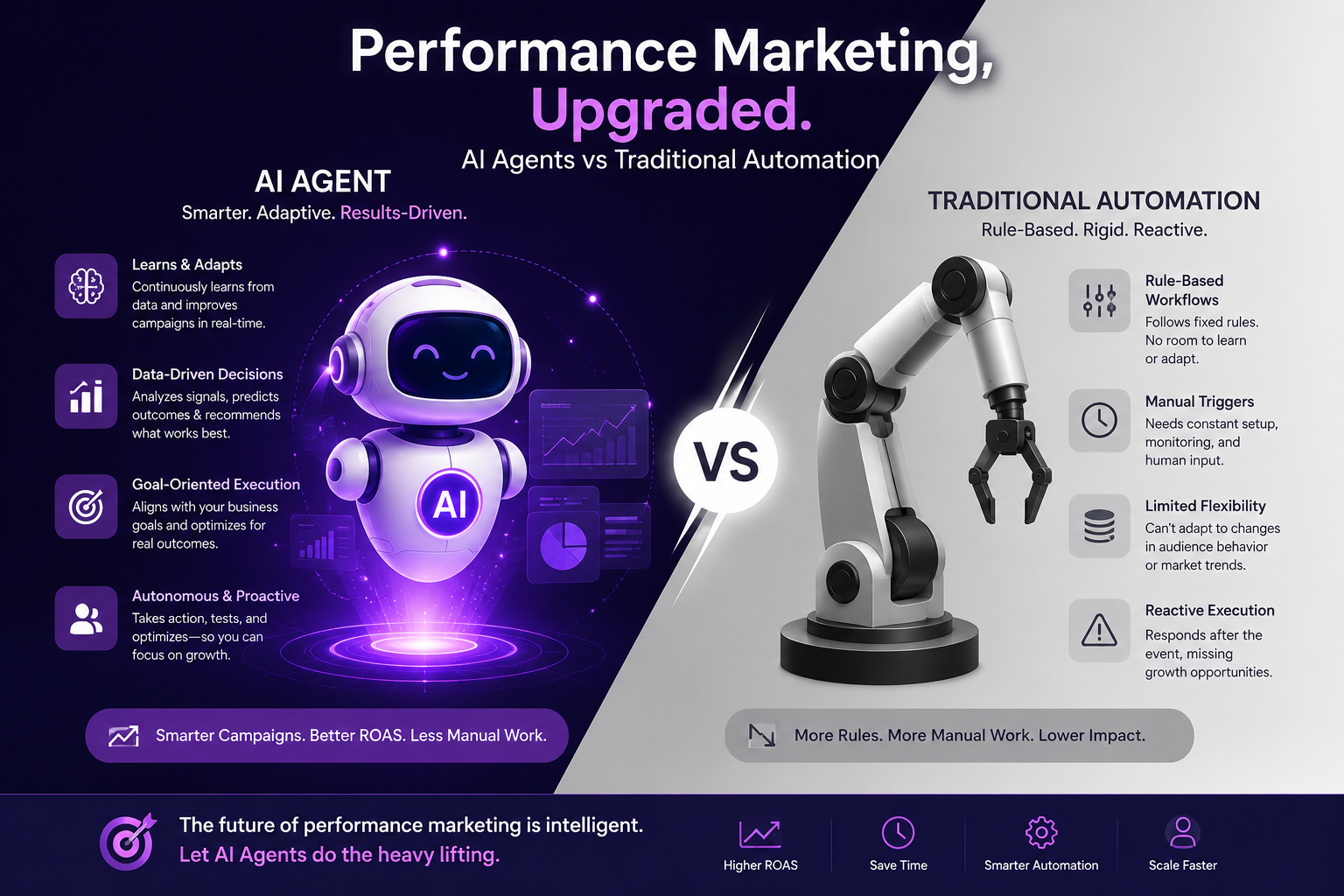
A Performance Marketing AI Agent is changing how marketers approach this challenge. Instead of acting as another automation tool, it works as an intelligent assistant that analyzes campaign performance, identifies meaningful trends, and recommends actions based on real-time insights. Rather than replacing marketers, AI enhances their ability to make informed decisions faster, allowing them to focus on strategy instead of spending hours reviewing reports.
For ecommerce brands aiming to grow efficiently, adopting intelligent marketing technology is no longer a future consideration. It is quickly becoming a necessity.
Why Performance Marketing AI Agent Is Changing Ecommerce Growth
A Performance Marketing AI Agent brings intelligence into everyday campaign management. Unlike traditional software that performs predefined tasks, AI continuously evaluates marketing performance and helps marketers understand what is happening behind the numbers.
Consider a growing ecommerce business running campaigns on Google Ads, Meta, TikTok, and email simultaneously. Each platform generates separate reports, each with its own metrics and recommendations. Reviewing every dashboard manually takes valuable time, and by the time marketers identify an issue, campaign performance may already have declined.
AI solves this problem by bringing together information from multiple sources, identifying unusual performance patterns, and surfacing recommendations that deserve immediate attention. Instead of spending the morning searching for insights, marketers can begin their day with prioritized opportunities already identified.
This shift transforms marketing from reactive optimization into proactive decision-making. Teams can address issues earlier, respond faster to customer behavior, and allocate their time to activities that generate business growth.
The Challenge With Traditional Marketing Approaches
Modern ecommerce generates more data than ever before. Every visitor interaction, product click, conversion, abandoned cart, and advertising impression contributes valuable information.
While having access to this data is beneficial, understanding it is becoming increasingly difficult.
Many organizations still rely on traditional marketing automation to improve efficiency. Automated reports, scheduled workflows, campaign rules, and email triggers certainly reduce repetitive work. These tools perform exactly as instructed and continue to play an important role within marketing operations.
The limitation appears when marketers need context.
Automation can notify a team that conversions have decreased.
It cannot explain why those conversions dropped.
Automation can pause campaigns when spending exceeds a limit.
It cannot determine whether temporarily increasing the budget would actually generate higher profits.
As ecommerce becomes more competitive, marketers require technology capable of supporting judgment, not simply executing instructions.
Intelligence Creates Better Marketing Decisions
The biggest difference between automation and AI lies in the quality of decision-making.
Rule-based systems operate within predefined conditions.
Artificial intelligence continuously evaluates changing conditions.
An AI agent for performance marketing reviews campaign performance from multiple perspectives simultaneously. It can recognize trends that would otherwise require hours of manual investigation and present those findings in a way marketers can immediately understand.
For example, instead of simply highlighting declining click-through rates, AI may identify that audience fatigue is affecting one campaign while seasonal demand is influencing another.
Rather than forcing marketers to investigate every possibility individually, AI provides valuable context that supports faster optimization.
This combination of speed and intelligence allows businesses to respond before small performance issues become expensive problems.
Moving Beyond Basic Performance Marketing Automation
For many years, marketers measured success by how much work they could automate.
Campaign scheduling.
Email sequences.
Audience segmentation.
Bid adjustments.
Report generation.
These remain valuable capabilities, but modern performance marketing automation should accomplish much more than repetitive execution.
Today's marketing environment requires systems that learn continuously from campaign behavior.
Advertising platforms evolve rapidly.
Customer preferences shift throughout the year.
Competitors launch promotions unexpectedly.
Creative assets lose effectiveness as audiences become familiar with them.
Because these situations rarely follow predictable rules, marketers need technology capable of recognizing changes as they occur.
AI helps bridge this gap by identifying meaningful signals within campaign data and presenting actionable recommendations rather than isolated metrics.
Instead of simply collecting information, marketers receive guidance that supports smarter business decisions.
Smarter Campaign Management Across Every Channel
Most ecommerce brands no longer depend on a single source of traffic.
Paid search captures high-intent shoppers.
Social advertising introduces products to new audiences.
Email marketing strengthens customer retention.
Remarketing encourages repeat purchases.
Each channel contributes valuable insights, yet each also creates another layer of complexity.
Reviewing separate dashboards throughout the day often slows decision-making because marketers spend more time collecting information than acting upon it.
This is where intelligent marketing systems provide measurable value.
Rather than treating each advertising platform independently, AI evaluates campaign performance collectively.
It can identify relationships between channels, detect emerging trends, and prioritize recommendations according to potential business impact.
Instead of asking marketers to interpret thousands of metrics manually, AI delivers meaningful insights that improve confidence in every optimization decision.
The result is greater efficiency without sacrificing strategic thinking.
Why Human Expertise Still Matters
Despite rapid advances in artificial intelligence, successful marketing still depends on people.
AI cannot fully understand brand positioning, emotional storytelling, customer relationships, or long-term business objectives.
Experienced marketers remain responsible for defining campaign strategies, developing creative concepts, understanding customer motivations, and building memorable brand experiences.
Artificial intelligence complements these strengths rather than replacing them.
By removing repetitive analysis and surfacing meaningful recommendations, AI gives marketers more time to focus on creativity, experimentation, and innovation.
This partnership between human expertise and intelligent technology creates stronger marketing outcomes than either could achieve independently.
Businesses that combine strategic thinking with intelligent decision support will continue outperforming those relying solely on manual analysis or static automation.
Preparing for the Future of AI Powered Performance Marketing
The digital advertising landscape continues evolving at an extraordinary pace. New platforms emerge, customer expectations change, and competition increases every year.
Businesses that continue relying entirely on manual optimization may find themselves overwhelmed by growing campaign complexity.
AI powered performance marketing offers a practical solution by helping marketers process information faster while improving the quality of business decisions.
Instead of reacting after campaign performance declines, marketers can anticipate opportunities, identify emerging trends, and optimize proactively.
Over time, this leads to better resource allocation, more efficient marketing operations, stronger customer acquisition, and sustainable business growth.
Artificial intelligence should not be viewed as a replacement for marketing professionals. Instead, it should be considered an intelligent partner that empowers teams to make smarter decisions with greater confidence.
Final Thoughts
A Performance Marketing AI Agent is redefining how ecommerce brands optimize campaigns in an increasingly competitive digital landscape. While automation remains essential for handling repetitive tasks, intelligent AI provides the insights and recommendations marketers need to make faster, more informed decisions. Businesses that invest in a strong AI Performance Marketing Strategy will be better positioned to improve campaign performance, adapt to changing customer behavior, and build sustainable long-term growth through smarter, data-driven marketing.
FAQs
1. What is a Performance Marketing AI Agent?
A Performance Marketing AI Agent analyzes campaign data, detects performance trends, and recommends optimization opportunities to help marketers make better decisions.
2. How is AI different from traditional marketing automation?
Traditional marketing automation executes predefined workflows, while AI evaluates campaign performance, recognizes patterns, and provides intelligent recommendations based on changing conditions.
3. Can AI improve advertising ROI?
Yes. By helping marketers identify optimization opportunities earlier and prioritize high-impact actions, AI can improve campaign efficiency and maximize advertising returns.
4. Is AI suitable for small ecommerce businesses?
Absolutely. AI helps businesses of all sizes reduce manual analysis, improve campaign optimization, and make better marketing decisions without significantly increasing operational costs.
5. Why is AI becoming important in performance marketing?
As advertising platforms generate more data and campaigns become increasingly complex, AI helps marketers transform information into actionable insights, enabling faster optimization and more effective business growth.

 English
 Arabic
 Français
 Español
 Português
 Deutsch
 Türkçe
 Italiano
 Russian
 Romaian