


Performance Marketing AI Agent: Why Every Campaign Needs a Second Opinion
Marketing has never been about making perfect decisions. It's about making the best possible decision with the information available at the time.
Every day, performance marketers face dozens of choices. Should the budget be increased? Is a creative really underperforming, or is it too early to judge? Has the audience reached saturation, or is the campaign simply experiencing a temporary dip? Is a lower return on ad spend a warning sign or part of a normal trend?
These decisions directly influence revenue, but they're often made under pressure and with incomplete information.
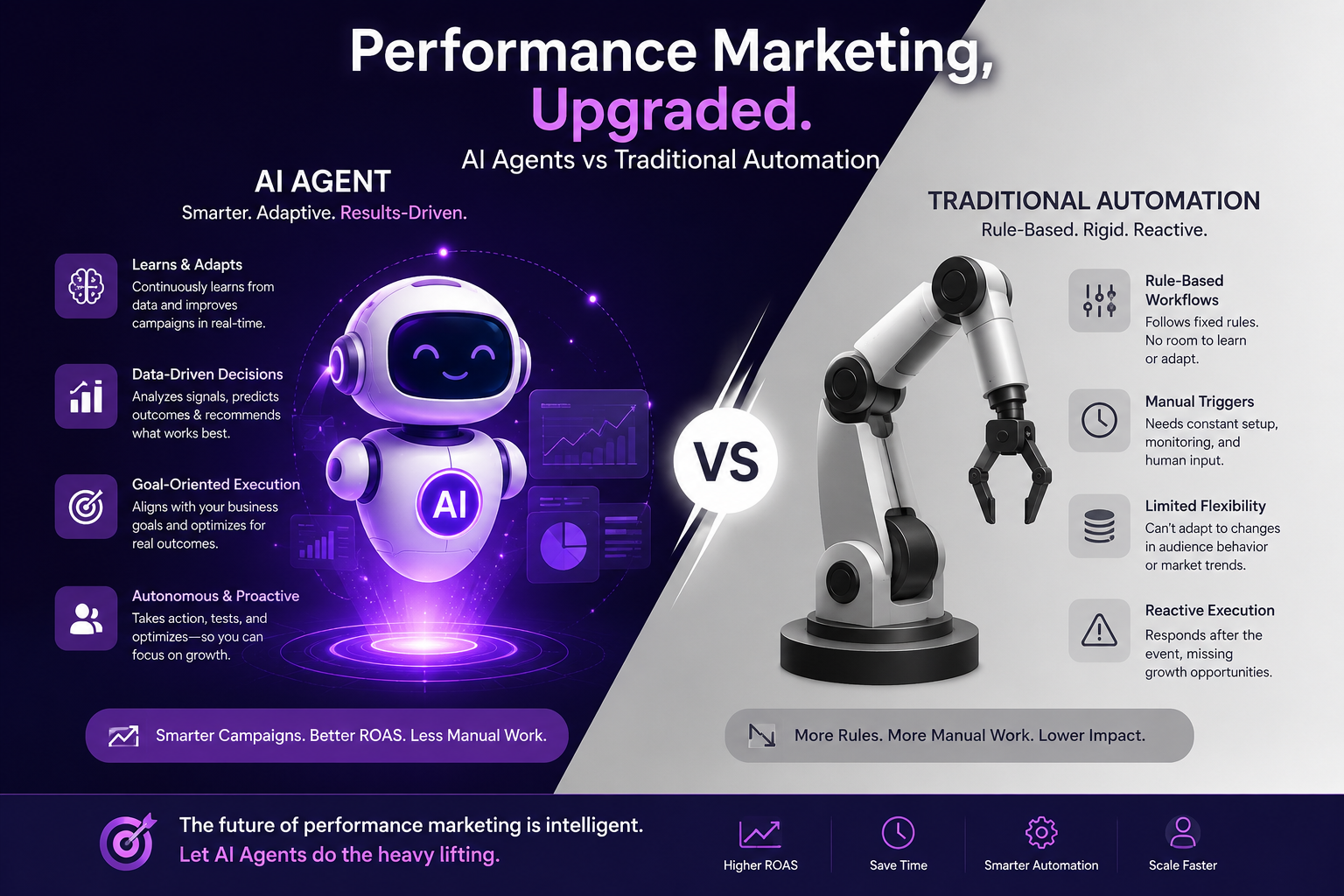
A Performance Marketing AI Agent acts as an intelligent second opinion. It doesn't replace marketers or make decisions for them. Instead, it analyzes campaign performance from multiple angles, validates assumptions with data, and highlights opportunities or risks that may otherwise go unnoticed.
As ecommerce advertising becomes more competitive, having an AI-powered layer of decision support is becoming just as valuable as having experienced marketers on the team.
Marketing Mistakes Usually Start With Assumptions
Many campaign decisions are based on experience.
Experienced marketers recognize patterns, understand customer behavior, and often know when to trust their instincts.
However, experience also creates assumptions.
A campaign that worked last quarter is expected to work again.
A familiar audience is assumed to remain profitable.
A successful creative is expected to continue generating conversions.
Unfortunately, digital advertising changes too quickly for assumptions to remain reliable.
Consumer behavior shifts.
Competitors launch new offers.
Advertising algorithms evolve.
What worked yesterday may produce completely different results today.
The most expensive marketing mistakes often begin with small assumptions that are never validated.
How a Performance Marketing AI Agent Challenges Those Assumptions
A Performance Marketing AI Agent evaluates campaign performance objectively instead of relying on historical habits or intuition alone.
Rather than confirming what marketers already believe, AI compares live campaign signals to identify patterns that deserve attention.
For example, a marketer may believe increasing budget is the correct response to rising sales.
AI may reveal that higher conversions are coming from only one audience segment while several others are already becoming inefficient.
Similarly, marketers may assume a declining click-through rate means creative fatigue.
AI could identify that the issue is actually changing audience behavior or increased market competition.
These insights encourage better decisions because they're supported by evidence rather than assumptions.
Why Traditional Marketing Automation Cannot Validate Decisions
Businesses have invested heavily in traditional marketing automation because it improves operational efficiency.
Automated workflows save time.
Scheduled reports reduce manual work.
Rule-based triggers simplify repetitive processes.
These capabilities remain extremely valuable.
However, automation executes instructions.
It does not question those instructions.
If marketers create an ineffective rule, automation will continue following it perfectly.
It cannot determine whether campaign strategy should change.
It cannot recognize when assumptions become outdated.
Validation requires intelligence.
That is something automation alone cannot provide.
AI Brings Confidence Instead of Guesswork
One overlooked benefit of an AI agent for performance marketing is confidence.
Many campaign decisions involve uncertainty.
Should marketers pause an advertisement after three days?
Should budgets increase immediately after strong weekend performance?
Should an audience be expanded despite slightly higher acquisition costs?
Without sufficient context, these decisions often become educated guesses.
AI reduces uncertainty by evaluating multiple campaign variables simultaneously.
Instead of highlighting isolated metrics, it explains relationships between customer behavior, advertising costs, engagement, and conversions.
This broader understanding allows marketers to act with greater confidence rather than reacting emotionally to short-term fluctuations.
Confidence leads to more consistent optimization over time.
Smarter Performance Marketing Automation Supports Better Decisions
Businesses often think automation is about reducing workload.
Modern performance marketing automation should also improve decision quality.
AI-supported systems continuously analyze campaigns and surface insights that deserve attention.
Rather than expecting marketers to search for problems manually, intelligent systems identify unusual patterns automatically.
A campaign spending efficiently but showing declining engagement.
A creative generating strong clicks but poor conversions.
An audience delivering fewer purchases despite higher traffic.
Instead of overwhelming marketers with additional reports, AI prioritizes the information most likely to influence business performance.
This transforms automation from an operational tool into a strategic advantage.
AI Makes Team Collaboration Stronger
Performance marketing rarely involves one individual.
Campaign managers collaborate with designers, copywriters, ecommerce managers, analysts, and leadership teams.
Each department interprets campaign performance differently.
Creative teams focus on messaging.
Finance reviews advertising efficiency.
Leadership evaluates business growth.
AI creates a shared understanding by presenting insights supported by data instead of personal opinions.
Instead of debating whether performance has improved, teams discuss how to respond to verified opportunities.
This alignment reduces internal friction and accelerates decision-making across the organization.
As campaigns become more sophisticated, collaboration becomes just as important as optimization.
Why AI Powered Performance Marketing Is About Better Decisions, Not More Automation
The next generation of marketing technology isn't focused solely on doing work faster.
It's focused on helping marketers think better.
AI powered performance marketing enables businesses to interpret campaign complexity without becoming overwhelmed by endless data.
Rather than replacing experience, AI strengthens it.
Instead of eliminating marketers, it helps them become more informed.
Organizations that combine human expertise with intelligent decision support will consistently outperform those relying on either one independently.
The future of marketing belongs to teams capable of making smarter decisions—not simply faster ones.
Final Thoughts
A Performance Marketing AI Agent gives ecommerce marketers something increasingly valuable: confidence in their decisions. By validating assumptions, uncovering hidden opportunities, and providing data-backed recommendations, AI helps teams optimize campaigns with greater precision. Building an effective AI Performance Marketing Strategy allows brands to combine human expertise with intelligent insights, resulting in stronger campaign performance, better collaboration, and sustainable long-term growth.
FAQs
1. Why do marketers make costly campaign decisions?
Many decisions are based on assumptions, limited data, or time pressure, which can lead to missed opportunities or inefficient budget allocation.
2. How does AI improve marketing decisions?
AI analyzes multiple campaign signals simultaneously and provides recommendations supported by data rather than assumptions.
3. Can AI replace marketing experience?
No. AI complements human expertise by providing deeper insights, while marketers remain responsible for strategy, creativity, and final decisions.
4. What makes AI different from traditional marketing automation?
Traditional marketing automation follows predefined rules, while AI continuously interprets campaign performance and adapts recommendations as conditions change.
5. Why is AI valuable for ecommerce performance marketing?
AI helps ecommerce businesses reduce uncertainty, identify optimization opportunities earlier, and make smarter decisions that improve long-term advertising performance.
 Deutsch
 English
 Arabic
 Français
 Español
 Português
 Türkçe
 Dutch
Dutch
 Italiano
 Russian
 Romaian