


Beginner CTF Challenges A HandsOn Practice Guide
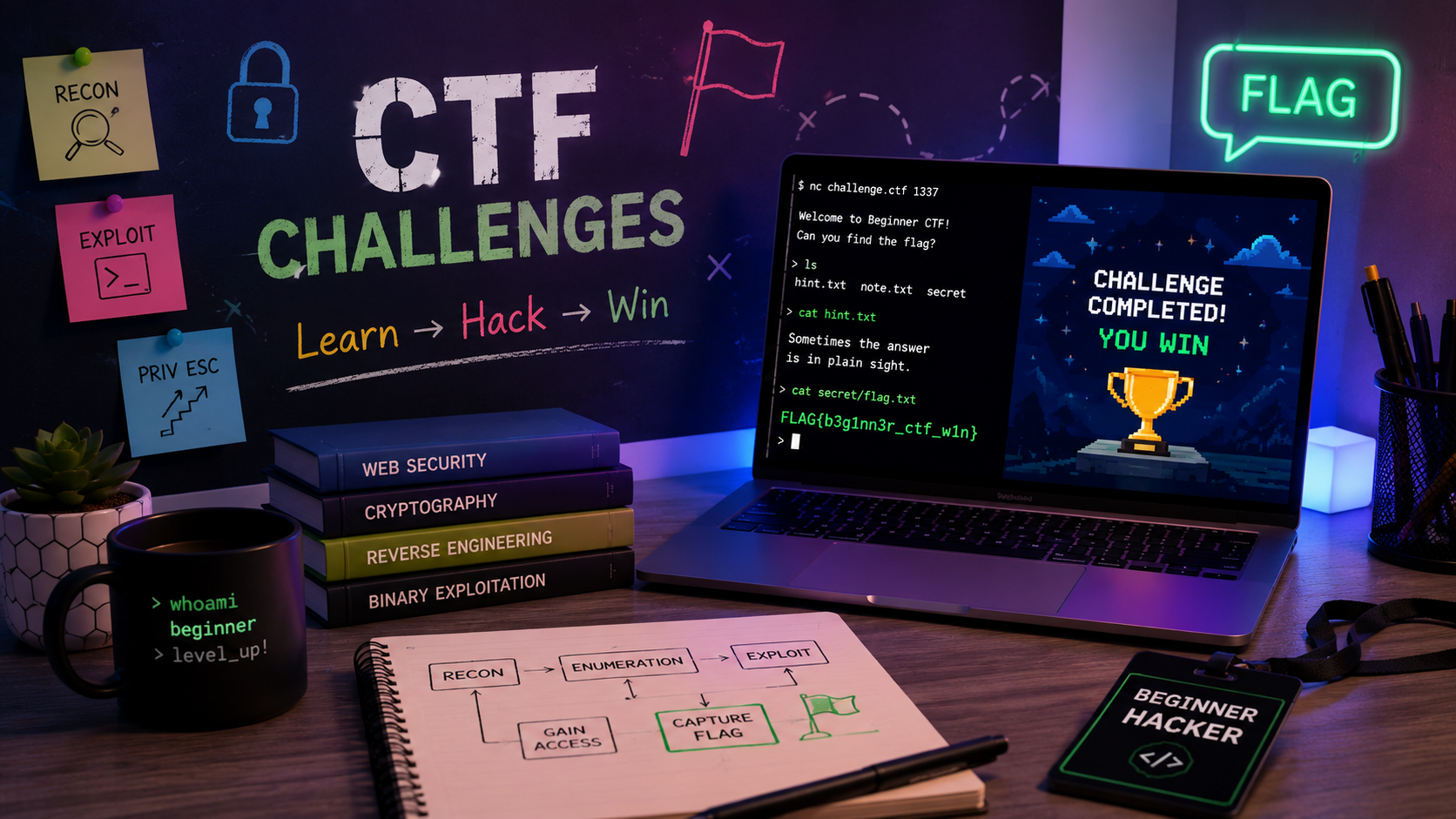
Beginner CTF challenges are structured, entry level cybersecurity puzzles where you find a hidden flag by exploiting an intentional vulnerability most commonly in web exploitation, SQL injection, XSS, or IDOR categories. The fastest way to build real skill is to skip long theory sessions, pick a category and solve small, guided challenges in order of difficulty using a free online beginner CTF lab built around real application vulnerabilities.
If you have searched for beginner CTF challenges, you have probably already read an introduction to what CTF is. This guide skips that part. It is built for the moment right after the theory when you are staring at a challenge board, unsure which flag to chase first and wondering whether you actually have the skills to start. You do. This is a practice first walkthrough of the beginner capture the flag challenges worth your time, organized by category, with a repeatable method for solving them.
Whether you found your way here through bug bounty prep, an application security course, or plain curiosity about ethical hacking practice, the approach below works the same way: small wins, real vulnerabilities and a method you can repeat on your own.
What Counts as a Beginner CTF Challenge?
Not every easylooking challenge is actually beginner appropriate, and not every beginner challenge looks easy at first glance. A genuinely entry level CTF challenge has three traits: it tests one vulnerability class at a time, it doesn't require chaining multiple exploits together, and it gives you enough feedback (error messages, response codes, visible source) to form a hypothesis without external hints.
Online beginner CTF labs typically grade challenges by point value or difficulty tag. Anything under roughly 100 points on a Jeopardystyle board, or labeled Easy on a guided platform, generally fits this definition. If you are new to the format entirely, our breakdown of what CTF hacking actually involves is a useful companion read before you dive into the practice list below.
Why Practicing Beats Reading for CTF SkillBuilding
Cybersecurity labs that emphasize doing over reading consistently produce faster skill gains than passive study, and beginner CTF challenges are the clearest example of that principle in action. You can read ten articles about SQL injection and still freeze the first time you're staring at a live login form. Solve three SQL injections challenges yourself, and the concept becomes muscle memory.
This is also why handson cybersecurity learning environments have become the default onboarding path for aspiring bug bounty hunters and junior security engineers alike. A resume line that says "completed OWASP Top 10 practice across 40 challenges" carries more weight in an interview than a certification alone, because it's backed by demonstrable, repeatable technique.
What You Need Before Your First Easy CTF Challenge
You do not need a security degree to start. Entry level CTF challenges are deliberately built for people without a formal background, but three small pieces of preparation make the first hour dramatically less frustrating:
-
Comfort with a browser's developer tools. Most beginner web challenges hinge on viewing page source, inspecting network requests, or editing cookies.
-
Basic command line familiarity. You will use curl, cat, and simple Python scripts more than you'd expect, even in webfocused categories.
-
A proxy tool. Burp Suite Community Edition (free) lets you intercept and modify requests, which is essential once you move past sourcecodevisible challenges into ones that require manipulating live traffic.
None of this requires prior offensive security training. It requires about an afternoon of setup before your first CTF practice for beginners session.
Beginner CTF Challenge Categories Worth Practicing First
The fastest growing skill area for anyone starting out is application security; it maps directly to real jobs, real bug bounty payouts, and the vulnerability classes that show up in nearly every CTF challenge with solutions published online. Below is a category by category practice menu, ordered roughly by how approachable each one is for a first time solver.
XSS Challenge: Your First Injection Category
Crosssite scripting is usually the first real aha moment for a beginner because the payoff is visible immediately when your injected script actually runs in the browser. A typical beginner XSS challenge asks you to get a comment field, search box, or URL parameter to execute a JavaScript alert, then escalate toward stealing a session cookie or bypassing a filter.
Start with reflected XSS before moving to stored or DOMbased variants. Each teaches a different part of how untrusted input becomes executable code, which is core to understanding web application security as a discipline rather than a checklist.
SQL Injection Challenge: The Classic Entry Point
SQL injection challenges remain the single most requested beginner category for a reason: the technique is intuitive once you see it work once. A basic version asks you to bypass a login form using a crafted input like ' OR '1'='1. More advanced beginner tier versions introduce UNIONbased extraction, asking you to pull data out of a database the application was never meant to expose.
Practicing dedicated SQL injection challenges builds pattern recognition you'll reuse constantly the moment you see a database error message reflected back to you in a response, you'll know exactly what to try next.
IDOR Challenge: Learning to Question Object References
Insecure direct object reference challenges are deceptively simple and genuinely educational. You're typically given access to your own account resource, an invoice, a profile, an order and asked to access someone else's by manipulating an ID in the URL or request body. There's rarely any complex payload involved; the skill here is noticing what a well behaved application should be checking and isn't.
IDOR challenges are also one of the fastest categories to transfer directly into bug bounty hunting, since broken objectlevel authorization remains one of the most commonly reported vulnerability classes in production applications.
Authentication Bypass Challenge
Authentication bypass challenges test whether you can get past a login mechanism without valid credentials through logic flaws, predictable tokens, weak password reset flows, or exposed backend endpoints. Beginner versions usually isolate a single flaw (a missing server side check, a guessable token) rather than chaining several together.
CSRF Challenge
Crosssite request forgery challenges ask you to craft a page or request that forces an authenticated user's browser to perform an action they didn't intend. Beginner CSRF challenges typically focus on a single statechanging action, like updating an email address, with no antiCSRF token protecting it.
SSRF Challenge
Server side request forgery challenges introduce a slightly different mental model: instead of attacking the client, you're tricking the server itself into making a request on your behalf, often to an internal resource it shouldn't be able to reach. Beginner SSRF challenges are a great bridge into understanding cloud metadata endpoint attacks, which show up frequently in realworld incident reports.
Command Injection
Command injection challenges test whether user input gets passed unsafely into a system shell. A classic beginner setup is a "ping this IP address" feature that lets you append ; ls or && whoami to run arbitrary commands. It's one of the more satisfying categories to solve because the impact of full command execution is immediate and obvious.
File Upload Vulnerability
File upload challenges ask you to bypass extension filters, content type checks, or path restrictions to upload a malicious file (often a simple web shell) and get it executed by the server. Beginner versions usually have one weak validation point; intermediate versions stack two or three checks you have to defeat in sequence.
API Security Challenge
As more applications move to APIfirst architectures, API security challenges have become a standard part of any modern CTF challenges for beginners. These challenges cover broken authentication on endpoints, excessive data exposure in JSON responses, and missing rate limiting testing the same underlying flaws as traditional web challenges, just through a different interface.
Practicing across these categories with real, structured labs rather than fragmented tutorials is exactly what platforms like App Security Master CTF challenge library are designed for.
How to Start Solving CTF Challenges: A Repeatable Method
Every beginner captures the flag challenge, regardless of category, rewards the same underlying process. Use this sequence on your very first attempt and it will still be the sequence you use a year from now on harder problems.
-
Read the challenge brief twice. Beginner challenges often hide a hint in the title, description, or point value.
-
Observe before you attack. Load the target, click around, view the page source, and note anything unusual before opening a proxy tool.
-
Form one specific hypothesis. "This input field probably isn't sanitized" is more useful than "something here is probably vulnerable."
-
Test the hypothesis with the smallest possible payload. A single quote, a basic script tag, or one manipulated parameter tells you more than a large automated scan.
-
Read the response carefully. Error messages, status codes, and subtle behavior changes are the challenge talking back to you.
-
Escalate only after confirmation. Once your hypothesis is proven, build toward the full flag methodically rather than guessing wildly.
-
Write down what worked. A two sentence note after each solve turns a onetime win into a reusable skill.
This process works whether you are inside a browser based lab or a downloaded VM, and it's the same discipline behind every well documented CTF for beginners success story.
Free Beginner CTF Challenges vs. Structured Practice Labs
Free, unstructured challenge boards and structured application security labs solve different problems, and most learners eventually need both.
|
Factor |
Free Beginner CTF Challenges |
Structured AppSec Practice Labs |
|
Cost |
No cost |
Often free tier + paid depth |
|
Guidance |
Minimal; you selfdirect |
Builtin learning objectives per challenge |
|
Category coverage |
Broad (crypto, forensics, pwn, web) |
Focused on application security |
|
Career relevance |
Mixed |
Directly maps to OWASP Top 10 and bug bounty categories |
|
Walkthroughs available |
Communitywritten, variable quality |
Often built into the platform |
|
Best for |
Exploring the full CTF landscape |
Building depth in web and API security |
If your goal is broad exposure, free boards are a great starting point. If your goal is application security or bug bounty readiness specifically, time spent in a focused environment compounds faster.
Choosing an Online Beginner CTF Lab: What Actually Matters
Not all online beginner CTF labs are built the same way, and the difference shows up fast once you're a few challenges in. Look for four things before committing your practice time to a platform:
-
Progressive difficulty, so challenges build on each other instead of jumping straight from trivial to advanced.
-
Realistic application context, so the vulnerability you are exploiting resembles something you'd encounter in a real codebase, not an abstract puzzle.
-
Category depth in application security, specifically SQL injection practice, in particular, benefits from multiple variations rather than a single one off challenge.
-
A path beyond exploitation, including source code review practice, which teaches you to spot the same vulnerability classes by reading code instead of only attacking a running app.
Common Mistakes Beginners Make on Easy CTF Challenges
Most beginners don't fail because a challenge is too hard; they fail because of process, not skill. Watch for these patterns in your own practice:
Jumping straight to a walkthrough. Reading a solution before making a genuine attempt trades a skillbuilding rep for a shortcut that won't hold up in a live competition or a real engagement.
Skipping source inspection. A large share of beginner web and application security challenges hide meaningful clues directly in HTML comments, JavaScript files, or response headers free information that a rushed solver misses entirely.
Treating every challenge as isolated. The SQL injection challenge you solve this week and the authentication bypass challenge you solve next week usually share an underlying lesson about trusting user input. Beginners who journal their solves notice these patterns faster than those who don't.
Avoiding categories that feel unfamiliar. It's tempting to only practice what's already comfortable. Rotating deliberately through XSS, IDOR, CSRF, SSRF, and command injection challenges builds a far more complete offensive security training foundation than mastering one category in isolation.
Turning Beginner CTF Practice Into an OWASP Top 10 Routine
The OWASP Top 10 exists because it captures the vulnerability classes that appear most often in real applications which makes it a natural map for structuring your CTF practice. Instead of solving challenges at random, build a rotation: one injection based challenge (SQL injection or command injection), one access control challenge (IDOR or authentication bypass), one clientside challenge (XSS or CSRF), and one server side trust challenge (SSRF or file upload) each week.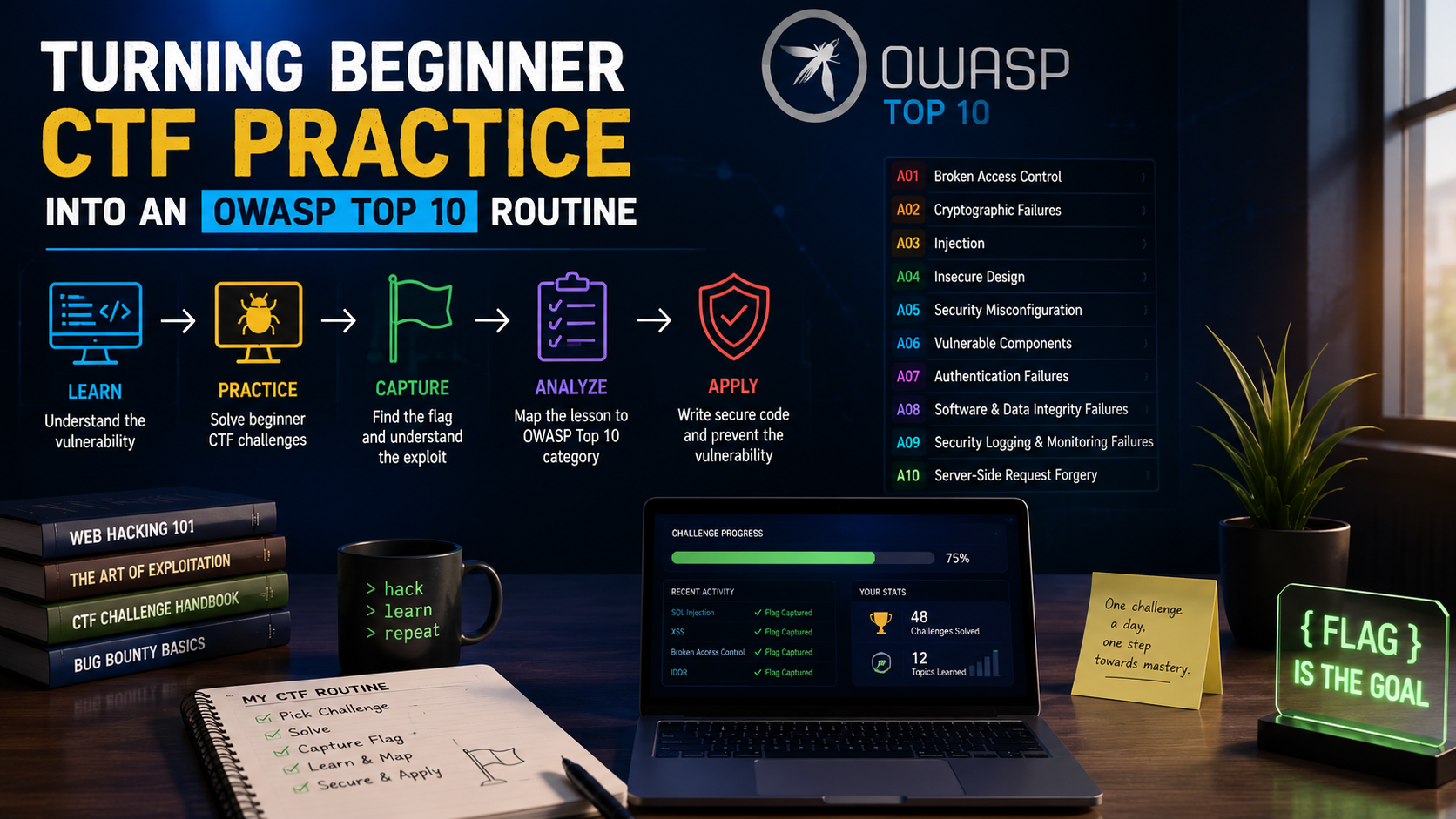
This kind of structured, repeatable OWASP Top 10 practice does two things a random challenge board can't: it ensures balanced skill development, and it gives you language to describe your growing expertise in concrete terms useful whether you're prepping for a bug bounty program, an interview, or an internal security certification.
A Sample Beginner CTF Challenge Walkthrough
Reading a method is useful; watching it applied to a real example makes it concrete. Here's how the sevenstep process above plays out on a typical easy CTF challenge from the web exploitation category.
The setup: You're given a URL for a simple "employee directory" application and told a flag is hidden somewhere in the system. There's a search box that returns employee records by last name.
Step 1 Read the brief. The description mentions the app "queries a database directly" a small but deliberate hint pointing toward an injectionbased vulnerability rather than, say, an authentication flaw.
Step 2: Observe. You search for a common last name and get a normal result. You search for a name that doesn't exist and get an empty result with no error. You view the page source and find nothing unusual there; this rules out a sourceinspection shortcut and confirms the interaction happens through the search request itself.
Step 3 Form a hypothesis. Given the hint about a direct database query, your hypothesis is that the search field is vulnerable to SQL injection.
Step 4 Test with a minimal payload. You enter a single quote (') into the search box instead of a name.
Step 5 Read the response. Instead of an empty result, the page returns a database syntax error, revealing the underlying query structure. This confirms your hypothesis immediately.
Step 6 Escalate methodically. Using the error message as a guide, you craft a UNIONbased payload to extract data from a table the application wasn't designed to expose, eventually surfacing the flag stored alongside employee records.
Step 7 Document it. You note the vulnerable parameter, the exact payload that worked, and the specific error message that gave away the query structure turning a fifteen minute solve into a reference you can recognize instantly next time.
This same rhythm brief, observe, hypothesize, test small, read carefully, escalate, document applies whether you're working through an XSS challenge, an IDOR challenge, or a more advanced SSRF scenario later on. The categories change; the discipline doesn't.
Practice Beginner CTF Challenges With App Security Master
App Security Master exists specifically for this stage of the learning curve handson, applicationsecurityfocused, and structured so each challenge teaches one concept clearly before testing it. Rather than piecing together tutorials from a dozen sources, you can work through web application hacking labs built around the exact categories covered above: XSS, SQL injection, IDOR, CSRF, SSRF, command injection, file upload, and API security.
The platform also connects exploitation practice with defensive understanding through codelevel review, which is covered in more depth in our guide to application security code review. Together, offensive challenges and code review practice build the kind of well rounded skill set that both CTF competitions and professional application security roles actually require.
Ready to put the method above into action? Head to the homepage to explore active tracks and pick your first challenge today.
Frequently Asked Questions (FAQs)
What are the easiest beginner CTF challenges to start with?
Web exploitation challenges, especially basic XSS and loginbypass SQL injection, are typically the easiest entry point because they require minimal tooling and give immediate visual feedback when solved.
Do I need coding experience for beginner CTF challenges?
No prior coding experience is required to start, though basic Python and command line familiarity make challenges faster to solve and become genuinely useful within your first few weeks of practice.
How many beginner CTF challenges should I solve before trying a competition?
Most learners feel reasonably prepared for a beginner tier live competition after solving 15–20 challenges across at least three categories, with documented notes on what worked.
Are free beginner CTF challenges as good as paid platforms?
Free challenge boards are excellent for broad exposure to the CTF format, but structured, paid or freemium platforms typically offer more consistent difficulty progression and deeper coverage of application security categories.
What is the difference between a CTF challenge and a real penetration test?
A CTF challenge always has a guaranteed, intentional solution built for learning, while a real penetration test involves uncertain outcomes, legal scope, and professional reporting requirements on live systems.

 Arabic
 Français
 Español
 Português
 Deutsch
 Türkçe
 Dutch
Dutch
 Italiano
 Russian
 Romaian