


AWS Data Engineering: A Complete Beginner’s Guide
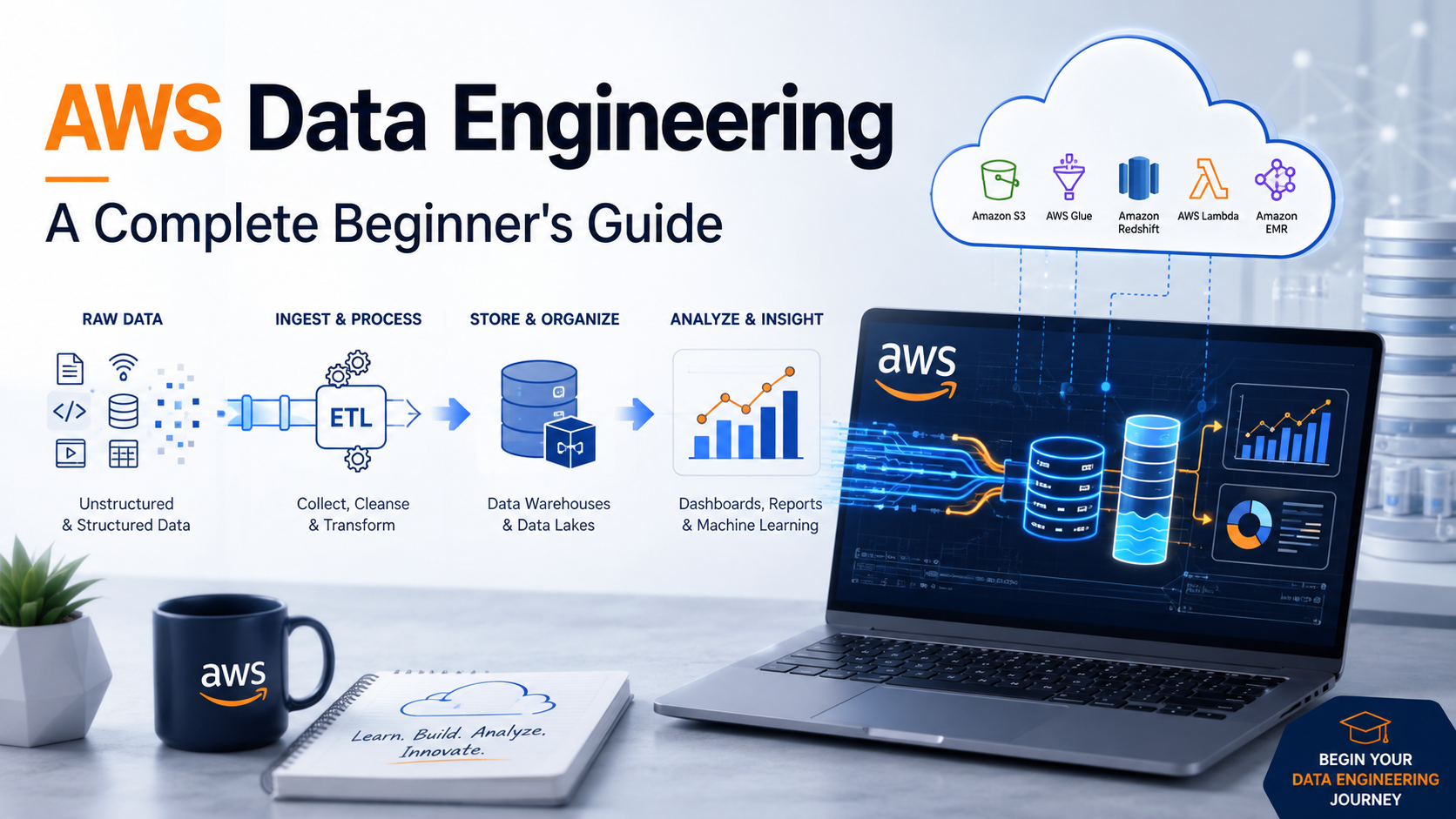
Businesses generate enormous volumes of information through websites, mobile applications, transactions, connected devices, and customer interactions. However, this raw information delivers little value until it is collected, organized, transformed, and made available for analysis.
This is where data engineering becomes essential.
AWS data engineering combines core data management practices with Amazon Web Services technologies to build scalable storage systems, automated pipelines, and reliable data platforms. For beginners, learning both data engineering fundamentals and cloud services can create a strong foundation for careers in data engineering, cloud computing, analytics, and database management.
What Is Data Engineering?
Data engineering is the process of designing and maintaining systems that collect, store, transform, and deliver data.
A data engineer builds the technical infrastructure that enables analysts, data scientists, applications, and business teams to access reliable information. Their responsibilities may include:
- Collecting information from databases, applications, files, and APIs
- Designing data warehouses and data lakes
- Building extract, transform, and load pipelines
- Cleaning and validating datasets
- Managing databases and cloud storage
- Monitoring data quality and pipeline performance
- Protecting sensitive information
In simple terms, data engineers ensure that the right data reaches the right system in a usable format.
What Does an AWS Data Engineer Do?
An AWS data engineer uses AWS services to create and operate cloud-based data solutions.
Rather than managing all infrastructure through physical servers, the engineer can use managed cloud services for storage, processing, security, monitoring, and automation. Depending on the project, an AWS data engineer may:
- Store structured and unstructured information in Amazon S3
- Design scalable storage architectures
- Build automated ETL workflows
- Query datasets using SQL
- Apply encryption and access controls
- Configure versioning, replication, and backups
- Maintain data quality and lineage
- Monitor pipelines for failures or performance issues
The role requires more than knowing individual AWS services. A successful engineer must understand how information moves through an entire architecture—from its original source to its final destination.
Why Is AWS Used for Data Engineering?
AWS provides a broad collection of services for storing, processing, securing, and analyzing data. Organizations can expand or reduce resources based on demand instead of purchasing and maintaining large amounts of physical infrastructure.
Key advantages include:
Scalability
Cloud resources can support growing datasets and changing workloads. This allows organizations to process larger volumes of information without redesigning their entire infrastructure.
Flexible Storage
AWS provides multiple storage options for different requirements. For example, Amazon S3 supports object storage, while Amazon EBS provides block storage and Amazon EFS delivers shared file storage.
Automation
Data workflows can be automated to reduce repetitive manual activity. Automated pipelines can collect, transform, validate, and deliver information according to defined schedules or events.
Security
AWS offers identity management, encryption, logging, and monitoring capabilities that help organizations protect their data environments.
Cost Management
Organizations can select resources according to their workload requirements and adjust capacity when those requirements change.
Which Data Engineering Fundamentals Should Beginners Learn?
Before exploring complex cloud architectures, beginners should develop a clear understanding of the following concepts.
1. Data Types
Data is commonly classified as structured, semi-structured, or unstructured.
Structured data follows a predefined format, such as rows and columns in a relational database. Semi-structured data contains organizational elements without using a rigid table structure. JSON and XML files are common examples. Unstructured data includes videos, images, audio files, emails, and documents.
Understanding these categories helps engineers select appropriate storage and processing technologies.
2. Databases and SQL
SQL is one of the most important skills for data engineering. It allows engineers to retrieve, combine, filter, aggregate, and modify information stored in relational databases.
A beginner should understand:
- Tables, rows, and columns
- Primary and foreign keys
- Filtering and sorting
- Joins
- Aggregate functions
- Subqueries
- Regular expressions
- Data normalization
Strong SQL knowledge helps engineers inspect datasets, troubleshoot problems, and prepare information for downstream users.
3. Data Warehouses and Data Lakes
A data warehouse stores structured and processed information that is typically optimized for reporting and analytics.
A data lake stores large amounts of raw or partially processed information in different formats. It can contain structured, semi-structured, and unstructured data.
Many modern architectures use both approaches. Raw information may first enter a data lake before selected datasets are cleaned and loaded into a warehouse.
4. ETL and ELT Pipelines
ETL stands for extract, transform, and load.
- Extract: Collect information from one or more sources.
- Transform: Clean, validate, combine, or reformat it.
- Load: Transfer it into a target database, warehouse, or storage system.
ELT follows a slightly different order by loading the data before transforming it. The best approach depends on the platform, workload, and business requirements.
5. Data Modeling
Data modeling defines how information is organized and connected. A well-designed model makes data easier to understand, query, and maintain.
Beginners should become familiar with entities, attributes, relationships, schemas, normalization, and dimensional modeling.
6. Data Quality
A pipeline is not successful simply because it moves information. The resulting dataset must also be accurate, complete, consistent, timely, and valid.
Data engineers use quality checks to identify missing values, duplicates, invalid formats, unexpected changes, and corrupted records.
7. Data Lineage and Schema Evolution
Data lineage tracks where information originated, how it changed, and where it moved.
Schema evolution refers to managing changes in a dataset’s structure over time. For example, an application may add a new field or modify an existing data type. Engineers must ensure that these changes do not unexpectedly break downstream pipelines.
Which AWS Storage Services Should Beginners Understand?
Several AWS storage services are particularly relevant when building foundational knowledge.
Amazon S3
Amazon Simple Storage Service, commonly called Amazon S3, is an object storage service. It is frequently used for data lakes, backups, logs, files, and analytics datasets.
Important S3 concepts include:
- Buckets and objects
- Storage classes
- Encryption
- Versioning
- Lifecycle management
- Replication
- Access permissions
Amazon EBS
Amazon Elastic Block Store provides block storage volumes that are commonly attached to Amazon EC2 instances. It can support workloads that require persistent disk storage.
Amazon EFS
Amazon Elastic File System provides shared file storage that multiple supported compute resources can access. It is useful when applications require a scalable file system.
Beginners do not need to memorize every configuration immediately. They should first understand how object, block, and file storage differ and when each option may be appropriate.
Do Beginners Need Programming Experience?
Programming experience is helpful, but it should not prevent someone from starting.
SQL is often the most accessible starting point because it is directly connected to working with databases and datasets. As learners progress, Python can help them automate tasks, process files, interact with APIs, and create more advanced workflows.
A balanced beginner learning path may include:
- Data engineering concepts
- SQL fundamentals
- AWS storage services
- ETL pipeline concepts
- Data security and quality
- Basic Python
- Hands-on cloud projects
How Can You Start Learning AWS Data Engineering?
A structured data engineering course can help beginners avoid learning disconnected tools without understanding how they work together.
The Data Engineering Foundations on AWS course available through Coursera introduces core data types, warehouses, data lakes, modeling, lineage, schema evolution, SQL, ETL pipeline orchestration, and AWS storage services. It is listed as a beginner-level course with two modules, approximately five hours of content, a flexible schedule, and eight assignments.
The course covers AWS storage capabilities such as Amazon S3, Amazon EBS, and Amazon EFS, along with versioning, replication, encryption, backups, and lifecycle management. Learners also explore SQL operations, data quality, sampling methods, and pipeline workflows.
For learners searching for Coursera data engineering training, this course provides a focused introduction without requiring them to begin with a large or highly advanced program. It is also part of an AWS Certified Data Engineer Associate exam-preparation specialization, making it a useful starting point for learners who may pursue additional AWS training later.
What Projects Should a Beginner Build?
Practical projects help convert theoretical knowledge into usable skills. Beginners can start with manageable projects such as:
- Uploading and organizing files in an Amazon S3 bucket
- Creating lifecycle rules for older objects
- Enabling versioning and testing file recovery
- Writing SQL queries against a sample dataset
- Cleaning duplicate or incomplete records
- Designing a simple customer or sales data model
- Documenting the stages of an ETL pipeline
- Creating data quality validation rules
- Comparing object, block, and file storage use cases
As skills improve, learners can combine these activities into an end-to-end project that collects raw information, stores it securely, transforms it, validates its quality, and prepares it for analysis.
Is AWS Data Engineering a Good Career for Beginners?
AWS data engineering can be a strong career direction for people interested in cloud platforms, databases, automation, analytics, or large-scale systems.
Beginners should not expect to master the field by memorizing service names. Employers generally value the ability to understand requirements, select suitable technologies, troubleshoot workflows, protect information, and explain architectural decisions.

 English
 Arabic
 Français
 Português
 Deutsch
 Türkçe
 Dutch
Dutch
 Italiano
 Russian
 Romaian