


Mobility-as-a-Service (MaaS) Market: Reimagining How People Move Through Integrated, On-Demand Transportation
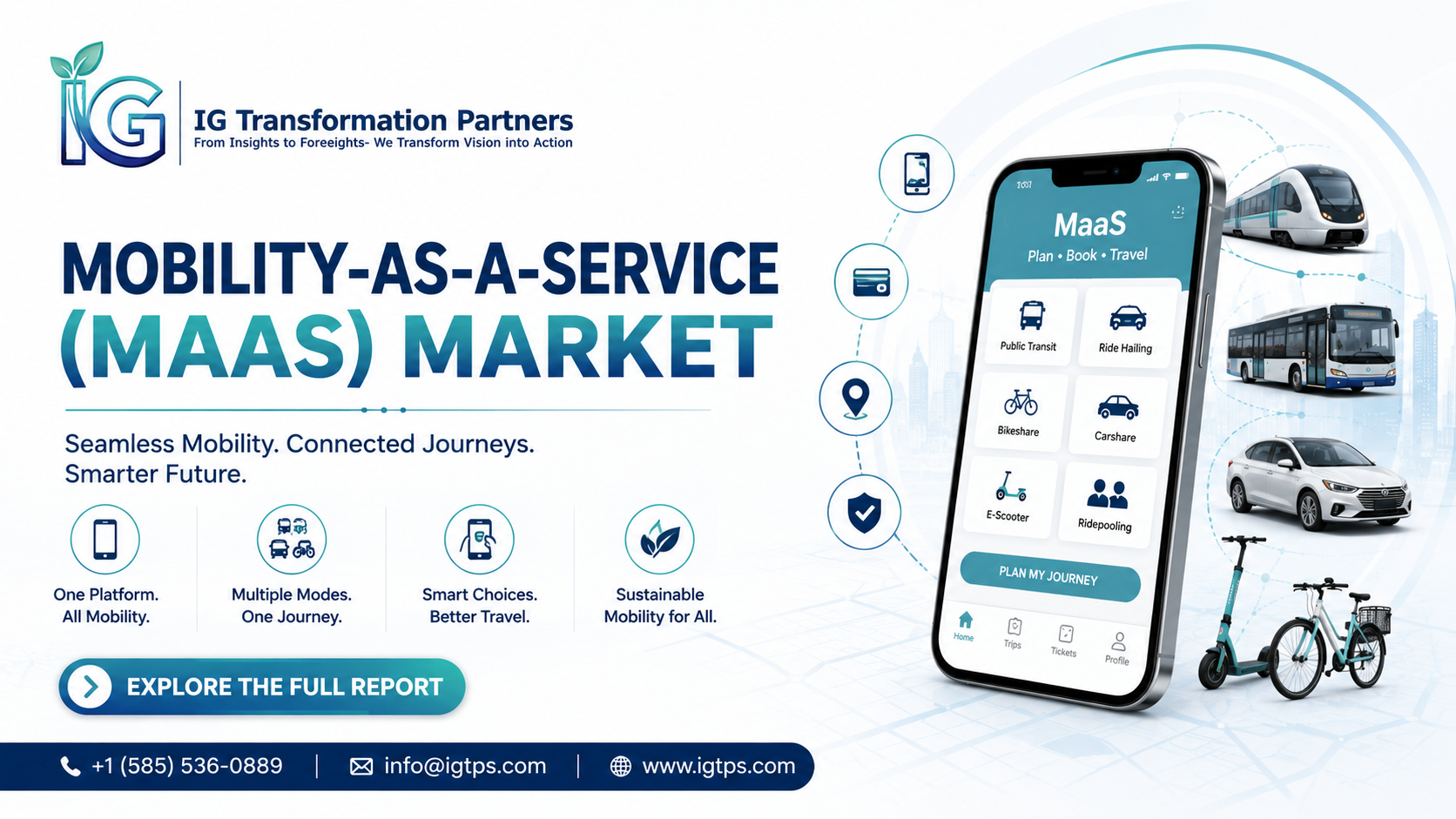
The global Mobility-as-a-Service (MaaS) Market is transforming the way people plan, book, and pay for transportation, moving away from vehicle ownership toward flexible, on-demand access to a wide range of mobility options. Instead of relying on a single mode of transport, MaaS platforms integrate public transit, ride-hailing, car sharing, bike sharing, and micro-mobility services into a single digital interface, allowing users to plan and pay for entire multi-modal journeys through one application.
This shift reflects a broader change in consumer attitudes, particularly among urban populations, who increasingly view transportation as a service to be accessed on demand rather than an asset to be owned. Rising urbanization, growing congestion in major cities, and increasing environmental awareness are all reinforcing this shift toward integrated, shared, and sustainable mobility solutions.
For cities and transportation authorities, MaaS also represents an opportunity to reduce private vehicle dependency, ease traffic congestion, and improve overall transportation efficiency by encouraging the use of public transit and shared mobility options alongside traditional private car usage.
Understanding the Mobility-as-a-Service Market
The Mobility-as-a-Service Market covers digital platforms and services that integrate multiple transportation modes into a unified, user-friendly system for trip planning, booking, and payment. A typical MaaS platform might allow a user to plan a journey that combines a train ride, a shared bicycle, and a ride-hailing trip, all booked and paid for through a single application without needing separate accounts or payment methods for each service.
These platforms typically operate through partnerships between technology providers, public transit authorities, private mobility operators, and payment processors, requiring significant coordination to integrate real-time data, scheduling, and payment systems across multiple independent transportation providers.
Unlike traditional standalone ride-hailing or transit applications, MaaS platforms are designed to optimize entire journeys across multiple transportation modes, often incorporating real-time data on traffic conditions, service availability, and pricing to recommend the most efficient or cost-effective travel option for each specific trip.
Key Growth Drivers of the Mobility-as-a-Service Market
One of the primary drivers of the Mobility-as-a-Service Market is rapid urbanization and the resulting increase in traffic congestion across major global cities. As urban populations grow, cities are increasingly seeking solutions that reduce private vehicle dependency and make more efficient use of existing transportation infrastructure.
Growing environmental awareness and sustainability goals are also accelerating MaaS adoption. Both consumers and city governments are increasingly prioritizing transportation options that reduce carbon emissions, making integrated public transit and shared mobility solutions an attractive alternative to private car ownership.
The widespread adoption of smartphones and mobile payment technology has been a critical enabler of MaaS growth, as these platforms depend entirely on the ability to plan, book, and pay for multi-modal journeys through a single mobile application.
Rising interest from public transit authorities in improving service integration and ridership is another significant growth driver. Many cities are actively partnering with MaaS platform providers to make public transit more accessible and convenient, particularly by integrating first-mile and last-mile solutions such as bike sharing and ride-hailing services.
Additionally, growing corporate and employer interest in offering MaaS-based transportation benefits to employees is creating a new demand segment, as businesses look for ways to reduce parking demands and support sustainable commuting options for their workforce.
Technological Advancements Supporting Market Growth
Technological innovation continues to shape the Mobility-as-a-Service Market through the development of advanced trip-planning algorithms, real-time data integration, and seamless payment processing systems. Artificial intelligence is playing an increasingly important role in optimizing route recommendations, predicting demand patterns, and personalizing mobility options based on individual user preferences and travel history.
Open data standards and application programming interfaces (APIs) are becoming essential infrastructure for MaaS platforms, enabling different transportation providers to share real-time schedule, pricing, and availability data in a standardized format that can be integrated into a single user-facing application.
Integration with autonomous vehicle technology is also emerging as a future growth area, as companies explore how self-driving shuttles and ride-hailing vehicles could eventually be incorporated into MaaS platforms, potentially reducing operating costs and expanding service availability in underserved areas.
Blockchain and digital identity technologies are being explored by some platform providers as a way to simplify cross-border and cross-operator payment processing, potentially enabling more seamless MaaS experiences for travelers moving between different cities or countries.
Advancements in mobile payment and digital wallet integration continue to reduce friction in the MaaS user experience, allowing for faster checkout processes and more flexible subscription-based pricing models that bundle multiple transportation modes into a single monthly fee.
Market Segmentation Analysis
The Mobility-as-a-Service Market can be segmented based on service type, transportation mode, end user, and region.
Based on service type, the market includes ride-hailing, car sharing, bike and scooter sharing, and public transit integration. Public transit integration is increasingly viewed as a foundational component of successful MaaS platforms, as it provides the backbone for affordable, high-capacity mobility that private services alone cannot replicate at scale.
By transportation mode, the market covers a mix of shared vehicles, micro-mobility options, and traditional public transportation systems. Combining these modes effectively is central to the value proposition of MaaS platforms, which aim to offer users the most efficient option for any given trip regardless of which operator provides it.
The end-user segments include individual consumers, corporate and employer mobility programs, and public sector transportation authorities. Corporate mobility programs are expected to see strong growth as businesses increasingly offer flexible transportation benefits as part of broader efforts to support hybrid work arrangements and sustainable commuting.
Regional Market Insights
Europe leads the Mobility-as-a-Service Market, supported by strong public transit infrastructure, high urban density, and proactive government policies encouraging integrated and sustainable mobility solutions across cities in Finland, Germany, the Netherlands, and the United Kingdom.
Asia-Pacific represents a rapidly growing regional market, driven by dense urban populations, expanding public transit networks, and strong consumer adoption of ride-hailing and micro-mobility services across major cities in China, Japan, South Korea, and Southeast Asia.
North America is also expanding steadily, supported by growing interest from both public transit authorities and private mobility operators in improving service integration, alongside rising corporate adoption of MaaS-based employee transportation benefits.
Emerging markets across Latin America, the Middle East, and Africa are beginning to explore MaaS solutions as urbanization accelerates and cities seek scalable alternatives to reduce congestion and improve transportation access for growing populations.
Challenges in the Mobility-as-a-Service Market
Despite strong growth potential, the Mobility-as-a-Service Market faces several challenges. Achieving effective integration between public transit authorities and private mobility operators remains complex, as these organizations often operate with different data systems, business models, and regulatory requirements.
Regulatory uncertainty across different cities and regions can also complicate MaaS platform expansion, as varying rules governing ride-hailing, micro-mobility, and data sharing create a fragmented compliance landscape for platform providers operating across multiple markets.
Ensuring reliable service availability across all integrated transportation modes remains an ongoing challenge, as inconsistent service quality from any single partner operator can undermine the overall user experience and trust in the broader MaaS platform.
Profitability remains a significant concern for many MaaS providers, as the business model often depends on thin margins across multiple service partnerships, requiring platforms to achieve substantial scale before becoming financially sustainable.
Emerging Opportunities in the Mobility-as-a-Service Market
The future of the Mobility-as-a-Service Market presents significant opportunities through continued urbanization, growing corporate adoption of mobility benefits, and increasing government investment in integrated transportation infrastructure.
Rising interest in subscription-based mobility bundles, which combine public transit, ride-hailing, and micro-mobility services into a single monthly fee, is expected to become a major growth area as consumers seek predictable and simplified transportation costs.
Growing integration with autonomous vehicle technology is also creating long-term opportunities, as self-driving shuttles and ride-hailing services could eventually reduce operating costs and expand service availability, particularly in suburban and underserved areas.
Continued expansion of open data standards and API integration is expected to further improve the ability of MaaS platforms to incorporate a wider range of transportation providers, strengthening the overall value proposition for users and expanding addressable market opportunities.
Role of IG Transformation Partners in Market Intelligence
As the Mobility-as-a-Service Market continues evolving through technological innovation, changing consumer preferences, and expanding government support for integrated transportation, organizations require reliable market intelligence to identify growth opportunities and make informed strategic decisions. IG Transformation Partners provides comprehensive market research, competitive benchmarking, technology analysis, industry forecasting, and strategic consulting that help businesses understand the dynamic MaaS landscape.
The company's research offers detailed insights into market size, regional demand, competitive landscape, pricing trends, investment opportunities, emerging technologies, and regulatory developments. Through extensive primary research and in-depth industry analysis, IG Transformation Partners enables mobility platform providers, transit authorities, investors, and policymakers to develop effective business strategies and strengthen their market position.
Whether organizations are launching new MaaS platforms, evaluating investment opportunities, or entering new geographic markets, IG Transformation Partners provides actionable market intelligence that supports sustainable growth and long-term business success.
Future Outlook of the Mobility-as-a-Service Market
The future of the Mobility-as-a-Service Market remains highly promising as urbanization, sustainability goals, and changing consumer attitudes toward vehicle ownership continue to reshape transportation preferences worldwide. Continuous innovation in trip-planning algorithms, open data integration, and subscription-based pricing models will continue driving market expansion.
Growing corporate adoption, expanding public transit partnerships, and rising integration with autonomous vehicle technology are expected to create substantial opportunities for MaaS platform providers. Companies focusing on seamless integration, regulatory compliance, and sustainable business models will be well positioned to capitalize on the evolving market landscape.
Conclusion
The Mobility-as-a-Service Market continues to reshape how people move through cities by offering integrated, flexible, and sustainable alternatives to private vehicle ownership. As urbanization accelerates and consumer attitudes shift away from ownership toward on-demand access, MaaS platforms are positioned to play an increasingly central role in the future of urban transportation.
Supported by rising urbanization, growing sustainability priorities, and continuous technological innovation, the market offers significant opportunities for mobility platform providers, transit authorities, investors, and technology developers. Businesses that invest in seamless integration, regulatory navigation, and sustainable business models will be well positioned to benefit from the long-term growth of the global Mobility-as-a-Service industry.
For detailed market insights, growth forecasts, competitive analysis, and strategic opportunities, explore the complete report here: https://www.igtps.com/report/mobility-as-a-service-maas-market
FAQs
1. What is the Mobility-as-a-Service (MaaS) Market?
The MaaS Market includes digital platforms that integrate public transit, ride-hailing, car sharing, and micro-mobility services into a single application for trip planning, booking, and payment.
2. What factors are driving the Mobility-as-a-Service Market?
Major growth drivers include rapid urbanization, growing environmental awareness, widespread smartphone adoption, and increasing public transit and corporate partnerships.
3. Which region leads the Mobility-as-a-Service Market?
Europe leads the market, supported by strong public transit infrastructure and proactive government policies encouraging integrated mobility solutions.
4. What are the major service types within the MaaS Market?
The market includes ride-hailing, car sharing, bike and scooter sharing, and public transit integration services.
5. What challenges does the market face?
Key challenges include complex integration between public and private operators, regulatory uncertainty, inconsistent service reliability, and profitability pressures.
6. Why is public transit integration important for MaaS platforms?
Public transit provides the affordable, high-capacity backbone that private mobility services alone cannot replicate at scale, making it essential to successful MaaS platforms.
7. What is the future outlook for the Mobility-as-a-Service Market?
The market is expected to see strong long-term growth driven by rising urbanization, subscription-based mobility bundles, and growing integration with autonomous vehicle technology.

 Arabic
 Français
 Español
 Português
 Deutsch
 Türkçe
 Dutch
Dutch
 Italiano
 Russian
 Romaian