


Building an AI-Augmented Finance Team Without Compromising Control
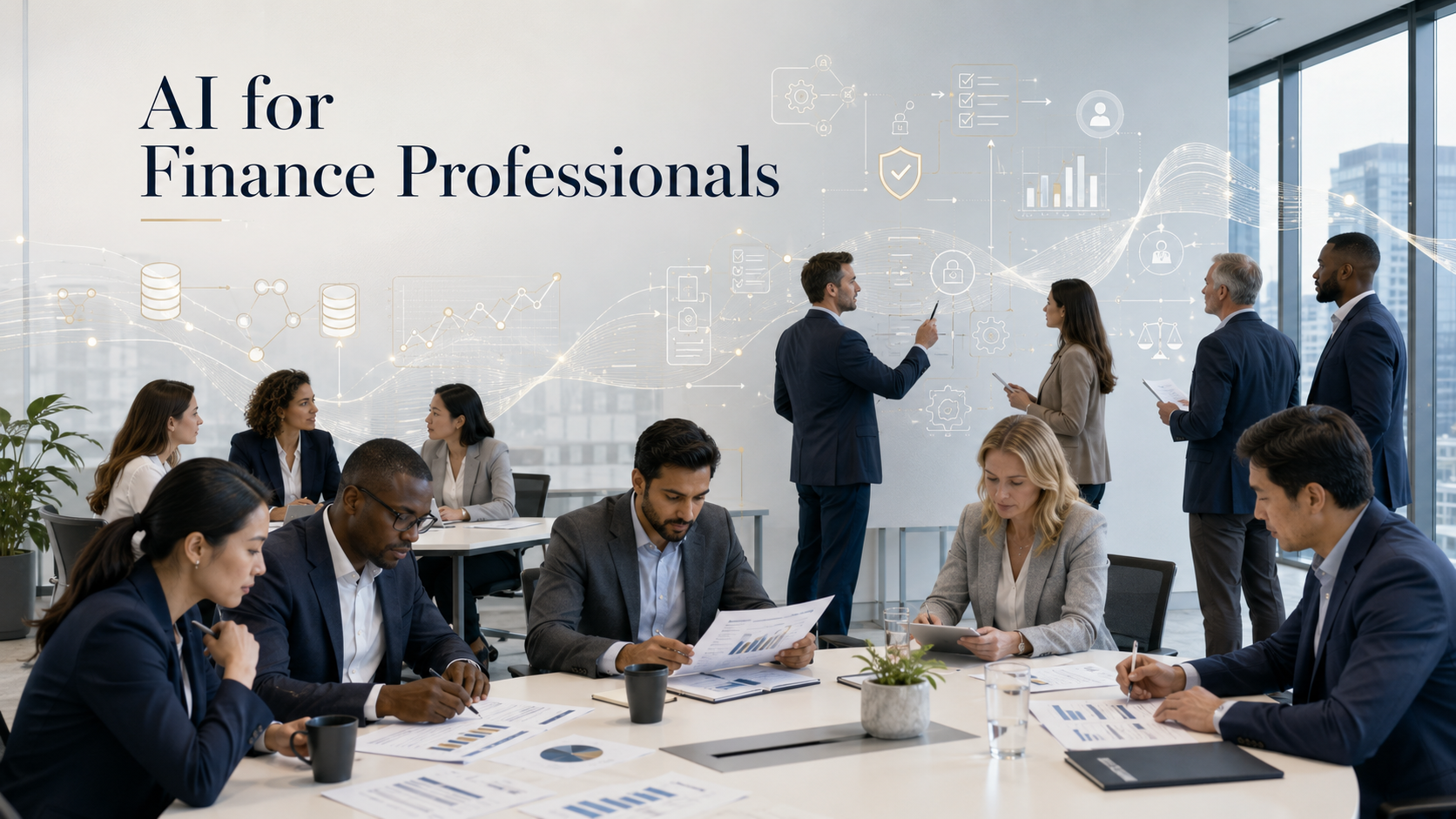
Finance teams are expected to deliver faster forecasts, cleaner close cycles, sharper board insights, and stronger control assurance. Yet many professionals still spend hours consolidating spreadsheets, drafting variance commentary, checking reconciliations, and translating raw data into management-ready narratives.
This is where an AI for Finance Professionals Course can create practical value. The objective is not to automate financial judgment. It is to help analysts, controllers, auditors, treasury specialists, and finance leaders use artificial intelligence to complete repeatable work faster while preserving accuracy, confidentiality, and accountability.
Why Finance Needs a Controlled AI Adoption Model
Finance is different from most business functions because every output may influence investment decisions, regulatory reporting, cash planning, tax positions, or executive action. A weak AI response is not merely inconvenient; it can create financial and reputational risk.
That is why corporate AI training for finance teams must extend beyond generic prompting. Professionals need to understand data classification, verification, audit trails, human approval, and the limitations of generative models. AI adoption should strengthen financial discipline rather than bypass it.
Where AI Can Improve Daily Finance Work
The strongest use cases are often found in high-volume analytical and documentation activities. In FP&A, AI can assist with variance analysis, forecast scenarios, management commentary, and board-pack preparation. Controllers can use it to support reconciliations, exception detection, journal-entry drafts, and close coordination.
Internal auditors may accelerate workpaper preparation and full-population testing, while treasury teams can improve cash-flow analysis and covenant monitoring. Tax professionals can organise research, compare regulatory interpretations, and structure documentation for expert review.
Make Advanced Analysis Accessible to Non-Coders
Modern tools can also reduce dependence on engineering teams. AI-powered financial analysis through advanced data analysis, AI-assisted Excel, and natural-language SQL can help finance professionals clean datasets, identify trends, and query enterprise information without writing complex code.
However, every calculation and generated explanation must be reconciled to approved source data. The finance professional remains responsible for the conclusion.
Benefits That Matter to the CFO Office
A well-designed AI finance training programme can shorten analysis cycles, improve consistency, and release capacity for higher-value activities. Instead of spending most of the month preparing information, teams can devote more time to challenging assumptions, advising business leaders, and identifying emerging risks.
AI can also improve communication. Complex financial results can be translated into clear narratives for boards, investors, regulators, and operational stakeholders. This supports faster decisions without diluting financial substance.
Best Practices for Responsible Implementation
Begin with two or three measurable workflows rather than attempting enterprise-wide automation immediately. Define the baseline time, error rate, review effort, and expected outcome before introducing AI.
Organisations should also establish:
-
Approved AI platforms and access controls
-
Green, amber, and red data classifications
-
Mandatory source validation and human sign-off
-
Documentation standards for AI-assisted work
-
Periodic reviews of vendors, models, and data rights
These controls make responsible AI in finance operational rather than theoretical.
Build Finance Capability Around Real Work
NovelVista’s 28-hour blended programme covers 13 modules across FP&A, controllership, Excel, SQL, audit, treasury, tax, board communication, vendor evaluation, risk management, and a finance-workflow capstone. It is designed for working finance professionals and can be adapted to an organisation’s technology stack and business objectives.
The future finance function will not be defined by automation alone. It will be defined by professionals who can combine AI speed with financial judgment, regulatory awareness, and disciplined validation.
Explore NovelVista’s AI for Finance Professionals Course to build practical, governed AI capability across your finance lifecycle. Request a customised corporate proposal aligned with your team’s workflows, systems, and transformation priorities.
Transform AI from an isolated productivity tool into a controlled finance capability. Explore NovelVista’s AI for Finance Professionals Course and request a customised corporate programme for your FP&A, accounting, audit, treasury, tax, and finance leadership teams.

 English
 Arabic
 Français
 Español
 Português
 Deutsch
 Dutch
Dutch
 Italiano
 Russian
 Romaian