


Deep Learning Practitioner Training for Production-Ready AI Skills
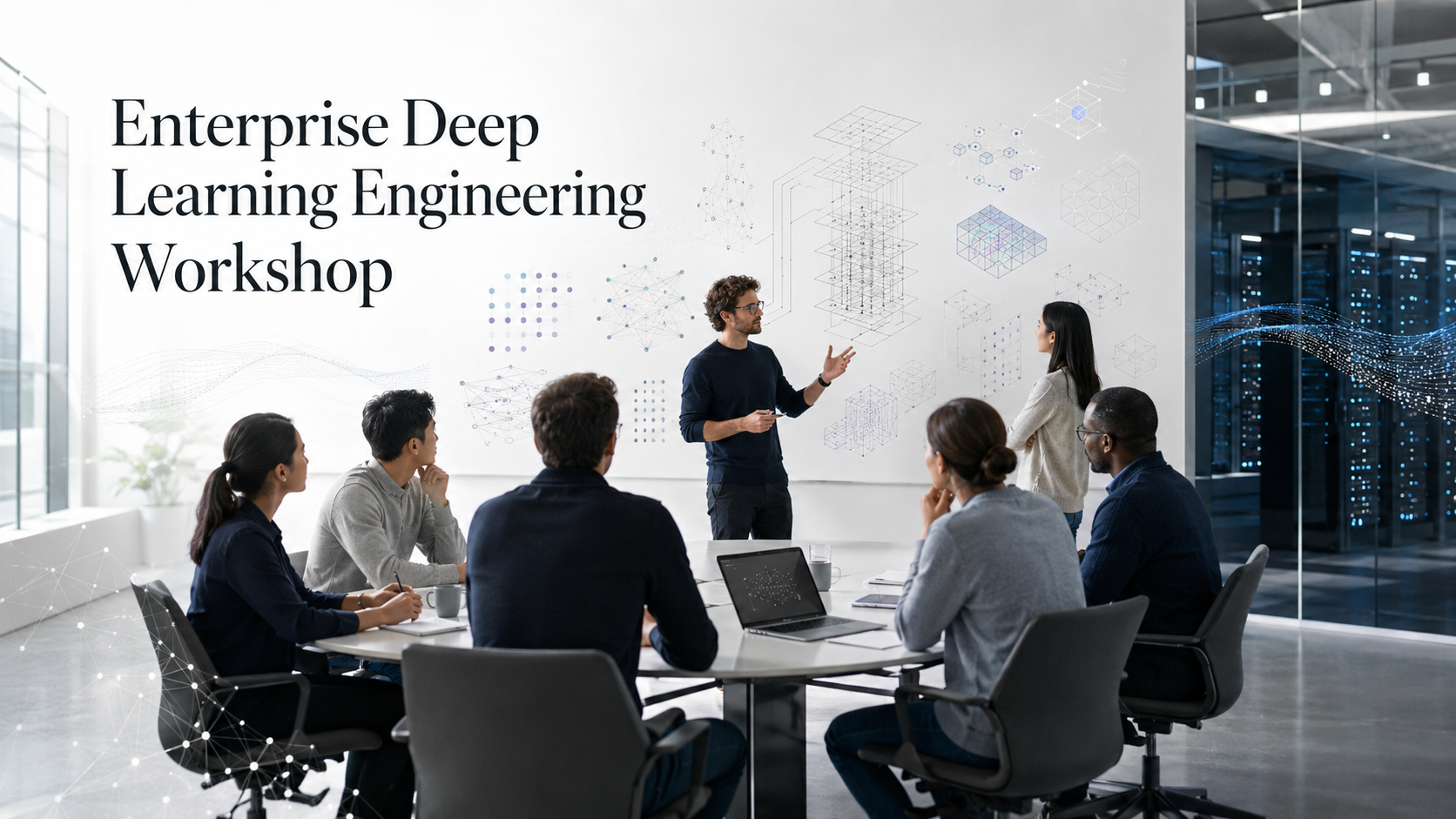
Deep learning has moved from research labs into everyday business systems. Recommendation engines, computer vision, generative AI, speech technologies, multimodal applications, and intelligent assistants all rely on neural networks that can learn complex patterns from large datasets. For technical professionals, understanding these systems at an engineering level is becoming increasingly important. A Deep Learning Practitioner course can provide the structured pathway needed to move from classical machine learning into modern AI development.
Why Deep Learning Skills Matter Now
Many engineers can use pre-built AI APIs, but fewer understand what happens inside the model. That knowledge gap becomes a problem when teams need to fine-tune models, diagnose unstable training, reduce inference costs, or deploy models under production constraints.
Strong deep learning training helps professionals understand representation learning, gradient descent, loss functions, optimisers, neural network architectures, and model behaviour. Instead of treating AI frameworks as black boxes, learners develop the ability to reason about why a model succeeds, why it fails, and how to improve it.
Build Practical PyTorch Engineering Skills
PyTorch has become an important framework for developing and experimenting with modern neural networks. Effective PyTorch training should go beyond basic library demonstrations. Learners need experience with tensors, autograd, training loops, schedulers, mixed precision, debugging, and performance optimisation.
This foundation prepares professionals to build convolutional neural networks for vision tasks and progressively work with more advanced architectures. Hands-on implementation also creates stronger intuition than simply calling high-level libraries without understanding the underlying engineering.
From Transformers to Multimodal AI
Modern deep learning skills increasingly require an understanding of transformers. Professionals should know how attention works, how transformer architectures process information, and how pre-trained models can be adapted for specific business tasks.
A practical deep learning certification programme should also expose learners to the Hugging Face ecosystem, fine-tuning techniques, Vision Transformers, multimodal systems, and diffusion models. These technologies are relevant to applications involving text generation, image understanding, document intelligence, visual search, content generation, and enterprise AI assistants.
Production Deployment Is the Real Differentiator
Training a model is only part of the job. Enterprise AI teams must also consider latency, scalability, compute requirements, model size, reproducibility, monitoring, and deployment reliability.
This is where production deep learning training creates significant value. Professionals who understand quantisation, model optimisation, distributed training, experiment tracking, and inference serving are better prepared to move AI prototypes into dependable services.
For larger workloads, knowledge of distributed approaches can also help teams use multiple GPUs efficiently while controlling training time and infrastructure costs.
Learn Through End-to-End Projects
Deep learning is best learned by building. Teams should work with realistic problems, train and compare models, analyse failures, optimise performance, and deploy their final solution. A portfolio-grade capstone can connect every stage of the learning journey while giving participants evidence of practical capability.
For software engineers transitioning into AI, ML engineers, junior data scientists, and applied AI practitioners, this project-based approach helps bridge the gap between conceptual knowledge and production responsibility.
Build Deep Learning Capability for Modern AI
Deep learning remains the technical foundation behind transformers, generative AI, computer vision, multimodal models, and many emerging intelligent systems. Organisations that want to develop stronger internal AI capabilities therefore need professionals who understand both model architecture and production engineering.
NovelVista’s Deep Learning Practitioner training provides corporate teams with a hands-on learning pathway covering PyTorch, modern neural architectures, transformers, model optimisation, deployment, and applied project work. Explore the programme to develop practitioners who can move confidently from neural-network fundamentals to production-ready AI solutions.
Strengthen your organisation’s advanced AI capabilities with practical, engineering-focused learning. Explore NovelVista’s Deep Learning Practitioner course and request a customised corporate training programme aligned with your technology stack and AI projects.
 Deutsch
 English
 Arabic
 Français
 Español
 Português
 Türkçe
 Dutch
Dutch
 Italiano
 Russian
 Romaian