


Data Analysis Assignment Help: A Complete Guide for Students
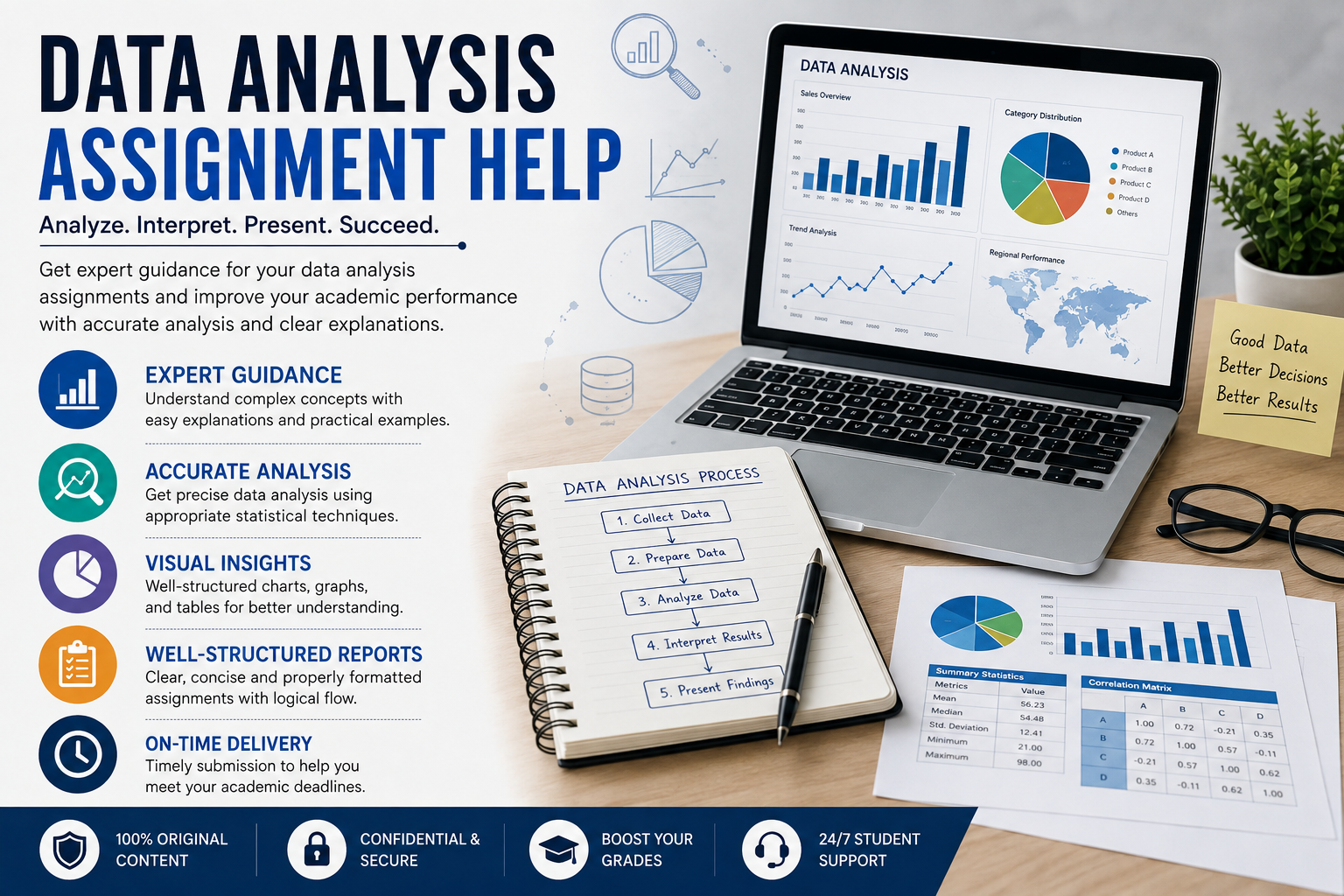
Data analysis has become an essential part of modern education, research, business, healthcare, technology, and social sciences. Students across different academic disciplines are increasingly required to collect information, interpret datasets, identify patterns, and present meaningful conclusions. Although working with data can be interesting, data analysis assignments can also be challenging because they require a combination of statistical knowledge, analytical thinking, research skills, and technical accuracy.
Students may need to work with spreadsheets, statistical methods, graphs, charts, surveys, or large datasets while completing their coursework. Understanding which analytical method to use and explaining the results clearly can take considerable time. Data Analysis Assignment Help can provide academic guidance to students who want to understand analytical concepts, organize their research, and improve the quality of their assignments.
What Is Data Analysis?
Data analysis is the process of examining information to identify useful patterns, relationships, trends, and conclusions. It can involve collecting data, cleaning datasets, applying analytical techniques, interpreting results, and communicating findings.
Depending on the subject and assignment requirements, students may work with:
- Quantitative data
- Qualitative data
- Survey responses
- Experimental results
- Business datasets
- Financial information
- Research observations
- Statistical reports
The purpose of analysis is not simply to produce numbers or charts. Students must understand what the results mean and explain how they relate to the research question.
Why Are Data Analysis Assignments Challenging?
Understanding Statistical Methods
Students may encounter statistical concepts such as averages, percentages, correlation, regression, probability, hypothesis testing, and standard deviation. Selecting an appropriate method can be difficult when several techniques appear relevant.
Working With Large Datasets
Large datasets can contain hundreds or thousands of individual observations. Cleaning and organizing this information requires patience and attention to detail. Missing values, duplicate records, or inconsistent entries can affect the results.
Interpreting Results
Producing a statistical result is only one part of an assignment. Students must explain what the result indicates and connect it to their research objectives. Poor interpretation can weaken an otherwise accurate analysis.
Presenting Findings Clearly
Tables, charts, graphs, and written explanations need to work together. Students must choose suitable visual formats and explain their findings in a way that readers can easily understand.
How Data Analysis Assignment Help Can Benefit Students
1. Better Understanding of Analytical Concepts
Academic guidance can help students understand difficult data analysis concepts through straightforward explanations and practical examples. This can make it easier to apply analytical methods independently in future assignments.
2. Improved Research Skills
Data analysis is closely connected with research. Students need to understand how data is collected, categorized, evaluated, and interpreted. Academic support can help learners develop a more structured research approach.
3. Assistance With Data Interpretation
Numbers can sometimes be misleading if they are interpreted without considering the research context. Guidance can help students understand how to discuss findings responsibly and distinguish between meaningful patterns and unsupported conclusions.
4. Stronger Academic Presentation
A good data analysis assignment should have a logical structure. Students need to introduce the research problem, explain their methodology, present findings, discuss results, and reach a suitable conclusion. Proper guidance can help improve the overall presentation.
Common Types of Data Analysis Assignments
Statistical Analysis
Statistical assignments may require students to examine numerical data using descriptive or inferential techniques. The task may involve calculating statistical measures and explaining their significance.
Survey Data Analysis
Survey-based assignments require students to examine responses and identify patterns or trends. Students may need to categorize answers, calculate percentages, and discuss relationships between variables.
Business Data Analysis
Business students may analyze sales figures, customer behavior, market information, or financial data. These assignments often focus on identifying trends that could support business decisions.
Research Data Analysis
Research assignments may involve analyzing data collected through experiments, interviews, observations, or questionnaires. Students must explain their methodology and connect findings with the research objectives.
Steps for Completing a Data Analysis Assignment
Understand the Research Question
Before analyzing data, students should identify exactly what the assignment is asking them to investigate. A clear research question provides direction for the entire analysis.
Prepare the Dataset
The quality of the data should be checked before applying analytical methods. Students should identify missing information, duplicate entries, unusual values, and other potential issues.
Select an Appropriate Method
Different research questions require different analytical approaches. Students should understand why a particular method is suitable rather than selecting a technique simply because it is commonly used.
Analyze the Information
After selecting an appropriate method, students can conduct their analysis and organize the results. Calculations and analytical procedures should be performed carefully.
Interpret the Findings
The results should be explained in relation to the research question. Students should avoid making claims that are not supported by the available evidence.
Present the Results
Charts, tables, and graphs can make complex findings easier to understand. However, each visual should have a clear purpose and be accompanied by an appropriate explanation.
Tips for Improving Data Analysis Assignments
Students can strengthen their academic work by following a few practical strategies:
- Read the assignment instructions carefully.
- Define the research question before beginning analysis.
- Keep datasets organized.
- Check calculations and analytical procedures.
- Use appropriate tables and visualizations.
- Explain findings rather than simply listing numbers.
- Support interpretations with credible academic sources.
- Proofread the final assignment carefully.
These habits can help students improve both their analytical abilities and academic writing.
Choosing Suitable Data Analysis Assignment Help
Students who seek academic guidance should focus on educational value and quality. A suitable support provider should understand statistical concepts, research methods, and academic writing requirements.
Subject Knowledge
Data analysis is used across many disciplines, so relevant subject knowledge is important. An analytical approach suitable for a business assignment may not necessarily be appropriate for a psychology or scientific research project.
Clear Explanations
Effective academic guidance should explain the reasoning behind analytical decisions. Understanding why a method is used helps students develop skills that they can apply to future projects.
Original Research
Students should use original analysis and credible research materials. Academic support should encourage independent learning and respect institutional academic integrity policies.
Attention to Accuracy
Data analysis depends heavily on accuracy. Incorrect calculations, poorly organized datasets, or misleading interpretations can affect the quality of an assignment.
The Growing Importance of Data Analysis Skills
Data literacy is becoming increasingly valuable in education and professional environments. Organizations use data to understand customers, evaluate performance, identify risks, and make strategic decisions.
Learning how to analyze and communicate data can therefore provide students with transferable skills. These abilities can be useful in areas such as business, finance, healthcare, marketing, research, technology, and public policy.
Data analysis assignments give students an opportunity to develop these skills in an academic environment. Although the tasks may initially appear complicated, regular practice and appropriate guidance can make the learning process more manageable.
Conclusion
Data analysis assignments require more than mathematical calculations. Students need to understand research questions, organize information, select appropriate analytical techniques, interpret results, and communicate findings clearly.
Data Analysis Assignment Help can provide valuable academic guidance for students who are struggling with statistical concepts, research methods, data interpretation, or assignment organization. By combining suitable support with independent study and regular practice, students can strengthen their analytical abilities and become more confident when working with data.
Developing strong data analysis skills can benefit students far beyond a single assignment. It can prepare them for future research projects, professional responsibilities, and a world where informed decisions increasingly depend on accurate and meaningful data.

 English
 Arabic
 Français
 Español
 Português
 Deutsch
 Türkçe
 Dutch
Dutch
 Russian
 Romaian