


Computer Vision with AI Training for Production-Ready Engineering Teams
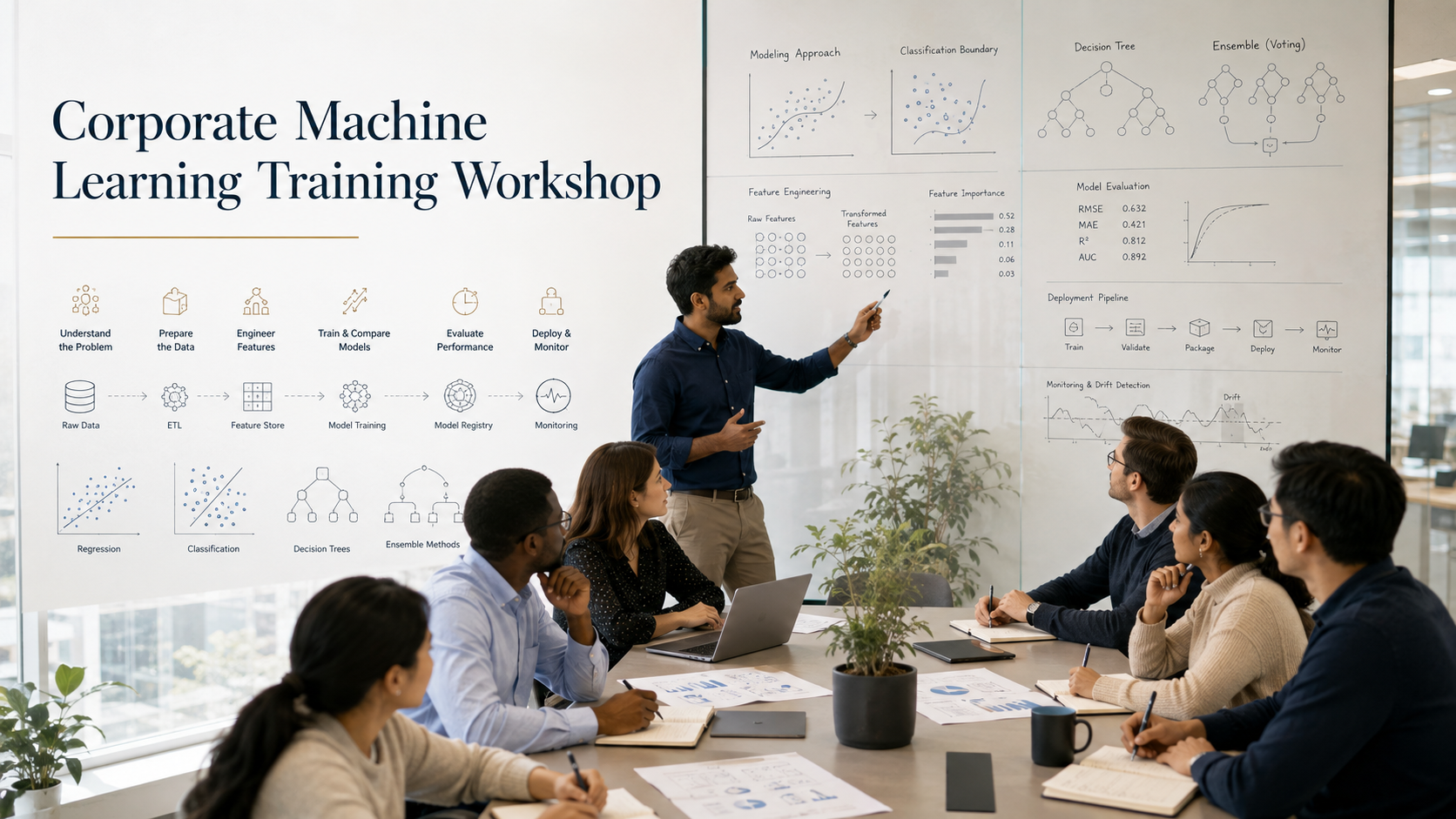
Computer vision is changing how organisations inspect products, monitor operations, understand physical environments, and automate visual decision-making. Manufacturing teams use it for defect detection, retailers for shelf intelligence, healthcare teams for imaging workflows, and security operations for visual analytics. Yet building reliable vision systems requires much more than training a model on sample images. A Computer Vision with AI course helps engineering teams understand the complete path from image data to deployable, governed AI systems.
Modern Computer Vision Goes Far Beyond Basic CNNs
Traditional image classification remains useful, but enterprise computer vision now includes object detection, segmentation, pose estimation, tracking, vision transformers, multimodal models, and foundation models. Engineers need to understand which architecture fits a specific operational problem instead of choosing a model simply because it is popular.
Practical computer vision corporate training should expose learners to classical image processing and modern architectures such as YOLO, DETR, SAM 2, and Vision Transformers. This helps teams compare speed, accuracy, hardware requirements, annotation effort, and deployment complexity before committing to a production design.
Data Quality Can Decide Whether a Vision Project Succeeds
Computer vision systems depend heavily on visual dataset quality. Poor annotations, inconsistent lighting, class imbalance, camera changes, or weak augmentation strategies can undermine even advanced models.
That is why computer vision training for engineers should include annotation workflows, dataset quality checks, augmentation, active learning, and evaluation. Engineers must know how to measure mAP, IoU, confusion matrices, and inter-annotator agreement while investigating model failures.
These practices matter in manufacturing, healthcare, retail, document intelligence, and security, where incorrect visual decisions can carry operational or regulatory consequences.
Production Deployment Creates the Real Business Value
A model that works inside a notebook is not automatically ready for an edge device, production camera, mobile application, or cloud inference service. Real deployments introduce latency limits, memory constraints, GPU costs, connectivity issues, and changing data distributions.
A strong advanced computer vision course therefore needs to cover TensorRT, ONNX, quantisation, edge deployment, and performance optimisation. Learning to reduce inference latency and model size helps engineers build solutions that work within actual enterprise infrastructure.
MLOps Keeps Vision Systems Reliable After Launch
Visual environments change continuously. Cameras are replaced, packaging changes, new object classes appear, and lighting shifts. These changes can create data drift and gradually reduce model accuracy.
Understanding MLOps for computer vision enables teams to track experiments, monitor performance, detect drift, manage retraining cycles, and maintain clear documentation. Model cards and system cards can also support governance by explaining intended use, limitations, datasets, performance, and risks.
Responsible Computer Vision Needs Human Oversight
Vision technologies can introduce privacy, surveillance, bias, and fairness concerns. Systems involving people require especially careful governance. Teams should evaluate whether a use case is appropriate, what data is necessary, how long it should be retained, and where human review belongs.
This makes responsible AI an important component of modern computer vision AI training rather than an optional compliance topic.
Build Computer Vision Capability That Can Ship
NovelVista’s Computer Vision Corporate Course is designed for ML engineers, computer vision engineers, robotics engineers, applied scientists, embedded developers, and senior software engineers building production vision solutions. The programme combines GPU labs with modern architectures, edge deployment, MLOps, responsible AI, and an industry-focused capstone.
For organisations investing in visual AI, the goal is to develop teams that can move confidently from raw images and annotations to monitored, production-ready computer vision systems.
Turn computer vision experiments into deployable enterprise solutions. Explore NovelVista’s Computer Vision with AI course and request a customised corporate training programme aligned with your team’s technology stack, industry use cases, and production requirements.
 Deutsch
 English
 Arabic
 Français
 Español
 Português
 Türkçe
 Dutch
Dutch
 Italiano
 Russian
 Romaian