


Why Production-Ready Agentic AI Requires More Than Prompt Engineering
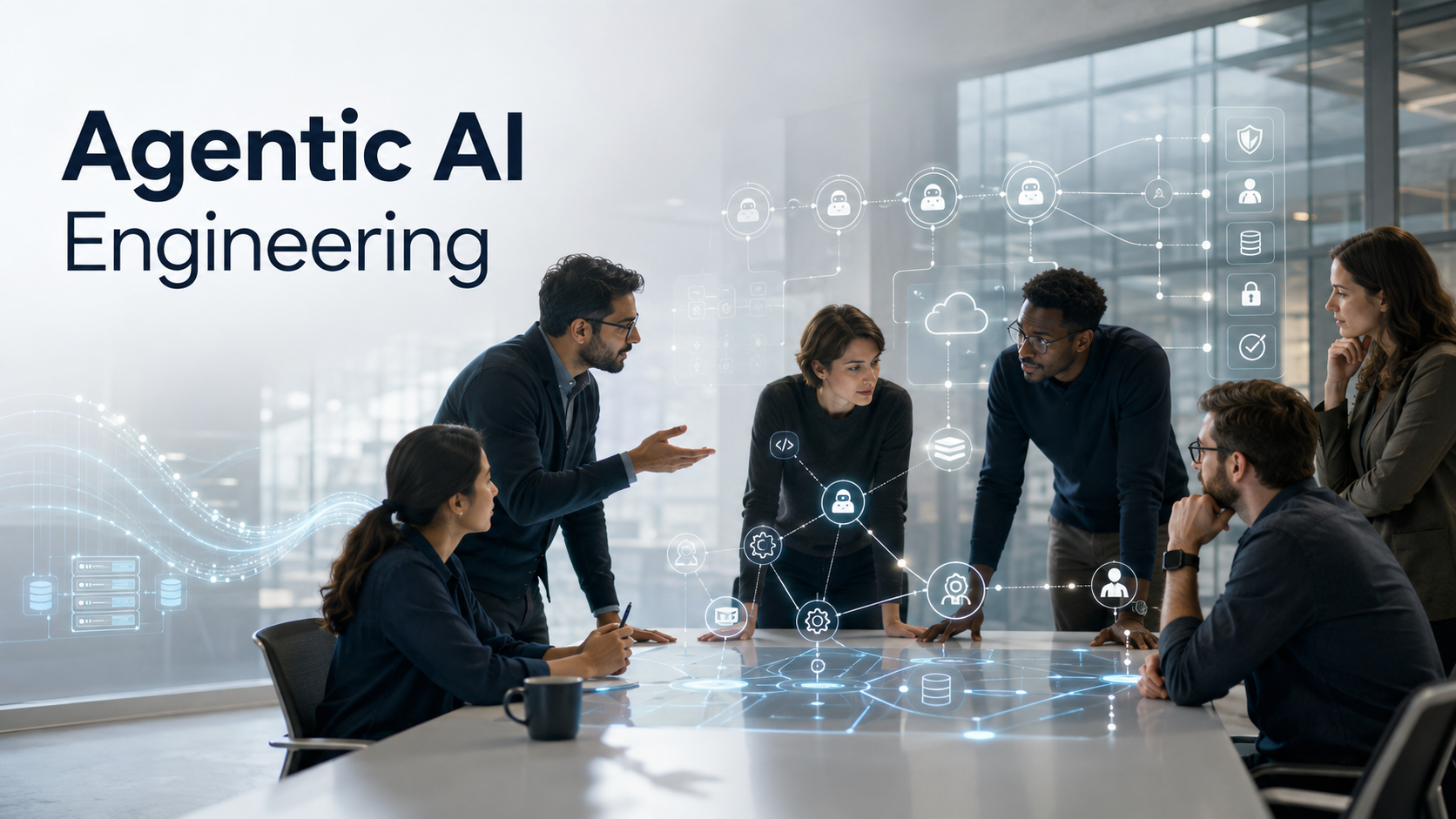
Agentic AI has moved quickly from experimental prototypes to serious enterprise conversations. Building an agent that can call a tool, retrieve information, or complete a multi-step task is no longer the hardest part. The real challenge begins when that agent must operate reliably across changing data, APIs, users, permissions, and business rules.
This is why Agentic AI Engineering is becoming a critical capability for technology teams. Organizations need engineers who can move beyond impressive demonstrations and design systems that are observable, secure, cost-aware, resilient, and ready for real workloads.
The Hidden Gap Between a Working Demo and Production
A prototype often runs in a controlled environment. Production does not.
An enterprise agent may need to interact with multiple tools, maintain state, recover from failed API calls, manage context, respect access controls, and produce outputs that can be evaluated. A weakness in one step can cascade through an entire workflow.
For this reason, production-grade AI agents require more than prompt engineering. Engineers need to understand architecture patterns, tool orchestration, memory, evaluation, tracing, human oversight, and failure recovery.
Architecture Should Follow the Problem
Not every workflow needs a complex multi-agent system. Sometimes a deterministic pipeline is safer, faster, and cheaper. In other cases, supervisor-worker, planner-executor, or critic-loop patterns can provide the flexibility a complex task requires.
A practical Agentic AI course should teach engineers how to choose an architecture based on the business problem rather than forcing every use case into one framework.
Reliability Is the New Competitive Advantage
The organizations that gain value from agents will be those that can operate them consistently.
That means engineering for retries, fallbacks, validation, latency, token usage, and graceful degradation. It also means implementing AI agent observability so teams can understand what an agent decided, which tools it used, where a workflow failed, and how much execution cost.
Evaluation is equally important. Without systematic testing, teams may know an agent “usually works” but cannot confidently measure whether it performs well enough for deployment.
Multi-Framework Skills Reduce Technology Lock-In
The agent ecosystem continues to evolve. Engineers may encounter OpenAI Agents SDK, LangGraph, CrewAI, AutoGen, or other orchestration technologies depending on the project.
Learning only one framework can limit architectural judgement. Strong Agentic AI training develops transferable engineering principles first, then applies them across frameworks. This helps teams select tools according to orchestration complexity, deployment constraints, and governance requirements.
The same principle applies to Model Context Protocol (MCP), which is increasingly relevant for connecting agents with tools and enterprise resources in a standardized way.
How Teams Can Build Production Readiness
Start with a narrow business workflow and measurable outcomes. Define what the agent can do, what it cannot do, and when a human must intervene. Add tracing and evaluation before expanding autonomy. Test tool failures deliberately. Track latency and cost. Finally, review security and rollback paths before broader deployment.
These practices turn agent development from experimentation into disciplined engineering.
Build Agentic AI Capability That Survives Production
NovelVista’s Agentic AI Engineering Bootcamp is designed for technical teams that want to build and ship real agentic systems rather than stop at prototypes. The programme covers agent architectures, major orchestration frameworks, MCP, memory, observability, evaluation, guardrails, reliability, and production-focused capstone work.
For organizations preparing engineers to lead real-world AI initiatives, structured corporate Agentic AI training can shorten the distance between experimentation and dependable delivery.
Explore the Agentic AI Engineering Bootcamp and discuss a customized learning path aligned with your team’s technology stack and business objectives.

 English
 Arabic
 Français
 Español
 Português
 Deutsch
 Türkçe
 Dutch
Dutch
 Russian
 Romaian