


Cloud Computing Explained for Modern Businesses and Everyday Users
Introduction
Technology moves fast, and few shifts have changed the way we work and live as much as the rise of remote, internet-based computing power. Whether you are streaming a movie, backing up photos from your phone, or running a multinational company's payroll system, chances are you are relying on a network of remote servers rather than a single machine sitting in an office closet. This shift has a name, and understanding it is no longer optional for anyone who uses a smartphone, a laptop, or a business application. In this guide, we will break down the concept in plain language, look at how it actually works behind the scenes, and explore why it has become the backbone of the modern digital economy.
What Is Cloud Computing
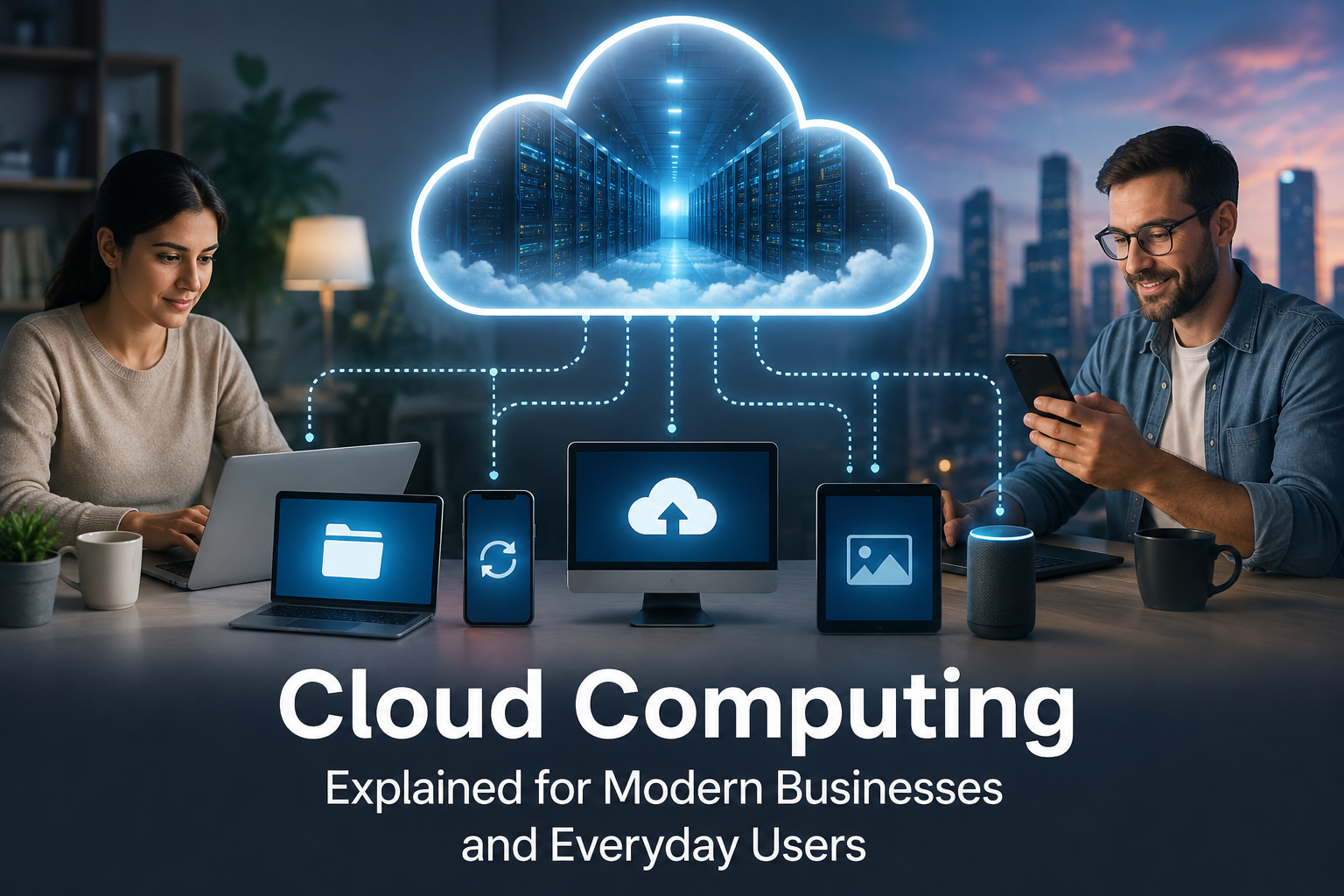
At its core, cloud computing is the delivery of computing services, including servers, storage, databases, networking, software, and analytics, over the internet rather than through equipment owned and maintained locally. Instead of buying physical hardware and installing software on individual machines, organizations and individuals can rent access to these resources from a provider and pay only for what they use. This model removes the need for large upfront investment in servers and data centers, and it allows resources to scale up or down instantly based on demand.
Many people first encounter the idea without realizing it. Sending an email through a web-based service, saving a document to an online drive, or watching a show on a streaming platform all involve remote infrastructure doing the heavy lifting. That infrastructure, hosted far away in specialized facilities and accessed through the internet, is the practical face of this technology in everyday life.
How Cloud Computing Works
Understanding how this system functions helps explain why it has become so widely adopted. Large providers build enormous data centers filled with thousands of interconnected servers. These facilities are designed with redundancy in mind, meaning that if one server fails, another can take over almost instantly without the end user noticing any disruption. Virtualization software divides the physical hardware into multiple virtual machines, allowing many customers to share the same physical infrastructure while keeping their data completely separate and secure.
When a person or company uses cloud computing, their request travels over the internet to one of these data centers, where the appropriate resources process the task and send the result back. This entire process typically happens in milliseconds, which is why applications feel instant even though the actual processing might be happening thousands of miles away. Providers also build in automated systems that monitor traffic and shift workloads dynamically, ensuring that performance stays consistent even during sudden spikes in usage.
Types Of Cloud Computing Services
Not every application built on remote infrastructure looks the same, and providers generally organize their offerings into a few broad categories. Infrastructure as a service gives customers raw computing power, storage, and networking, leaving them free to install and manage their own operating systems and applications on top. Platform as a service goes a step further by offering a ready-made environment where developers can build and deploy applications without worrying about the underlying servers. Software as a service delivers a finished application directly to the user through a browser, with the provider handling everything from maintenance to security updates.
Each of these models suits different needs. A startup building a custom application might prefer the flexibility of infrastructure services, while a small business looking for accounting software would likely choose a finished product delivered as a service. This flexibility is part of what makes modern cloud computing appealing across such a wide range of industries, from healthcare to entertainment to manufacturing.
Benefits Of Cloud Computing for Businesses
The appeal of moving operations to remote infrastructure goes well beyond convenience. Cost savings are often the first benefit companies notice, since there is no need to purchase, house, or maintain expensive physical servers. Instead, businesses pay a predictable subscription or usage-based fee, which frees up cAPItal for other priorities. Scalability is another major advantage; a company experiencing rAPId growth can add resources within minutes rather than waiting weeks for new hardware to arrive and be configured.
Collaboration also improves significantly. Teams spread across different cities or countries can access the same files and applications simultaneously, which has become especially important as remote and hybrid work arrangements have become standard practice. Disaster recovery is another quiet but powerful benefit, since data stored across multiple redundant locations is far less likely to be lost due to a local hardware failure, fire, or natural disaster. Together, these advantages explain why so many organizations, from small startups to global enterprises, have shifted at least part of their operations toward remote infrastructure.
Cloud Computing Security Considerations
No conversation about remote infrastructure is complete without addressing security, since handing data over to a third party naturally raises questions. Reputable providers invest heavily in protective measures, including encryption of data both while it travels and while it sits in storage, strict access controls, and continuous monitoring for suspicious activity. Many providers also hold independent certifications that verify their practices meet recognized industry standards.
That said, security in this environment is a shared responsibility. Providers secure the underlying infrastructure, but customers must still configure their accounts correctly, manage user permissions carefully, and keep credentials safe. Businesses adopting cloud computing should treat security as an ongoing process rather than a one-time setup, regularly reviewing who has access to what and staying alert to emerging threats.
The Future of Cloud Computing
Looking ahead, this technology shows no sign of slowing down. Emerging trends such as edge processing, which brings computation closer to where data is generated, and artificial intelligence integration are pushing capabilities even further. As more devices connect to the internet and generate data, the demand for flexible, remote infrastructure will likely keep growing. For businesses and individuals alike, developing a solid understanding of this technology is quickly becoming as fundamental as understanding how the internet itself works, and those who embrace it early are positioning themselves to adapt more easily as the digital landscape continues to evolve.

 English
 Arabic
 Español
 Português
 Deutsch
 Türkçe
 Dutch
Dutch
 Italiano
 Russian
 Romaian