


Key Components of a Decentralized Prediction Market
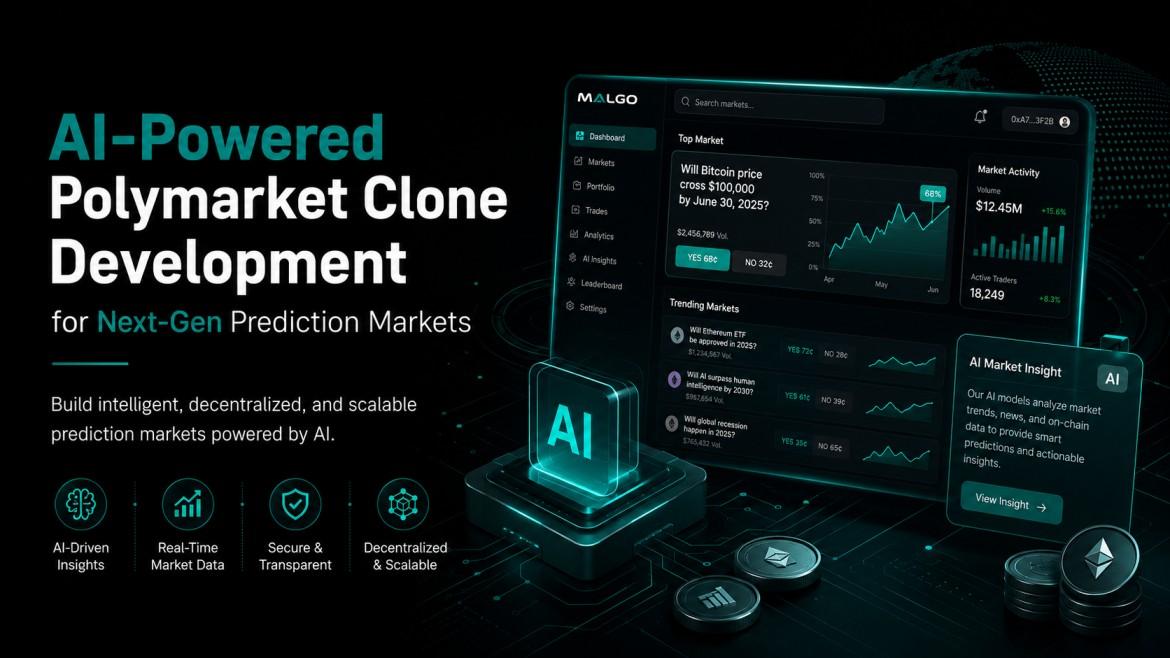
A decentralized prediction market brings together blockchain infrastructure, market intelligence, transparent trading, and automated settlement to let users trade positions on the possible outcomes of real-world events. Unlike conventional prediction platforms, decentralized systems can reduce reliance on a central operator by using smart contracts and publicly verifiable transaction records. For businesses exploring this model, polymarket clone development can serve as a practical starting point for understanding how event-based prediction platforms are structured, customized, and deployed for different market requirements.
The strength of a decentralized prediction market does not come from a single feature. It depends on several interconnected components working together—from market creation and liquidity management to oracle-based outcome verification and blockchain settlement. Each component has a specific role in maintaining transparency, usability, security, and market integrity.
1. Smart Contracts
Smart contracts form the operational foundation of a decentralized prediction market. They can automate important processes such as market creation, position management, collateral handling, trading rules, and settlement.
Because the contract logic is deployed on a blockchain, predefined conditions can be executed without requiring manual intervention for every transaction. Well-designed smart contracts should also account for edge cases, disputed outcomes, invalid markets, and settlement rules before deployment.
For a production-grade platform, contract development should include code review, testing, security assessment, and clearly documented business logic.
2. Prediction Market Engine
The prediction market engine manages the core logic behind event-based markets. It determines how users interact with available outcomes and how those positions change as market sentiment develops.
A capable market engine should support:
- Event and outcome creation
- Market status management
- Position tracking
- Order or trade processing
- Market suspension
- Resolution workflows
- Settlement coordination
- Historical market data
The engine should be designed for flexibility because prediction markets can cover a broad range of subjects, including sports, finance, politics, technology, entertainment, and other measurable events.
3. Blockchain Infrastructure
Blockchain provides the transparent transaction layer for a decentralized prediction platform. Depending on the product strategy, developers may select a network based on transaction throughput, ecosystem maturity, wallet compatibility, developer tooling, and user experience.
The blockchain layer can record relevant transactions and provide an auditable history of market activity. However, not every platform operation necessarily needs to happen directly on-chain. A carefully designed architecture can balance decentralization with performance by determining which operations require blockchain verification and which can be handled through supporting infrastructure.
4. Oracle and Outcome Verification System
A prediction market is only as reliable as its ability to determine the outcome of an event correctly. This is where oracle infrastructure becomes critical.
Oracles connect external information with blockchain-based applications. They can provide verified information used to determine whether a market should resolve in favor of a particular outcome.
A robust outcome-verification system should consider:
- Reliable data sources
- Data aggregation
- Timestamping
- Resolution conditions
- Conflicting information
- Exceptional or cancelled events
- Dispute mechanisms
Clear resolution rules are particularly important. Users should be able to understand what source determines the result and what happens if the expected data becomes unavailable or contradictory.
5. Liquidity Mechanism
Liquidity directly affects the quality of the trading experience. A market with limited liquidity can experience wider spreads, poor execution, and difficulty entering or exiting positions.
Decentralized prediction platforms can use different liquidity models depending on their market design. These may include order-book-based trading, automated market-making mechanisms, liquidity pools, or hybrid approaches.
The appropriate mechanism depends on factors such as market size, expected trading activity, supported assets, and the type of users the platform is designed to serve.
6. Trading and Order Management
The trading layer gives participants the tools required to express their views on potential outcomes. Depending on the platform architecture, users may place orders against other participants or interact with an automated liquidity mechanism.
A well-structured trading system should provide:
- Buy and sell functionality
- Real-time market information
- Order status updates
- Position management
- Trade history
- Market depth or liquidity information
- Transaction confirmation
Fast and understandable trade execution is important because prediction markets can experience rapid changes when new information becomes available.
7. Wallet Integration
Wallet connectivity provides the bridge between users and blockchain-based markets. A decentralized prediction platform should make wallet interaction straightforward while maintaining strong security practices.
Common wallet functionality includes connecting an account, viewing supported assets, signing transactions, checking balances, and reviewing transaction history.
The user interface should clearly distinguish between actions that require a blockchain signature and ordinary platform interactions. This reduces confusion and helps users understand what they are authorizing.
8. User Authentication and Access Control
Although decentralized applications can use wallet-based authentication, additional access-control mechanisms may still be necessary depending on the platform's operational model.
A mature platform may require controls for administrators, market creators, moderators, compliance teams, or other authorized roles. Role-based permissions can help prevent unauthorized changes to sensitive platform functions.
Security should be considered across both decentralized and conventional application layers rather than treating blockchain integration as a complete security solution.
9. Market Creation and Administration
Market creation tools allow authorized users or platform operators to define new prediction events. These tools should make the market's rules explicit before trading begins.
Important market parameters can include:
- Event description
- Available outcomes
- Trading start and end conditions
- Resolution criteria
- Oracle or data source
- Settlement conditions
- Market status
- Dispute procedures
Administrative controls should also provide visibility into unusual activity, unresolved markets, disputed results, and operational issues.
10. Dispute Resolution Mechanism
Not every real-world event produces an immediately clear result. News reports can conflict, official results can be revised, or an event can be cancelled altogether.
A decentralized prediction market therefore needs a clearly defined dispute-resolution framework. Depending on the architecture, this could involve designated resolution processes, decentralized governance, arbitration mechanisms, or predefined fallback rules.
The most important principle is predictability: participants should know the resolution procedure before committing to a market.
11. Data Indexing and Analytics
Blockchain data is transparent, but raw blockchain records are not always convenient for everyday users. Indexing infrastructure can organize transaction and market data into searchable information that the application can display efficiently.
Analytics can help users understand:
- Market activity
- Trading volume
- Historical outcomes
- Price movements
- Open positions
- Liquidity trends
- Participant activity
For operators, analytics can also support platform monitoring, market performance evaluation, and detection of unusual behavior.
12. Security and Risk Controls
Security should be integrated into every layer of a decentralized prediction market rather than added after development.
Important areas include smart-contract security, wallet interactions, API protection, access control, transaction validation, data integrity, infrastructure monitoring, and protection against market manipulation.
Developers should also test scenarios such as abnormal trading activity, oracle failures, duplicate transactions, unexpected market states, and smart-contract edge cases. Independent security reviews can provide another layer of assurance before a platform is introduced to users.
13. User-Friendly Interface
Decentralization happens behind the technology, but users experience the product through the interface. Even sophisticated blockchain infrastructure can struggle to gain adoption if users cannot easily understand how a market works.
A strong interface should make the following information immediately clear:
What is the event?
Users should understand exactly what they are predicting.
What are the available outcomes?
Each outcome should have an unambiguous definition.
How is the market resolved?
The data source and resolution conditions should be easy to find.
What does the current market indicate?
Relevant market information should be presented without unnecessary complexity.
What happens after the market closes?
Settlement and resolution should be clearly explained.
14. Governance Layer
Governance can become important as a decentralized prediction market expands. A governance framework may determine how certain platform rules, market disputes, protocol upgrades, or ecosystem decisions are handled.
The exact governance model depends on the project's decentralization goals. Some platforms may retain operational control over selected functions, while others may distribute decision-making among token holders, designated participants, or decentralized organizations.
The key is to define governance responsibilities clearly so users know which decisions are automated and which require human or community intervention.
Why These Components Matter
A decentralized prediction market is essentially an interconnected ecosystem. Smart contracts provide programmable execution, blockchain infrastructure supplies transparent settlement, oracles connect external events to on-chain logic, liquidity mechanisms support trading, and the application layer turns complex infrastructure into a usable product.
When these components are designed independently without considering how they interact, weaknesses can emerge between system layers. For example, a technically secure smart contract cannot compensate for ambiguous market-resolution rules, while a sophisticated trading interface cannot solve unreliable outcome data.
For that reason, successful prediction market development requires an architecture that considers security, transparency, liquidity, scalability, market integrity, and user experience as connected requirements.
Frequently Asked Questions
What is the most important component of a decentralized prediction market?
There is no single component that determines the quality of a prediction market. Smart contracts, outcome oracles, liquidity infrastructure, trading logic, blockchain settlement, and security controls must work together to create a dependable platform.
How do decentralized prediction markets determine outcomes?
They typically rely on predefined resolution rules and external data supplied through an oracle or another verification mechanism. The market's rules should specify which source is authoritative and how exceptional situations are handled.
Why are oracles important in prediction markets?
Blockchains cannot independently access most real-world information. Oracle infrastructure provides external event data that can be used to trigger market-resolution logic.
What blockchain features are important for prediction market development?
Transaction efficiency, ecosystem support, wallet compatibility, developer tooling, network reliability, and the ability to handle the platform's expected activity are among the factors developers typically evaluate.
Can a decentralized prediction market support different event categories?
Yes. The underlying architecture can be designed to support multiple categories, provided each market has clearly defined outcomes, reliable data sources, appropriate resolution conditions, and rules that users can understand before trading.
Final Takeaway
Building a decentralized prediction market involves considerably more than adding blockchain transactions to a conventional trading application. The platform needs reliable market logic, transparent resolution, dependable data verification, sufficient liquidity, secure wallet interaction, robust administration, and an interface that makes the entire process understandable.
A thoughtful architecture brings these elements together into a system where users can see how markets operate, how outcomes are verified, and how positions are ultimately settled. That combination of technical reliability and user transparency is what gives a decentralized prediction market a strong foundation for long-term adoption.

 English
 Arabic
 Français
 Español
 Português
 Deutsch
 Türkçe
 Italiano
 Russian
 Romaian