The hospitality industry is undergoing a pronounced technological metamorphosis. Hotels, resorts, restaurants, and other accommodation businesses increasingly depend on software to orchestrate reservations, guest services, billing, housekeeping, revenue management, and customer relationships. What was once a collection of disconnected administrative functions is becoming a more integrated digital ecosystem.
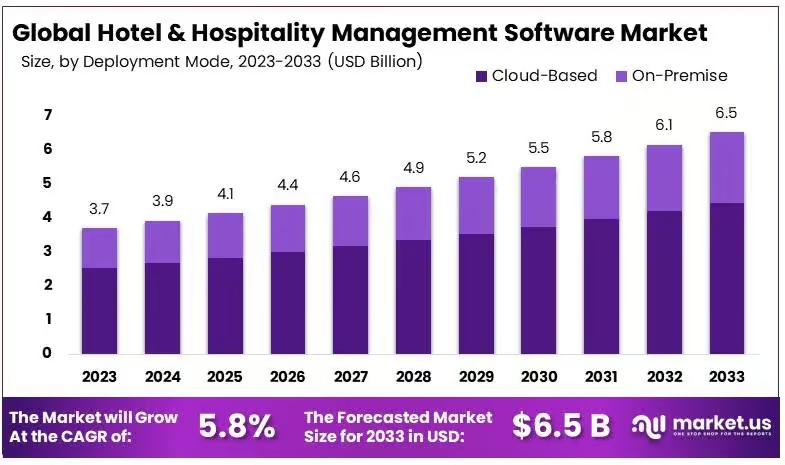
According to Market.us, the global Hotel and Hospitality Management Software Market was valued at USD 3.7 billion in 2023 and is projected to reach approximately USD 6.5 billion by 2033, expanding at a 5.8% CAGR from 2024 to 2033.
The trajectory reflects more than a technological upgrade. It signals a fundamental change in how hospitality businesses perceive operational intelligence, guest engagement, and commercial efficiency.
Get Sample PDF: https://market.us/report/hotel-and-hospitality-management-software-market/request-sample/
1. Evolution and Market Dynamics
Digital Transformation Across Hospitality Operations
Hotel management has traditionally involved an intricate web of manual procedures. Front-desk employees handled reservations and check-ins, housekeeping teams relied on room-status updates, finance departments processed payments, and managers consolidated operational information from multiple sources.
Modern software is gradually dismantling these silos.
Property Management Systems (PMS), Central Reservation Systems (CRS), Customer Relationship Management (CRM) platforms, Point-of-Sale (POS) systems, and Revenue Management Software can now coordinate different facets of hotel operations. Market.us identifies Property Management Systems as the leading software type, accounting for 26.5% of the market in 2023.
A sophisticated PMS, for instance, can centralize room availability, reservations, check-in and check-out procedures, billing, and staff coordination. This creates a single operational nerve center, allowing managers to obtain information without constantly reconciling disparate spreadsheets or applications.
The commercial implications are substantial. Better information flow can help hotels minimize administrative friction, identify operational bottlenecks, and respond more rapidly to fluctuations in demand.
Digital transformation is also influencing the guest journey. Online reservations, mobile check-ins, digital payments, automated communications, and personalized offers are increasingly becoming components of the hospitality experience. The result is an environment in which software is no longer merely a back-office instrument; it has become part of the guest-facing service architecture.
Growing Adoption of Cloud-Based and Automated Platforms
Cloud deployment has emerged as one of the strongest structural trends in the market. Market.us reports that cloud-based solutions represented 68.1% of the deployment segment in 2023, supported by scalability, accessibility, and cost advantages.
The appeal is particularly evident for businesses operating multiple properties. Cloud platforms can allow authorized personnel to access operational information remotely, facilitate software updates, and reduce dependence on extensive on-premise infrastructure.
Automation adds another dimension.
Routine activities such as reservation confirmations, payment processing, room-status updates, customer communications, and selected reporting tasks can be automated. This can reduce repetitive workloads and allow employees to devote greater attention to service-oriented responsibilities.
Cloud-based systems are also well suited to an increasingly mobile hospitality workforce. Managers can monitor occupancy, revenue, reservations, and operational indicators from different locations rather than remaining tethered to a particular workstation.
The broader market is therefore moving toward software environments characterized by flexibility, interoperability, and continuous accessibility.
2. Core Technologies and Emerging Trends
Property Management, Reservation, Revenue, and CRM Solutions
The hotel software ecosystem encompasses several specialized technologies, each addressing a particular operational requirement.
Property Management Systems form the central infrastructure for many hotels. They facilitate room inventory, reservations, guest profiles, billing, housekeeping coordination, and front-office activities. Central Reservation Systems, meanwhile, help manage booking availability across distribution channels and support centralized reservation processes.
Revenue Management Software addresses a different but equally consequential challenge: pricing. Hotels operate in an environment where demand can fluctuate according to seasonality, events, holidays, competition, and local economic conditions. Analytical tools can help properties evaluate these variables and adjust pricing strategies accordingly.
CRM software concentrates on the guest relationship. It can consolidate information about previous stays, preferences, interactions, and feedback, enabling hotels to develop more personalized communications and loyalty initiatives.
POS systems extend software functionality into restaurants, spas, bars, and other hotel-operated services.
Together, these technologies form an increasingly interconnected architecture. The strategic value lies not simply in having multiple applications, but in enabling them to exchange information efficiently.
However, integration remains an important consideration. Fragmented technology stacks can create duplicated data, multiple logins, inconsistent workflows, and operational friction. Recent hospitality discussions continue to highlight integration and usability as significant concerns for multi-property environments.
AI, IoT, Analytics, and Personalized Guest Experiences
Artificial intelligence is becoming an increasingly prominent component of hospitality technology. AI-powered systems can analyze operational and customer data to identify patterns, support forecasting, automate communications, and generate recommendations.
Revenue optimization is one notable application. Predictive analytics can help evaluate demand patterns and support pricing decisions. Guest-facing applications are another frontier, with intelligent systems capable of assisting travelers with common requests or recommending services based on available customer information.
IoT is expanding the technological perimeter even further. Smart thermostats, connected lighting, keyless entry systems, sensors, and other devices can communicate with management platforms. Market.us identifies IoT, blockchain, voice-enabled services, and sustainability-oriented technologies among the emerging trends influencing the market.
The guest experience can consequently become more responsive. A connected environment may allow room preferences, service requests, and operational information to flow between different systems with less human intervention.
Personalization is another major frontier. Guests increasingly expect interactions that feel relevant rather than generic. Software can help hospitality businesses analyze available customer information and tailor communications, offers, room preferences, and loyalty initiatives.
Yet personalization must be balanced with data governance. Hospitality companies handle sensitive information, including payment details and personal guest records. Strong cybersecurity, access controls, compliance mechanisms, and responsible data practices are therefore becoming indispensable components of modern hotel technology.
3. Market Opportunities and Future Outlook
Expansion Across Hotels, Resorts, and Other Hospitality Businesses
The addressable market extends well beyond large international hotel chains. Independent hotels, boutique properties, resorts, serviced accommodations, restaurants, and smaller hospitality establishments are increasingly potential users of digital management platforms.
This creates a particularly interesting opportunity for cloud-based Software-as-a-Service models. Smaller operators may prefer solutions that minimize infrastructure requirements and provide predictable subscription-based access to essential capabilities.
The Indian hospitality landscape illustrates this opportunity. Recent reporting has highlighted technology providers developing more accessible platforms for smaller hotels, guest houses, homestays, serviced apartments, and boutique properties that historically faced barriers related to cost and complexity.
Geographical expansion also creates substantial opportunities. Market.us reports that North America accounted for 37.4% of the global market in 2023, supported by its substantial hospitality sector, technological infrastructure, and adoption of cloud-based solutions.
At the same time, emerging tourism markets can generate demand as hotel inventories expand and operators seek standardized digital infrastructure.
The proliferation of mobile booking, contactless services, automated communications, and digital guest experiences further reinforces the need for software capable of connecting front-office and back-office operations.
Strategic Opportunities and Challenges Shaping Future Growth
The future of hotel management software will likely be defined by convergence. PMS, CRM, revenue management, payment systems, guest communication, analytics, and IoT technologies are increasingly expected to function as parts of a cohesive ecosystem.
AI could accelerate this convergence by acting as an analytical and operational layer across existing systems. Investment activity in the hospitality software sector already reflects growing interest in AI-driven capabilities. For example, a 2025 investment round valued hospitality software provider Mews at approximately USD 2.5 billion, with the company emphasizing AI-driven operational and guest-experience tools.
Nevertheless, market expansion will not be frictionless.
Implementation costs, employee training, cybersecurity, system compatibility, data migration, and resistance to technological change can complicate adoption. A sophisticated platform can still fail to deliver value if employees find its workflows cumbersome or if it cannot communicate effectively with existing systems.
Scalability will consequently become a decisive criterion. Hotels require technology that can evolve alongside their operations rather than forcing businesses into repeated system replacements.
The competitive landscape is also becoming more dynamic. Market.us identifies companies including Oracle Corporation, Agilysys, Amadeus Hospitality, Infor, Zoho Corporation, Maestro PMS, Sabre Hospitality, Cloudbeds, eZee FrontDesk, and Hotelogix among the key players.
Ultimately, the market's future rests on a deceptively simple proposition: hospitality technology must make operations easier without making the guest experience feel more technological.
The strongest platforms will likely be those that remain almost invisible to the traveler while empowering employees with better information, faster workflows, and more intelligent decision-making. As cloud infrastructure, automation, artificial intelligence, IoT, and analytics mature, hotel management software is poised to become an increasingly indispensable layer of the global hospitality ecosystem.





 English
 Arabic
 Français
 Español
 Português
 Deutsch
 Türkçe
 Italiano
 Russian
 Romaian