


Zipprr AI Chat: How One Support Team Cut Response Time 70%
Right now, thousands of support teams are quietly ripping up their old playbook and replacing it with something that never clocks out, never gets grumpy on a Friday afternoon, and never leaves a customer staring at a "typing..." bubble for twenty minutes.
Picture a mid-size online retailer selling home goods, the kind of business with maybe forty thousand orders a month and a support inbox that never stops filling up. Before they made any changes, their average first response time sat at eleven minutes during the day and ballooned past two hours overnight. Customers asking about order status, sizing, or return windows were stuck waiting behind a queue of tickets that all needed the same three or four answers.
The support manager, we will call her Priya for this story, had already tried the usual fixes: more agents during peak hours, a longer help center, canned responses for the top ten questions. None of it moved the needle much, because the real bottleneck was not agent skill or article quality. It was the gap between when a customer asked and when a human was free to answer.
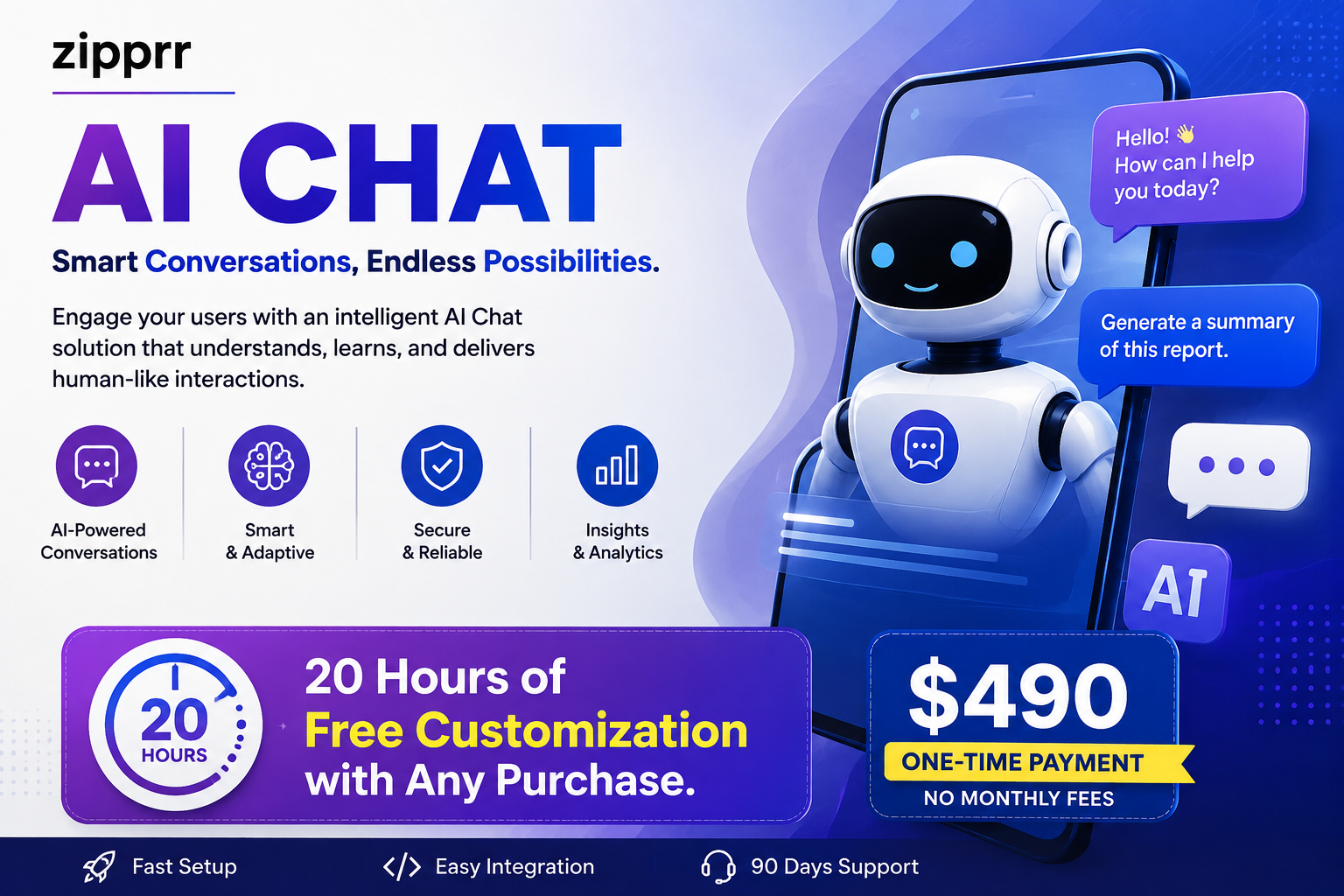
That gap is exactly what AI chat for customer support is built to close. Priya's team implemented Zipprr's AI Chat widget across their storefront and order confirmation emails, training it on their return policy, shipping timelines, and product specs. Within the first week, the assistant was handling roughly sixty percent of incoming conversations without any human involvement at all.
Here is the part that actually mattered to the business: response time did not just improve, it collapsed. Average first response dropped from eleven minutes to under ninety seconds during business hours, and overnight tickets that used to sit for hours were answered the moment they arrived. Across the full data set, that worked out to a seventy percent cut in overall response time once you blended day and night traffic together.
The mechanics behind that shift come down to intent recognition and natural language processing working together in the background. When a shopper types "where is my order," the system does not just match keywords. It identifies the intent behind the message, pulls the relevant order data, and responds in a tone that matches a helpful human rather than a rigid script. For messier questions, sentiment analysis flags frustration early, so an angry message about a damaged item gets escalated to a live agent before it turns into a public complaint.
Escalation is where a lot of chatbot projects fall apart. Nobody wants to get stuck arguing with a bot that cannot understand a refund dispute. Priya's team built clear escalation rules into their AI chat for customer support setup, so any conversation involving a complaint, a billing error, or three failed attempts to resolve an issue automatically routes to a human with full context attached. Agents were not fighting fires anymore; they were solving the problems that genuinely needed a person.
The ripple effects went beyond the response time metric. Customer satisfaction scores climbed eighteen points over the following quarter, largely because people got answers fast enough that a minor annoyance never had time to become a real grievance. Agent turnover also dropped, since the team was no longer buried under repetitive questions and had room to actually help people with complex situations.
What makes this kind of result achievable for smaller teams, not just big-budget retailers, is that the setup work is front-loaded and mostly one-time. Once the knowledge base is trained and the escalation paths are mapped, the system keeps running without needing constant babysitting. Priya's team reviews conversation logs weekly to spot new question patterns and update the assistant, but the daily grind of answering "is this in stock" a hundred times a day is gone.
If there is one lesson worth pulling from this story, it is that speed compounds. A fast answer prevents a frustrated follow-up message, which prevents a pile-up in the queue, which keeps every other customer's wait time shorter too. Teams exploring AI chatbot response time improvements often expect a modest bump in efficiency, but when the assistant is trained well and escalation is handled properly, the compounding effect is what produces numbers like a seventy percent cut.
Businesses evaluating conversational AI support tools today are increasingly looking at platforms like Zipprr's AI Chat not as a replacement for their team, but as the layer that catches the repetitive volume so agents can focus on nuance. That distinction matters, because customers can usually tell the difference between a tool that is trying to deflect them and one that is actually trying to help them faster. The retailers seeing real gains are the ones treating automated customer support chat as an extension of their support philosophy, not a shortcut around it. Set up thoughtfully, with clear escalation paths and a well-trained knowledge base, this kind of customer support automation turns a chronically backed-up inbox into a channel customers actually trust.
FAQ (8)
Q1: How much can AI chat actually reduce customer support response time?
A1: Results vary by business, but well-trained AI chat setups commonly cut average response time by 50 to 70 percent, mostly by eliminating queue wait time for routine questions. The biggest gains usually show up overnight and during peak hours when human staffing is thinnest.
Q2: Does adding AI chat mean replacing the support team?
A2: No, it means shifting the team's focus. The assistant absorbs repetitive, high-volume questions so human agents spend their time on complaints, edge cases, and conversations that genuinely need judgment and empathy.
Q3: How long does it take to set up an AI chat assistant for support?
A3: Basic setup, including training on FAQs, policies, and product data, typically takes one to three weeks depending on how organized the existing knowledge base is. Fine-tuning based on real conversation logs continues for the first couple of months.
Q4: What happens when the AI chat assistant cannot answer a question?
A4: A properly configured system escalates the conversation to a human agent automatically, passing along the full conversation history so the customer never has to repeat themselves. Clear escalation triggers, like repeated failed attempts or detected frustration, are essential to this working smoothly.
Q5: Can AI chat handle order status and account-specific questions?
A5: Yes, when the assistant is connected to order and account systems, it can pull real order data and answer specific questions like shipping status or delivery estimates instantly, rather than giving only generic answers.
Q6: Is AI chat only useful for large companies with huge ticket volumes?
A6: Smaller businesses often see proportionally bigger relief, since a handful of repetitive questions can overwhelm a lean team just as easily as a large one. The setup effort scales down with the business, not just the benefit.
Q7: How does sentiment analysis improve the support experience?
A7: Sentiment analysis flags frustration or anger in a customer's message early in the conversation, triggering a faster handoff to a human before the situation escalates further. It essentially gives support teams an early warning system.
Q8: Will customers notice they are talking to an AI assistant?
A8: Most well-trained assistants respond naturally enough that customers focus on getting their answer rather than on who or what provided it, but transparency about using AI chat when directly asked tends to build more trust than hiding it.
CTA
Curious what a seventy percent response time cut would look like for your own inbox? See how Zipprr AI Chat handles real support conversations before you commit to anything.

 Arabic
 Français
 Español
 Português
 Deutsch
 Türkçe
 Dutch
Dutch
 Italiano
 Russian
 Romaian