


10 Practical Ways Project Managers Can Use Generative AI to Improve Project Delivery
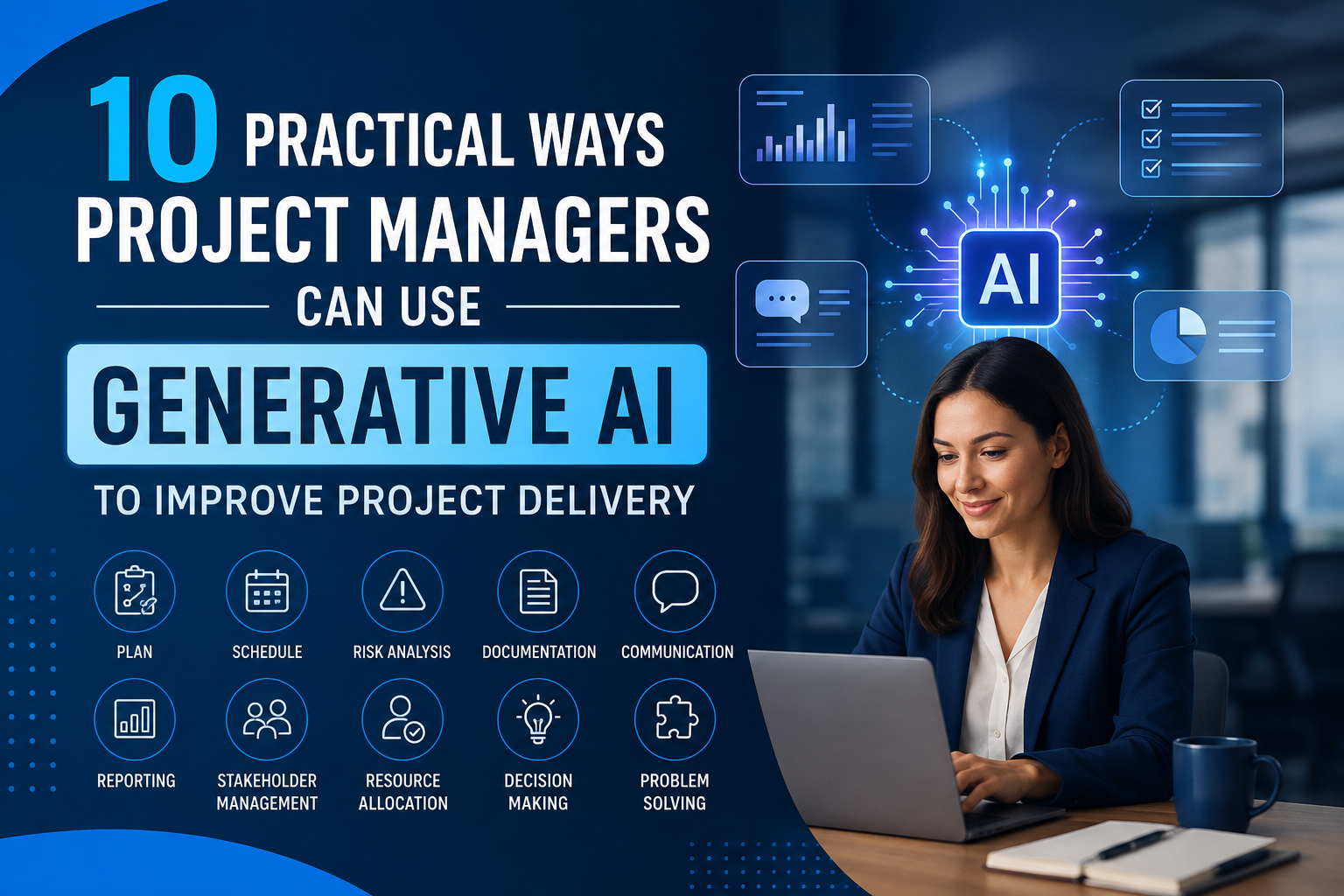
10 Practical Ways Project Managers Can Use Generative AI to Improve Project Delivery
Project managers are constantly balancing deadlines, budgets, resources, stakeholder expectations, risks, and documentation. As project environments become more complex, generative AI is emerging as a practical way to support many of these activities.
Rather than replacing project management expertise, AI can help professionals reduce repetitive work, organize information, explore alternatives, and make better use of their time.
Understanding Generative AI in Project Management can therefore help project professionals identify where AI can be applied effectively across the project lifecycle.
Here are 10 practical ways project managers can use generative AI to improve project delivery.
1. Create Project Plans Faster
Project planning involves defining objectives, deliverables, activities, timelines, dependencies, and responsibilities. Creating the initial structure can take considerable time, particularly for complex projects.
Generative AI can help project managers create an initial project plan based on defined objectives, scope, constraints, and expected outcomes.
For example, a project manager can provide the project requirements and ask AI to suggest:
-
Major project activities
-
Potential deliverables
-
Task dependencies
-
Milestones
-
Planning considerations
-
Questions that need clarification
The AI-generated plan should be reviewed and adjusted based on the actual project environment, but it can provide a useful starting point.
2. Support Project Scheduling
Scheduling requires project managers to consider activities, dependencies, resources, deadlines, and constraints.
Generative AI can help organize project activities and identify potential scheduling considerations. It can also help project managers explore alternative approaches when timelines change.
For example, if a critical milestone moves forward, AI can help generate possible questions and scenarios for assessing how the change could affect dependent activities.
The project manager remains responsible for validating the schedule and making the final decision.
3. Automate Routine Project Documentation
Documentation is an important part of project management, but it can also consume significant amounts of time.
Generative AI can assist with creating first drafts of:
-
Project updates
-
Meeting summaries
-
Project documentation
-
Requirements
-
Action-item lists
-
Status reports
-
Communication drafts
Instead of starting every document from scratch, project managers can use AI to structure information and then review the output for accuracy and completeness.
This can help reduce administrative workload while maintaining human oversight.
4. Improve Risk Identification
Risk management requires project teams to identify potential issues before they affect project objectives.
Generative AI can support brainstorming and risk identification by helping project managers explore different risk scenarios based on project characteristics.
For example, AI can help generate potential risks related to:
-
Schedule delays
-
Resource availability
-
Budget constraints
-
Dependencies
-
Stakeholder expectations
-
Technical challenges
-
Operational changes
Project managers can then evaluate these suggestions and determine which risks are actually relevant to the project.
5. Support Resource Planning
Allocating the right resources to the right activities is essential for successful project delivery.
Generative AI can help project managers organize information about project requirements, skills, workloads, and activities. It can also help identify questions that should be considered when assigning resources.
For example, a project manager could use AI to explore different resource allocation scenarios and compare their potential advantages and limitations.
However, resource decisions should consider real-world factors such as availability, experience, organizational priorities, and team dynamics.
6. Improve Stakeholder Communication
Project managers communicate with different groups throughout the project lifecycle. Executives may need concise progress updates, while project teams may require detailed information about tasks and responsibilities.
Generative AI can help adapt project communication for different audiences.
It can assist with:
-
Drafting project updates
-
Summarizing complex information
-
Creating stakeholder emails
-
Preparing meeting agendas
-
Structuring announcements
-
Converting detailed updates into executive summaries
This can make communication more consistent while allowing project managers to focus on the message, context, and stakeholder relationship.
7. Generate Better Project Reports
Project reporting requires project managers to collect information, organize it, and communicate project status clearly.
Generative AI can help transform structured project information into an initial report format. It can also help summarize updates and highlight areas that may require further attention.
For example, a project manager could use AI to structure a report around:
-
Completed activities
-
Upcoming milestones
-
Current issues
-
Project risks
-
Resource concerns
-
Key decisions
-
Action items
The project manager should verify the underlying information before sharing the report with stakeholders.
8. Support Project Decision-Making
Project managers regularly need to evaluate alternatives and make decisions under time constraints.
Generative AI can support this process by helping teams explore different options, identify potential advantages and disadvantages, and generate questions for further analysis.
For example, when evaluating two possible approaches to a project activity, AI can help structure a comparison based on factors such as time, resources, risks, and expected outcomes.
AI should support the decision-making process rather than become the final decision-maker. Project managers still need to apply professional judgment and consider information that AI may not have access to.
9. Improve Team Productivity
Many project teams spend time on repetitive activities such as summarizing information, preparing documents, drafting communications, and organizing ideas.
Generative AI can help reduce the effort required for these activities.
Project teams can use AI to support brainstorming, content drafting, information summarization, and routine documentation. This can allow team members to spend more time on activities that require creativity, collaboration, expertise, and problem-solving.
The goal is not simply to complete more tasks. It is to use technology to make better use of the team's available time.
10. Support Continuous Project Improvement
Generative AI can also help project managers reflect on project performance and identify opportunities for improvement.
After completing a project phase or milestone, teams can review what happened, identify recurring challenges, and use AI to structure lessons-learned discussions.
AI can help organize information around areas such as:
-
What worked well
-
What could be improved
-
Recurring project issues
-
Process inefficiencies
-
Communication challenges
-
Potential improvements for future projects
This can help organizations build more structured approaches to continuous improvement.
Skills Project Managers Need to Use Generative AI Effectively
Simply having access to AI does not guarantee better project outcomes. Project managers need to understand how to use AI responsibly and effectively.
Some important skills include:
AI Fundamentals
Project professionals should understand what generative AI is, how it produces outputs, and where its limitations may affect project work.
Prompt Engineering
Clear instructions generally produce more useful AI outputs. Project managers can improve results by providing context, defining objectives, specifying constraints, and describing the desired format.
Critical Thinking
AI-generated information should be reviewed rather than accepted automatically. Project managers need to validate important information and identify potential errors or gaps.
Project Management Expertise
AI works best when combined with strong project management knowledge. Understanding project objectives, stakeholders, risks, resources, and organizational context remains essential.
Responsible AI Usage
Project professionals should consider privacy, confidentiality, data security, accuracy, and organizational policies when using AI in project environments.
How to Start Using Generative AI in Project Management
Project managers don't need to transform their entire workflow overnight. A practical approach is to begin with low-risk, repetitive activities.
Start by identifying tasks that consume significant time, such as documentation, meeting summaries, reporting, or communication drafts. Then experiment with AI on appropriate tasks and evaluate the quality of the results.
As teams become more comfortable, they can explore more advanced applications across planning, risk management, resource allocation, and decision support.
The most effective approach is to treat AI as an assistant that supports professional expertise rather than as a replacement for it.
Why AI Skills Are Becoming Important for Project Managers
As organizations adopt AI-enabled workflows, project managers increasingly need to understand how emerging technologies can affect project delivery.
Developing structured AI skills can help professionals identify useful applications, evaluate AI outputs, improve productivity, and support responsible adoption within their organizations.
Professionals who want to develop these capabilities through structured learning can consider a Generative AI in Project Management Certification to build practical knowledge around AI applications, prompt engineering, project workflows, risk management, and AI-supported decision-making.
Conclusion
Generative AI can support project managers across many parts of the project lifecycle—from planning and scheduling to documentation, risk management, reporting, communication, and decision-making.
The biggest opportunity is not simply automation. It is giving project professionals more time to focus on strategic thinking, stakeholder relationships, problem-solving, and successful project delivery.
As AI continues to evolve, project managers who combine strong project management fundamentals with practical AI skills will be better prepared to adapt to the changing workplace.

 English
 Arabic
 Français
 Português
 Deutsch
 Türkçe
 Dutch
Dutch
 Italiano
 Russian
 Romaian