


When AI Works but the Service Still Fails: The New SRE Challenge
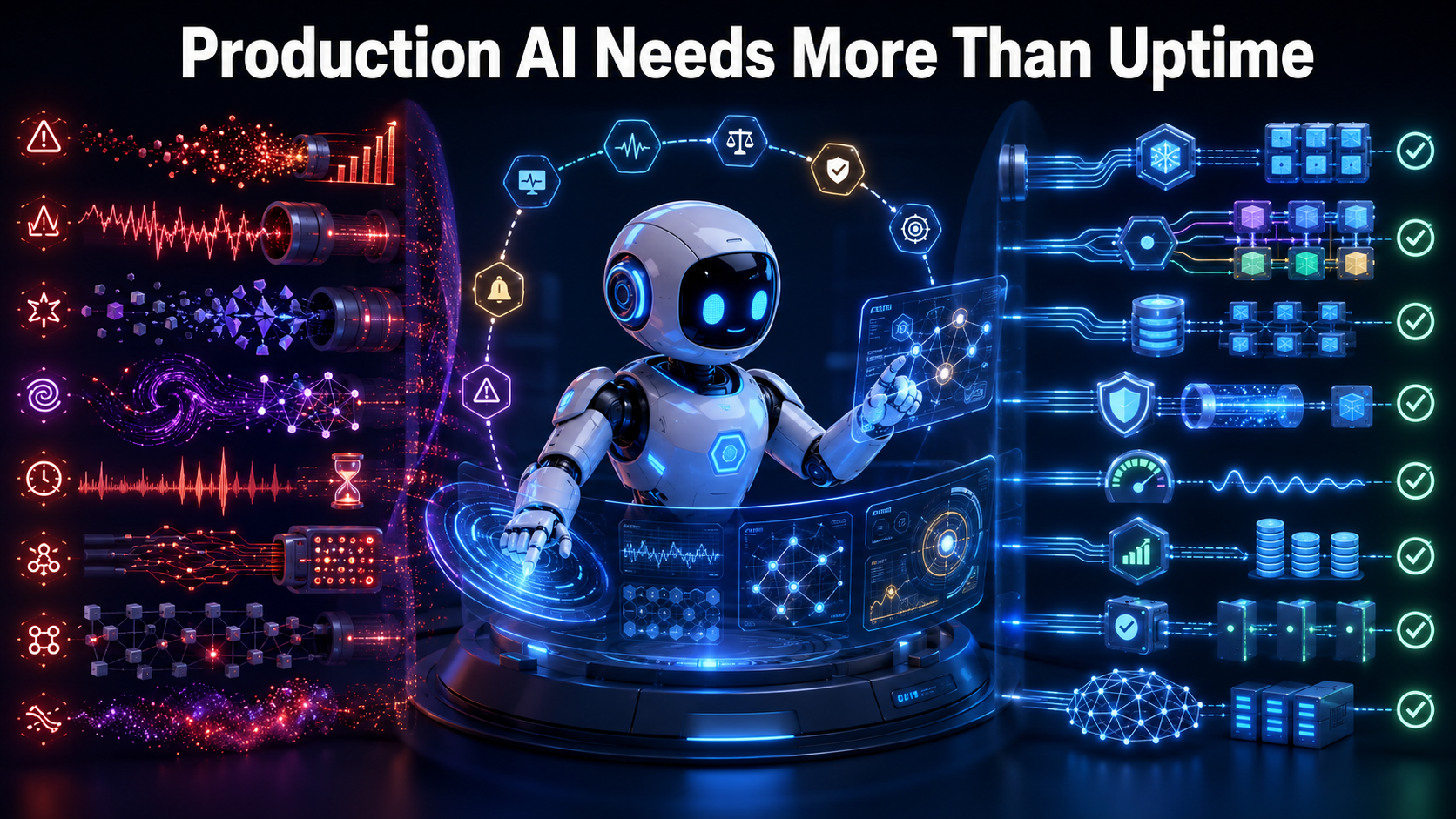
Generative AI applications often look impressive in demos and controlled tests. The real operational challenge begins after deployment. A model may suddenly become slower, retrieval quality may decline, token consumption may spike, or a prompt change may cause unexpected outputs even though the infrastructure itself is healthy.
Traditional monitoring can tell teams whether a service is online. It cannot always tell them whether an AI response is still accurate, relevant, safe, or economically sustainable. This is why AI Ops Engineer training is becoming important for SRE, DevOps, platform, and production-support teams responsible for live AI services.
AI Systems Fail Differently from Traditional Applications
A conventional application usually produces repeatable outputs from defined logic. Generative AI introduces probabilistic behaviour, external model dependencies, embeddings, retrieval components, prompts, and rapidly changing data.
As a result, teams can experience failures that standard CPU, memory, and availability dashboards will not reveal. LLM observability must include response quality, latency, token usage, retrieval performance, safety signals, model behaviour, and cost.
For enterprises operating business-critical AI, simply knowing that an API returned HTTP 200 is no longer enough.
Reliability Must Include the Quality of the Answer
Measure What Users Actually Experience
AI services need operational indicators that connect infrastructure health with output quality. Teams should define service-level indicators for latency, successful responses, faithfulness, relevance, and other business-critical measures.
Strong AI reliability engineering also requires offline and online evaluation pipelines. Tools and frameworks for evaluating RAG and LLM applications can help detect regressions before they become large-scale production incidents.
Detect Drift Before Users Report It
AI behaviour can change even when application code has not.
Source data may shift. Embeddings can become less representative. Prompts may evolve. A model update can alter output characteristics. AI drift detection gives operations teams a way to identify these changes and establish thresholds for investigation.
This moves AI operations from reactive troubleshooting toward continuous reliability management.
Treat AI Incidents as an Engineering Discipline
When an AI service fails, restarting a container may solve the infrastructure symptom without solving the actual problem.
Teams need AI incident management training that covers runbooks for retrieval failures, model regressions, token overruns, prompt injection, unsafe outputs, and other AI-specific incidents. Game-day exercises and chaos testing can help engineers practice diagnosis before a high-impact failure occurs.
Structured post-mortems are equally important because they turn incidents into improvements in alerts, evaluations, architecture, and operational procedures.
Reliability Without Cost Control Is Incomplete
Production AI introduces a cost surface that can move quickly. Token volume, model choice, context size, traffic patterns, GPU utilization, and repeated inference can all increase spend.
FinOps for LLMs training helps teams connect reliability decisions with economics through caching, model routing, quantisation, autoscaling, quotas, and cost-per-feature monitoring.
NovelVista’s AIOps Engineer Corporate Training addresses this broader production responsibility through LLM observability, evaluation pipelines, drift detection, SLIs and SLOs, chaos engineering, incident management, performance optimization, FinOps, and responsible AI operations.
Conclusion
Enterprises cannot operate production AI with infrastructure monitoring alone. They need engineers who can understand whether an AI service is available, useful, trustworthy, resilient, and financially sustainable at the same time.
By developing production AI operations capabilities across observability, evaluation, incident response, resilience, and cost governance, organizations can move from fragile AI deployments to services they can confidently operate at scale.
Ready to build an operations team for production AI? Explore NovelVista’s AI Ops Engineer Corporate Training and equip your SRE and DevOps teams to own the reliability, performance, security, and economics of live AI services.

 English
 Français
 Español
 Português
 Deutsch
 Türkçe
 Dutch
Dutch
 Italiano
 Russian
 Romaian