


What Can Weekly Dharma Reflections Actually Change in You?
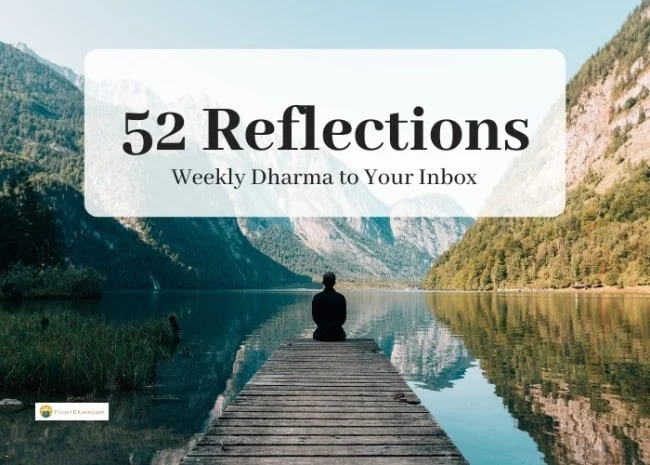
There's a particular gap in most practitioners' spiritual lives that rarely gets named directly — the space between the intensive practice periods and ordinary daily life.
The retreat ends. The insights are real and the opening is genuine. The quality of awareness feels qualitatively different from what was available before. And then ordinary life gradually reasserts itself — the pace, the demands, the habitual patterns — and three weeks later the practitioner is navigating roughly the same reactions, the same relationship dynamics, and the same internal conditions they were navigating before the retreat, with a memory of something better and a growing uncertainty about how to maintain what they found.
This isn't failure. It's a structural problem. The intensive practice opened something real. But without a sustained, continuous form of engagement that keeps the dharma inquiry alive through the ordinary weeks, what the retreat revealed gradually gets covered over by the accumulated momentum of habitual life.
Dharma reflections — practiced consistently, genuinely, as a weekly contemplative engagement rather than a casual reading exercise — address this structural problem directly. They create the thread of continuous dharma inquiry that keeps the insights from intensive practice alive and deepening rather than slowly receding back into the background noise.
What a Dharma Reflection Actually Is — And Isn't
There's a common misunderstanding worth addressing from the start: a dharma reflection is not an inspirational quote. It's not a piece of spiritual content to be consumed, appreciated, and moved past. And it's not a meditation instruction to be followed during a designated practice period and then set aside.
A genuine dharma reflection is a question — or an observation with the quality of a question — that's designed to be genuinely carried into the fabric of ordinary daily life across an entire week. Not answered. Carried. Held in the background of conversations, decisions, irritations, moments of unexpected joy, and all the texture of an ordinary week, and allowed to surface specific things — specific reactions, specific patterns, specific instances of the gap between intention and actual living — that the question has been calibrated to reveal.
The difference between reading about shadow material and genuinely sitting with a dharma reflection that touches the specific territory where your shadow most consistently operates is the difference between studying a map and walking the terrain. Both have value. Only one produces the direct, embodied, specific knowledge that actually changes something.
Planet Dharma's programme of fifty-two weekly dharma reflections is structured to provide this kind of sustained, year-long contemplative engagement. Each reflection is designed not to resolve but to disturb — in the most productive sense. To create a quality of honest discomfort with the gap between what the practitioner understands and how they're actually living. And to create this disturbance gently enough, consistently enough, and across a sufficient range of territory that genuine cumulative shift becomes possible.
Introducing Planet Dharma
Planet Dharma is a Buddhist-inspired spiritual education platform founded by Dharma teachers Doug Duncan (Qapel) and Catherine Pawasarat Sensei. Their teaching draws from the Namgyal Rinpoche lineage and integrates Theravada and Vajrayana Buddhist practice, Jungian depth psychology, the Western esoteric traditions, and decades of direct experience with an international community of practitioners.
Their dharma reflections programme is one of several accessible entry points into their teaching — alongside video teachings, the dharma podcast, online courses, and in-person retreats — all designed to create a complete, multi-dimensional approach to genuine spiritual development that works within the ordinary constraints of a contemporary practitioner's life.
What the Daemon vs Demon Has to Do With Your Weekly Practice
Here's where the dharma reflections programme connects to something that most practitioners don't initially expect to find in a weekly contemplative email: the precise, psychologically sophisticated distinction between the two inner voices that are quietly governing most significant decisions.
The daemon vs demon framework — drawn from ancient Greek philosophical tradition and developed through Planet Dharma's teaching — describes the ongoing tension that every practitioner is navigating, usually with more confidence than accuracy about which voice they're actually following.
The daemon is the deep inner signal of authentic calling. The quiet, settled, periodically surfacing voice that knows what genuine growth requires, what genuinely needs to happen, and where real development lies. It doesn't argue. It doesn't escalate. It states what's true with unusual clarity and then waits — sometimes with patience that outlasts several complete cycles of the practitioner's ordinary avoidance before surfacing again.
The demon is the voice assembled from shadow material — from the specific fears, the particular shame, the unconscious beliefs about safety and worthiness that have accumulated over a lifetime of conditioning. It speaks in the language of reason, wisdom, and appropriate caution. It sounds, in other words, exactly like a mature and thoughtful version of yourself — which is precisely what makes it so consistently convincing and so consistently able to prevent what the daemon is pointing toward.
Why Weekly Dharma Reflection Develops Daemon-Demon Discrimination
This is the specific mechanism by which regular dharma reflection builds one of the most important capacities on the entire path: the ability to tell these two voices apart in real time rather than only in retrospect.
A well-designed dharma reflection held across an ordinary week creates repeated, specific opportunities to notice which voice is actually motivating specific decisions. The hesitation about sending a particular email — is that the daemon's genuine discernment about timing, or the demon's fear of exposure dressed in the language of appropriate caution? The strong pull toward a particular choice — is that the daemon's authentic calling, or the demon's anxious craving for a specific outcome dressed in the language of inspiration?
These questions can't be answered by thinking harder. They require a quality of sustained, honest observation across real situations, over time, with enough genuine self-knowledge to recognize the demon's specific disguises. And the systematic, weekly practice of genuine dharma reflection builds exactly this quality — the accumulated, embodied self-knowledge that makes genuine discrimination possible rather than being continually available as a framework while remaining perpetually just out of practical reach.
The Dharma Class — Where Reflections Stop Being Private and Start Being Real
Here's the dimension of the dharma reflections practice that most practitioners underestimate until they experience it: the quality of what surfaces in private contemplation changes significantly when it's brought into genuine community.
A dharma class — a structured group practice environment with experienced guidance — transforms the dharma reflection from a private exercise into a shared inquiry. And shared inquiry, held skillfully, surfaces dimensions of both the reflection and the practitioner's relationship to it that solitary contemplation rarely reaches.
Planet Dharma's international network of affiliated dharma communities — including weekly practice groups in Toronto, across Europe in the UK, Germany, Italy, France, and Spain, in Calgary, Nelson BC, and Brazil, alongside the flagship Clear Sky Meditation Centre in the BC Rockies — provides exactly this kind of held, guided, sustained community context.
What Happens When Reflections Are Brought Into a Dharma Class
When a practitioner shares what a week's dharma reflection has surfaced — what specific reaction it revealed, what pattern it illuminated, what the gap between intention and actual living looked like when that particular lens was held — something happens that private journaling cannot produce.
First, the act of articulating it changes it. Shadow material that remained comfortably vague in private reflection becomes more specific when it has to be expressed in language to another human being. The pattern that felt somewhat uncomfortable in private becomes recognisable in its full specificity when described to a community of practitioners who will recognise it, not because they're judging it, but because they've navigated their own versions of the same territory.
Second, the community's response — the recognition, the questions, the gentle challenges, the teacher's precision — adds dimensions to the reflection that the practitioner's private engagement hadn't reached. The demon's particular costume in that practitioner's life becomes visible from outside in a way it never quite becomes from within.
Third, witnessing other practitioners share what the same reflection surfaced in their own experience produces a quality of normalisation — the recognition that the gap between intention and living, between what's understood and what's actually happening, is not a personal failing but a universal condition being honestly faced. And this normalisation paradoxically makes the honesty required to close the gap more accessible rather than less.
Building a Complete Practice Architecture With These Three Elements
What emerges when dharma reflections, daemon-demon discrimination, and a genuine dharma class work together is considerably more than the sum of the individual elements.
The weekly dharma reflections create sustained, continuous engagement with the path through ordinary daily life — keeping the dharma inquiry alive between more intensive practice periods and building the cumulative self-knowledge that genuine discrimination requires. The daemon vs demon framework gives that inquiry a specific, practically urgent focus — not just general contemplation of dharma themes, but the specific, immediate question of which inner voice is actually shaping this week's significant moments. And the dharma class provides the relational context in which both the reflections and the discrimination work become genuinely visible rather than remaining sealed in the privacy where the shadow most prefers to operate.
Together, they address the structural gap between intensive practice and ordinary life in a way that neither individual practice, isolated contemplation, nor occasional community attendance can achieve.
FAQs
Q: What makes dharma reflections different from inspirational daily quotes or standard meditation prompts?
A: Genuine dharma reflections are calibrated to be carried across an entire week and to surface specific, embodied information about the gap between intention and actual living — not to produce a pleasant moment of recognition and then be forgotten.
Q: How long does it take for weekly dharma reflections to produce noticeable change?
A: Individual reflections can produce significant insight quickly. Cumulative change — the kind that shifts baseline patterns rather than just producing periodic insights — typically requires sustained engagement across months rather than weeks.
Q: What is the daemon vs demon distinction and how do dharma reflections develop the capacity to distinguish them?
A: The daemon is authentic calling — quiet, clear, growth-oriented. The demon is conditioned avoidance speaking in the language of reason. Weekly reflections, held across ordinary daily situations, build the accumulated self-knowledge required to recognise the demon's specific disguises in real time.
Q: How does a dharma class change the quality of what weekly dharma reflections produce?
A: By providing the relational context in which what reflections surface becomes visible from outside the practitioner's own perspective — through articulation, community recognition, teacher precision, and the normalisation of honest engagement with the gap between understanding and living.
Q: Can I engage with Planet Dharma's dharma reflections and dharma class online?
A: Yes. The fifty-two weekly reflections are accessible online, and Planet Dharma's affiliated communities include both in-person groups internationally and online engagement options for practitioners who aren't able to attend local groups.
Q: Is the dharma reflections programme suitable for practitioners who are new to the path?
A: Yes. The programme is designed to meet practitioners wherever they are — providing genuine depth for experienced meditators while remaining genuinely accessible to those who are newer to formal dharma engagement.
Final Thoughts
The gap between the insight available during intensive practice and the quality of ordinary daily life isn't primarily a problem of motivation or commitment. It's a structural problem that requires a structural solution — a form of sustained, continuous, genuinely engaging dharma practice that keeps the inquiry alive through the ordinary weeks rather than allowing it to recede until the next retreat.
Weekly dharma reflections provide exactly this. The daemon vs demon framework gives them practical, immediately relevant urgency — connecting the contemplative practice to the specific inner dynamic that most directly determines the quality of the practitioner's actual choices. And a genuine dharma class transforms both from private practices into a shared inquiry where the real work finally becomes visible enough to genuinely move.
Planet Dharma holds all three of these elements within a coherent, accessible, and genuinely demanding framework — built for practitioners who are serious about closing the gap between understanding and living rather than simply maintaining a comfortable relationship with both.
The practice is continuous. The inquiry is always already present. And the daemon, as always, is waiting quietly to see whether this week's ordinary moments will finally be met with genuine attention.

 Arabic
 Français
 Español
 Português
 Deutsch
 Türkçe
 Dutch
Dutch
 Italiano
 Russian
 Romaian