


Pressure Washer Nozzle Color Chart: Understanding Spray Angles and Cleaning Power
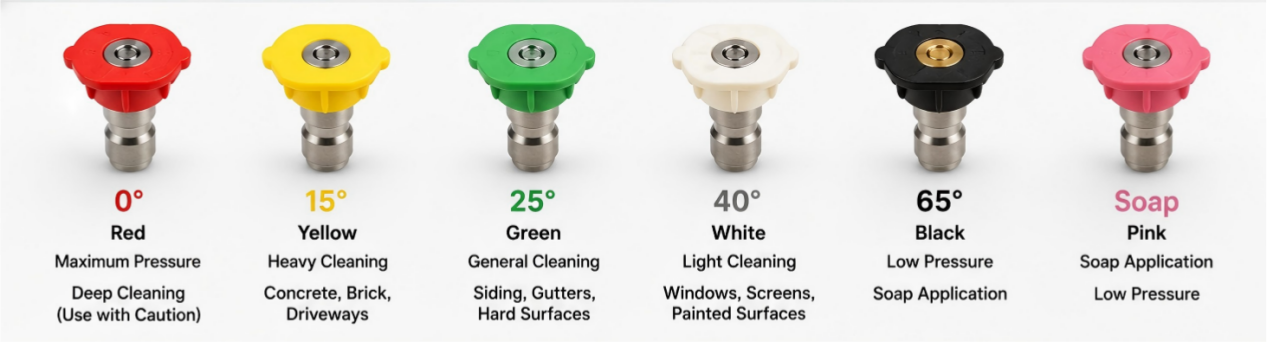
Pressure Washer Nozzle Color Chart: Understanding Spray Angles and Cleaning Power
If you have ever opened a pressure washer accessory kit, you may have noticed a collection of red, yellow, green, white, and black spray tips. These colors are not simply decorative. They provide a quick way to identify the spray pattern and intended use of each nozzle.
Learning how this color system works can help homeowners choose the right tip for a cleaning project and avoid using excessive pressure on sensitive surfaces.
Why Are Pressure Washer Nozzles Different Colors?
The color of a pressure washer nozzle is generally associated with its spray angle.
A smaller angle creates a narrower and more concentrated stream. A larger angle creates a wider fan that covers more surface area with less concentrated impact.
This means that nozzle selection affects both cleaning power and coverage.
For example, a 0-degree nozzle produces a very concentrated stream, while a 40-degree nozzle spreads the water across a much wider area.
Understanding the Basic Nozzle Color Chart
The common color system can be summarized as follows:
· Red – 0°: Extremely concentrated spray for specific heavy-duty applications.
· Yellow – 15°: Narrow spray for stubborn dirt and durable surfaces.
· Green – 25°: General-purpose option for many outdoor cleaning tasks.
· White – 40°: Wider and gentler spray for delicate surfaces and rinsing.
· Black – 65°: Low-pressure tip commonly used for applying detergent.
These are general guidelines, so users should always check the instructions provided with their specific pressure washer and nozzle set.
Smaller Angle Does Not Always Mean Better
It can be tempting to assume that the strongest nozzle will produce the best cleaning results. In practice, excessive concentration can create new problems.
A narrow spray can remove dirt quickly, but it can also strip paint, damage wood fibers, mark soft materials, or leave visible lines on certain surfaces.
For this reason, cleaning should begin with an appropriate nozzle rather than automatically using the most powerful option.
Match the Spray Angle to the Material
The surface you are cleaning should determine the nozzle you choose.
For example, concrete and other durable materials can generally tolerate more concentrated spray patterns. A yellow 15-degree nozzle may be useful when removing heavy dirt from a driveway.
For routine cleaning of patios, sidewalks, and similar surfaces, a green 25-degree nozzle can provide a useful balance between cleaning power and coverage.
Vehicles and other delicate surfaces usually benefit from a wider spray. A white 40-degree nozzle can distribute water more evenly and reduce the risk associated with a highly concentrated stream.
Nozzle Color Is Not the Same as PSI
One common misunderstanding is that nozzle color directly determines the pressure produced by the pressure washer.
It does not.
The color primarily identifies the spray angle, while the nozzle orifice size works together with the pressure washer's flow rate to determine the operating characteristics.
Using an incorrectly sized orifice can restrict flow or reduce pressure, potentially affecting the performance of the equipment. This is why replacement nozzles should be selected according to the pressure washer's specifications rather than color alone. The relationship between nozzle color, spray angle, and orifice size is explained in more detail in this pressure washer nozzle color chart.
How to Use a Pressure Washer Nozzle More Safely
Even the correct nozzle can cause damage if it is used incorrectly.
Keep the spray moving instead of holding it continuously over one spot. Maintain an appropriate distance from the surface, especially when using a narrow-angle tip.
It is also a good idea to test the spray on a small hidden section before cleaning the entire surface. This is particularly important when working with painted wood, older materials, vehicles, or surfaces whose condition is uncertain.
Choose the Nozzle Based on the Job
There is no single pressure washer nozzle that is ideal for every cleaning task.
A narrow-angle tip can be useful for concentrated cleaning, while a wider-angle tip is better for coverage and more delicate surfaces. Detergent nozzles serve a different purpose by allowing cleaning solutions to be applied before high-pressure rinsing.
Understanding the pressure washer nozzle color chart makes this selection process much simpler. Instead of choosing a nozzle based only on how powerful it appears, you can consider the spray angle, surface material, cleaning task, and equipment specifications together.
With the right nozzle, pressure washing becomes not only more effective but also safer for the surfaces being cleaned.

 Arabic
 Français
 Español
 Português
 Deutsch
 Türkçe
 Dutch
Dutch
 Italiano
 Russian
 Romaian