


How Sustainability and Automation Are Changing Port Service Operations
Ports Are Being Redefined by What Happens Beyond the Waterfront
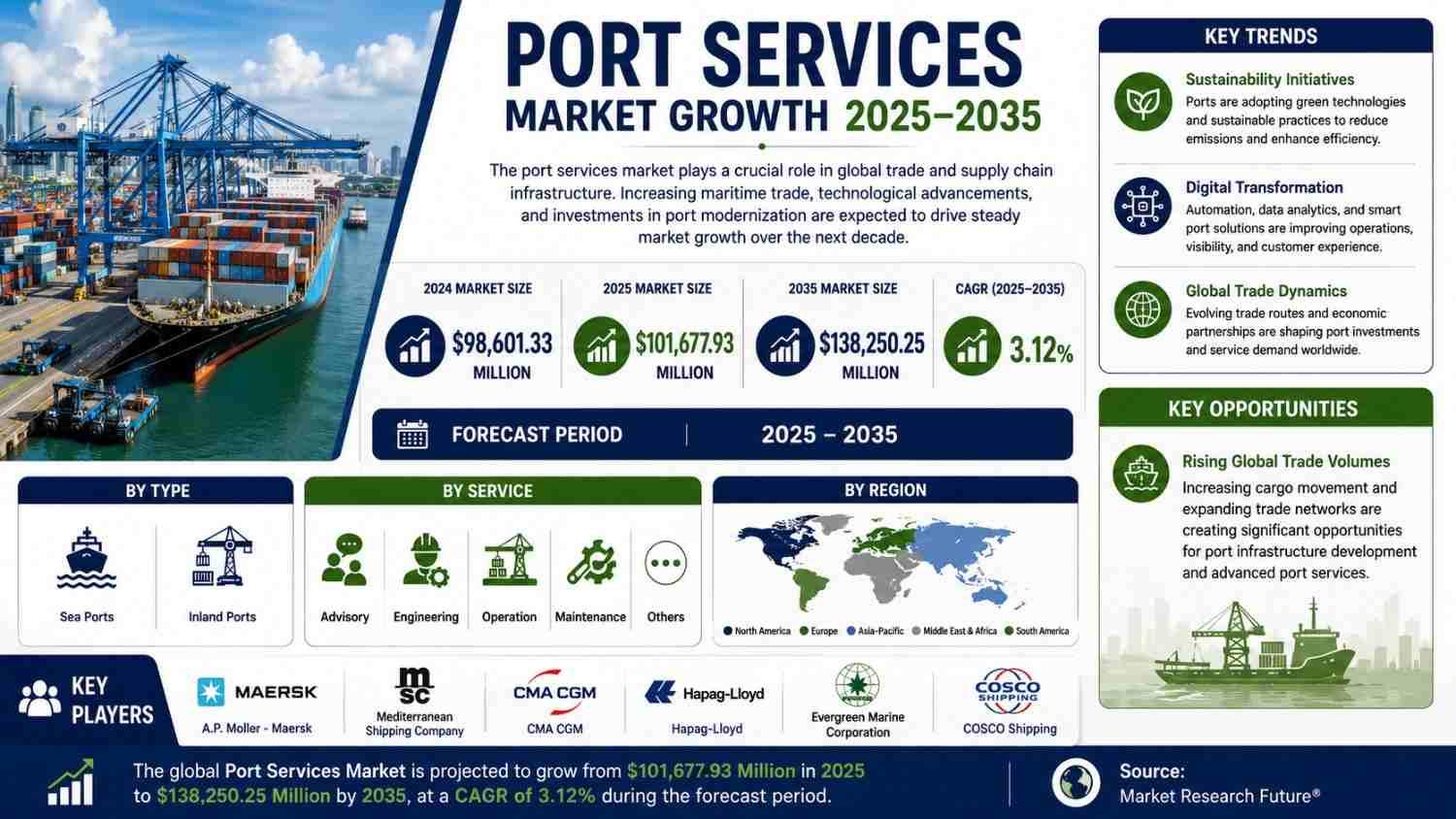
A port's economic importance is increasingly determined by everything connected to it. A ship may arrive on schedule, but the cargo still needs to be unloaded, stored, documented and transferred into inland logistics networks. The Port Services Market Outlook captures this broader operating environment. At USD 98.60 billion in 2024, the market reached USD 101.68 billion in 2025 and is expected to reach USD 138.25 billion by 2035, reflecting a 3.12% CAGR. The next stage of development is likely to center on coordination rather than simple physical expansion.
The Port Is Becoming a Network, Not a Single Facility
Historically, port performance was closely associated with berth capacity and cargo-handling equipment. Those factors remain essential, but they no longer tell the whole story.
Cargo must move through a chain of interconnected activities. Delays in one activity can reduce the value of efficiency achieved elsewhere.
This is why port services increasingly encompass advisory, engineering, operations and maintenance. Each function contributes to the reliability of the overall network.
A well-managed terminal can absorb changes in cargo schedules more effectively than one that operates close to its limits with little operational flexibility.
Digital Transformation Is Changing Decision-Making
The digital port is not simply an automated terminal. Its defining characteristic is the ability to use operational information to make better decisions.
Vessel schedules, equipment availability, cargo locations and maintenance data can be combined to create a more detailed picture of terminal performance.
This visibility can support better resource allocation. It can also make disruptions easier to manage because operators have more information about where the problem is occurring.
Automation can complement these systems by reducing manual intervention in appropriate activities. Yet ports must consider cybersecurity, system integration and workforce training alongside technology investment.
Trade Growth Is Creating a Capacity Quality Problem
Rising trade volumes create demand for more port services, but adding physical capacity is not always the fastest solution.
A new terminal can take years to plan, finance and build. Existing facilities can sometimes gain productivity through equipment upgrades, process redesign and better coordination.
This creates opportunities for engineering and technology providers. Instead of selling only new infrastructure, companies can help ports improve the performance of what they already own.
The commercial advantage is clear: better utilization can increase throughput without requiring equivalent increases in physical footprint.
Sustainability Is Influencing the Modernization Equation
Ports are under pressure to reduce environmental impacts while continuing to support trade.
Energy use is an important consideration because terminals rely on cranes, handling equipment, lighting and other infrastructure. Reducing unnecessary movements and improving equipment efficiency can therefore have measurable operational value.
Sustainability also affects procurement decisions. Operators increasingly have to consider not just acquisition costs but operating energy, maintenance requirements and asset life.
The transition will not be uniform. Established ports may face higher costs when retrofitting existing infrastructure, while newer facilities may be able to incorporate sustainability considerations from the design stage.
Inland Ports Can Relieve Pressure on Coastal Gateways
Inland ports provide an important extension of maritime infrastructure.
By supporting storage, consolidation and intermodal transfers away from the coast, they can distribute logistics activity across a wider geographic area.
This approach can be particularly valuable where coastal terminals operate near urban areas or face land constraints. Rather than solving every capacity issue at the waterfront, logistics planners can develop complementary inland nodes.
Port-service providers that understand this network relationship may find new opportunities in engineering, operations and technology integration.
Regional Strategies Will Not Look the Same
Asia-Pacific's major role in manufacturing and trade creates sustained requirements for high-volume port operations.
Europe's priorities increasingly combine trade efficiency with environmental performance and digital infrastructure. North America has a strong need for dependable port-to-inland connectivity because large domestic markets depend on complex transportation networks.
Meanwhile, strategically located ports in emerging trade regions can gain importance by offering efficient connections between major maritime corridors.
Geography remains powerful, but infrastructure quality determines how effectively a location can translate that advantage into commercial value.
Competitive Positioning Is Becoming More Integrated
The market includes major maritime companies such as A.P. Moller - Maersk, Mediterranean Shipping Company, CMA CGM, Hapag-Lloyd, Evergreen Marine Corporation, and COSCO Shipping.
Their presence illustrates the increasingly integrated nature of maritime commerce. Shipping companies operate within ecosystems involving terminals, inland transportation, warehousing and logistics services.
For port-service providers, this raises the importance of interoperability and network coordination. Customers increasingly care about the reliability of the complete journey.
The Best Opportunities May Come From Existing Assets
Modernization of existing ports could become an important source of demand through 2035.
Digital control systems, equipment upgrades, predictive maintenance, energy-efficiency projects and operational redesign can improve performance without requiring complete reconstruction.
Data-driven services could become particularly valuable because they can improve visibility across complex operations.
Another opportunity lies in linking coastal facilities with inland logistics hubs, creating networks that can absorb changing cargo patterns.
Risks Remain Significant
Port infrastructure is expensive and difficult to modify quickly. Large investments must account for long asset lives and uncertain trade conditions.
Technology can introduce integration and cybersecurity challenges, while regulatory requirements can add complexity to infrastructure projects.
Trade itself is another variable. Changes in shipping routes, manufacturing locations or global economic conditions can alter cargo volumes and port priorities.
Flexible infrastructure and diversified connectivity can therefore become important risk-management tools.
The Next Generation of Port Services
The market's projected value of USD 138.25 billion by 2035 points to continued demand, but the industry's more important transformation will be operational.
Ports are moving toward models in which engineering, digital systems, sustainability and logistics coordination work together.
The strongest facilities will not simply handle cargo efficiently at the waterfront. They will help make the entire trade journey more predictable.
Another Trending Topics
Plastic Wrap Market | Plastomers Market | Platform Lifts Market

 Arabic
 Français
 Español
 Português
 Deutsch
 Türkçe
 Dutch
Dutch
 Italiano
 Russian
 Romaian