


Data Science and Engineering: Course, Skills, Career Scope and Future Opportunities
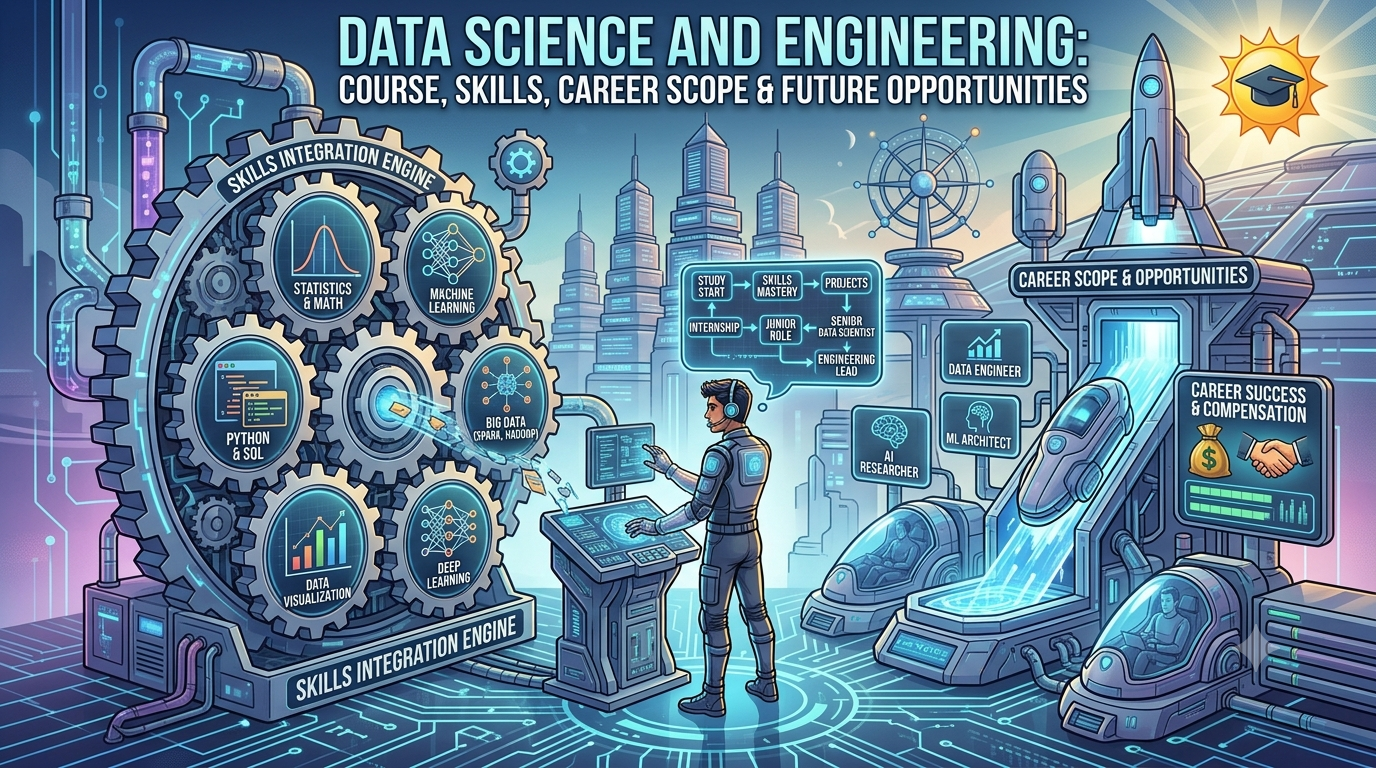
Data has become one of the most valuable resources for organisations across industries. From predicting customer behaviour to improving business operations, companies increasingly depend on data to make informed decisions. This growing reliance on data has created demand for professionals who can collect, analyse, interpret, and transform complex information into useful insights. For students interested in technology, mathematics, statistics, and problem-solving, data-focused engineering can offer an exciting career direction.
Students considering a technology-oriented undergraduate degree can explore data science and engineering as an option that combines computer science principles with statistics, data analysis, programming, and emerging technologies. The field can prepare students for careers involving data analytics, machine learning, artificial intelligence, business intelligence, and other data-driven applications.
What Is Data Science and Engineering?
Data Science and Engineering is an interdisciplinary field that combines computer science, mathematics, statistics, programming, and data analysis. The objective is to help students understand how large volumes of data can be collected, processed, analysed, and used to solve real-world problems.
Unlike traditional approaches to data analysis, modern data science often involves working with massive and complex datasets. Students learn how computational tools and analytical techniques can be used to identify patterns and generate meaningful insights.
The field also overlaps with artificial intelligence and machine learning, making it relevant to many modern technology applications.
Why Is Data Science Important Today?
Organisations generate enormous amounts of data through websites, applications, transactions, connected devices, social media, and business operations. However, raw data has limited value unless it can be converted into useful information.
Data professionals help organisations answer important questions such as what customers want, which products are performing well, why certain processes are inefficient, and what may happen in the future.
Industries such as banking, healthcare, e-commerce, manufacturing, logistics, education, telecommunications, and entertainment increasingly use data-driven approaches. This broad applicability makes data science a versatile field for students interested in technology and analytics.
What Do Students Learn in a Data Science Programme?
A data-focused engineering programme generally begins with fundamental computer science and mathematical concepts before moving into advanced analytical topics.
Students may study:
- Programming and computational thinking
- Data structures and algorithms
- Probability and statistics
- Database management
- Data visualisation
- Machine learning
- Artificial intelligence
- Big data technologies
- Cloud computing
- Predictive analytics
- Data mining
- Software engineering
The exact curriculum can differ between institutions, so students should review the programme structure before applying.
Importance of Programming Skills
Programming is an essential part of data science because professionals use code to process datasets, automate tasks, build analytical models, and implement solutions.
Languages such as Python and R are commonly associated with data analysis and machine learning. Students may also work with SQL for managing and querying databases.
However, becoming a successful data professional requires more than knowing programming syntax. Students should understand algorithms, data structures, statistics, and the reasoning behind analytical techniques.
Strong fundamentals can make it easier to learn new tools as technology changes.
Role of Mathematics and Statistics
Mathematics and statistics form the foundation of many data science techniques. Concepts such as probability, distributions, correlation, regression, and statistical testing help professionals interpret datasets correctly.
Machine learning algorithms also rely on mathematical principles. Understanding these concepts allows students to evaluate models and identify whether results are meaningful rather than simply relying on software tools.
Students who enjoy mathematics and analytical problem-solving may find data science particularly engaging.
Practical Learning and Projects
Data science is highly practical, so students should gain experience working with real or realistic datasets. Academic projects can help them understand how data is collected, cleaned, analysed, visualised, and interpreted.
For example, students could develop projects involving customer behaviour analysis, sales forecasting, recommendation systems, fraud detection, healthcare analytics, or sentiment analysis.
Hackathons, competitions, internships, and research projects can provide additional opportunities to apply classroom knowledge. Building a portfolio of practical projects can also help graduates demonstrate their skills to potential employers.
Career Opportunities After Data Science and Engineering
The growing use of data across industries has created multiple career paths for graduates with relevant skills.
Data Analyst
Data analysts examine datasets to identify trends, generate reports, and support business decisions. They often work with databases, spreadsheets, visualisation tools, and statistical techniques.
Data Scientist
Data scientists use advanced analytical methods, programming, and machine learning to solve complex business and technical problems. They may build predictive models and extract insights from large datasets.
Machine Learning Engineer
Machine learning engineers develop and deploy models that allow software systems to make predictions or decisions based on data. This role requires strong programming, mathematical, and machine learning knowledge.
Business Intelligence Analyst
Business intelligence professionals transform organisational data into dashboards, reports, and insights that help managers make strategic decisions.
Data Engineer
Data engineers design and maintain systems that collect, store, process, and transfer data. They work with databases, data pipelines, cloud platforms, and large-scale data infrastructure.
Industries Hiring Data Professionals
One of the major advantages of studying data science is its relevance across multiple industries. Banks use data to detect fraud and assess financial risk. Healthcare organisations use analytics to improve planning and patient services. E-commerce companies analyse customer behaviour and product performance.
Manufacturing organisations use data to monitor equipment and improve production processes, while logistics companies use analytics to optimise routes and supply chains.
This cross-industry relevance gives graduates flexibility when exploring career opportunities.
Skills Students Should Develop
Students should build a combination of technical and professional skills during their degree.
Important technical skills include programming, SQL, statistics, data visualisation, machine learning, databases, and cloud technologies. Students should also develop communication skills because data professionals frequently need to explain technical findings to people without a technical background.
Critical thinking, curiosity, attention to detail, and problem-solving are equally valuable. These abilities help professionals ask the right questions and interpret results effectively.
Higher Education and Certifications
Graduates interested in specialising further can pursue postgraduate programmes in data science, artificial intelligence, machine learning, business analytics, or related fields.
Professional certifications can also help students develop specific skills in areas such as cloud computing, analytics platforms, databases, or machine learning. However, certifications are most useful when combined with practical experience and a strong understanding of fundamentals.
Future Scope of Data Science
The future of data science is closely connected to developments in artificial intelligence, automation, cloud computing, and big data. As organisations continue collecting information from digital platforms and connected systems, the ability to extract useful insights from data will remain important.
Emerging areas such as generative AI, real-time analytics, edge computing, and responsible AI are also creating new applications for data professionals.
Students who develop strong fundamentals and remain willing to learn new technologies can adapt to these changing requirements.
Conclusion
Data Science and Engineering offers students an opportunity to combine programming, mathematics, statistics, and analytical thinking to solve modern problems. Its applications extend across technology, finance, healthcare, manufacturing, retail, logistics, and many other sectors.
A successful career in this field requires more than completing an academic programme. Students should gain practical experience, work on projects, develop programming and analytical skills, and understand how data is used to support real-world decisions. With consistent learning and hands-on experience, data science can provide diverse career opportunities in an increasingly data-driven economy.

 Arabic
 Français
 Español
 Português
 Deutsch
 Türkçe
 Dutch
Dutch
 Italiano
 Russian
 Romaian