


Healthcare App Development Service: Key Features, Costs, and Development Stages
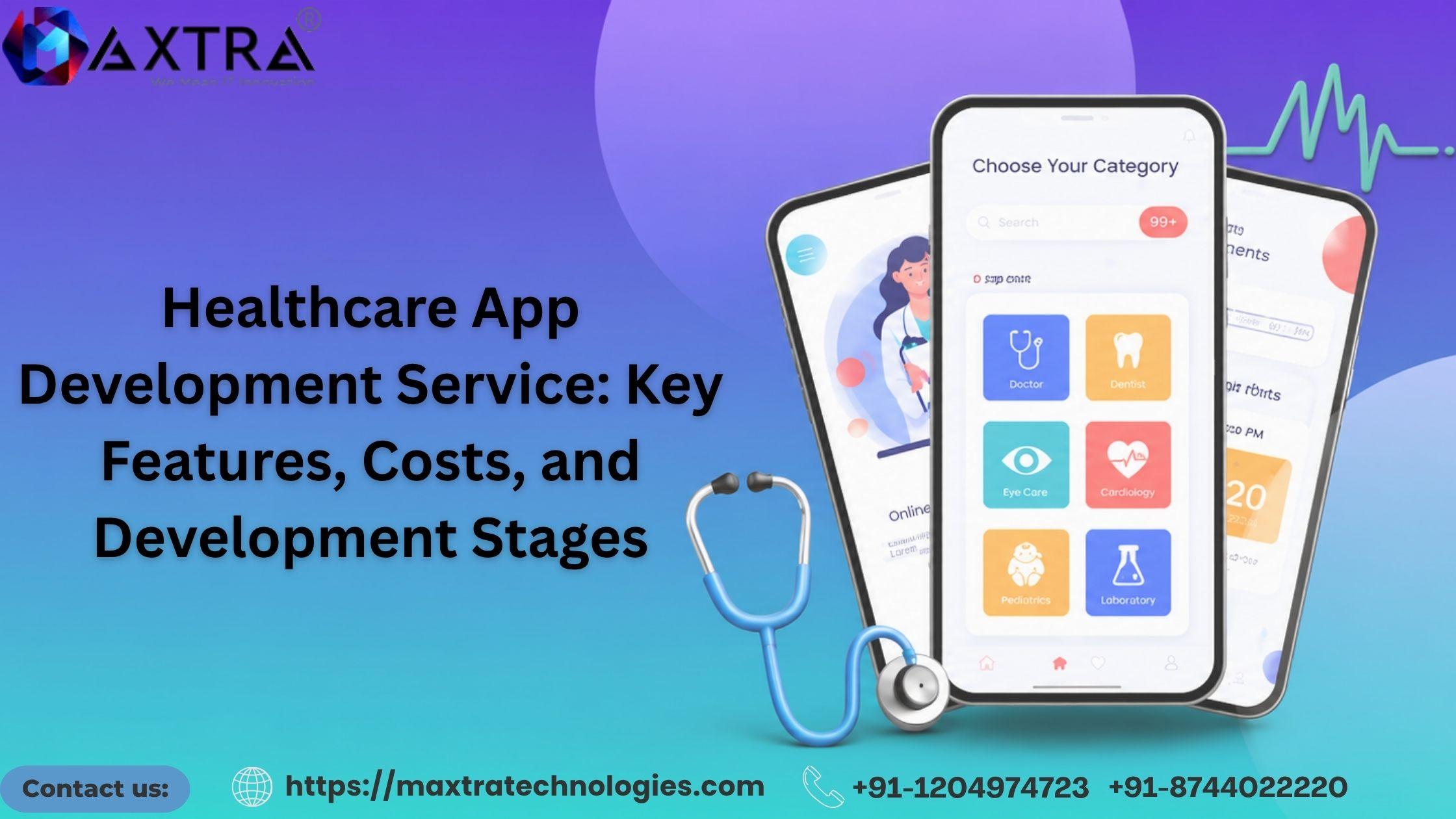
The healthcare industry is quickly turning towards digital means of enhancing accessibility, connectivity, and convenience. From virtual consultation to appointments, medicine intake, and even remote monitoring, apps are becoming an increasingly important component in modern healthcare.
Nevertheless, the development of a healthcare app goes beyond just the creation of an appealing mobile interface. The issues of security, interoperability, scalability, usability, and regulation must be taken into account from the start. Selecting the appropriate healthcare app development service provider can have a big impact on a project's success.
What Is a Healthcare App Development Service?
Developing a healthcare application development service entails planning, designing, developing, testing, implementing, and maintaining software that is developed to be used for healthcare purposes.
Based on the commercial objective, the applications may be intended for use by patients, doctors, hospitals, pharmacies, pharmaceutical companies, or even the healthcare administration sector.
Examples of the different types of healthcare apps include:
- Telemedicine and virtual consultation apps
- Patient appointments apps
- Medication reminder and management apps
- Remote patient monitoring apps
- Pharmacy apps
- Patient portals
- Communication in healthcare apps
- Wellness and health apps
- Hospital and clinic management apps
The most effective way is to focus on solving a certain problem as opposed to developing everything at once.
Key Features of a Healthcare Mobile App
Required capabilities depend on the goal of the software but some of them are generally useful.
1. Authentication Security: Applications that deal with confidential data may require secure login, multi-factor authentication, role-based permissions and correct session management to ensure user data protection.
2. Appointment Scheduling: The application provides the possibility for patients to look for healthcare practitioners, choose an available time slot, book an appointment and get reminders about it.
3. Telemedicine and Communication: Telemedicine, messaging, notifications and electronic prescription could be implemented to ensure secure interaction between patients and healthcare specialists via the Internet.
4. Health Information Accessibility: Where applicable, connections between existing systems and the application itself would allow for providing health information to authorized users.
5. Prescription Drugs Management: Information about medication schedule, refills, prescriptions and other relevant features can help patients to control their treatment routine.
6. Push Notifications: Push notifications could be sent by the application for appointment reminder, medication schedule, account activities and other purposes.
7. Analytics and Reporting: Dashboard can be provided by the healthcare organization to track application performance, engagement and other relevant business metrics.
How Much Does Healthcare App Development Cost?
There isn’t one set price for healthcare app development, as each individual application has its own requirements.
Cost factors that influence the final cost include:
- Number of features and feature complexity
- iOS, Android, web or cross-platform development
- UI/UX design needs
- Third party integrations
- Healthcare system integrations
- Cloud-based infrastructure needs
- Security and QA testing
- AI, analytics or remote monitoring needs
- Maintenance and post-launch support
For example, a patient facing app would likely have a different development budget than a healthcare platform with telemedicine, integrations, real-time data and analytics capabilities.
How to Get a More Accurate Estimate
Prior to soliciting a quote for the development process, specify the following:
- Target audience
- Main business challenge
- Required functionality
- Platforms
- Integrations
- Data and security needs
- Scope of the MVP
- Product roadmap
This will allow you to provide the development team with all the necessary data to quote the price realistically.
Healthcare App Development Stages
A systematic development approach can minimize technical risks and increase the quality of the product.
Stage 1: Discovery and Requirement Analysis: The team outlines business goals, user personas, workflows, technical requirements, integrations, and priorities.
Stage 2: UI/UX Design: Designers develop wireframes, prototypes, user flows, and interfaces that are intuitive to use.
In healthcare products, usability is especially critical since the users can range from patients to caretakers, doctors, and even administrators with vastly different needs.
Stage 3: MVP Development: The development team develops the core functionality needed in the first release.
Having a concentrated MVP allows organizations to validate their concept before pouring resources into secondary functionalities.
Stage 4: Integration and Testing: The application is integrated into the necessary systems and services. Testing must be done in terms of functionality, usability, performance, compatibility, and security.
Stage 5: Deployment: Once the app is tested and validated, the next step is preparing it for production and deployment.
Stage 6: Maintenance and Optimization: Post deployment support may include:
- Bug fixing
- Security patches
- Performance optimization
- Enhancement features
- System integration
- Technical monitoring
- Version updating
Continual improvement is needed since the expectations and demands of users and technologies keep changing over time.
How to Choose a Healthcare Mobile App Development Company
Choosing a development partner should be more than just comparing their hourly rate or estimates for the project.
While evaluating a healthcare mobile app development company, look at:
- Experience in healthcare development
- Security and privacy protocols
- Expertise in integration
- Experience with UI/UX
- Testing/QA methodologies
- Experience with scalability
- Communication and project management
- Support after launch
- Technical documentation and ownership
Ask them about their approach to your unique use case.
When Do You Need a Pharma App Development Company?
Most of the pharmaceutical companies have unique digital needs that involve healthcare professionals, patients, drug information, engagement initiatives, and internal processes.
When working with a pharmaceutical app development company, it is important to know that the app you are building might need certain pharmaceutical-specific functionalities.
Some of the possible solutions include:
- Drug information portals
- Patient engagement apps
- Drugs information apps
- Medication adherence platforms
- Healthcare professional engagement platforms
- Pharmaceutical sales and field force apps
- Clinical research apps
And the app development strategy needs to depend on who will use the app and for what purpose.
Practical Tips for Healthcare App Development
Before embarking on your project, remember the following points:
- Start by defining the problem: Define clearly the problem that the app is supposed to solve.
- Focus on MVP: Develop the most important functionalities first.
- Think about security: Do not take security as an afterthought while developing the application.
- Think about data flow: Know what information is being captured, stored, transferred, and accessed.
- Consider integrations: Think of external systems before you finalize your architecture.
- Do testing with your representative users: They can tell you how usable the app is.
- Define KPIs: Define measurable goals for the adoption of your product.
Why Choose Maxtra Technologies?
Maxtra Technologies assists companies in creating digital solutions through their technology, design, and product development offerings.
In case of a healthcare provider, their range of services will be useful for various stages in the lifecycle of an application, such as:
- Product Discovery & Planning
- Design UI/UX
- Mobile and Web Application Development
- Integration with APIs and other Third-Parties
- Testing & Quality Assurance
- Deployment
- Maintenance & Technical Support
It is not about just releasing the application; it must be something that is secure, user-friendly, scalable, and meets business objectives.
Conclusion
Healthcare application development is not just about developing a mobile application. It entails developing a digital product that should strike a perfect balance between the user, business, technical, security, and healthcare considerations.
Professional healthcare application development services are essential for helping organizations transition from discovering their products to designing and developing them and then deploying and optimizing them.
Whatever your application – a telemedicine application, a patient app, a medication application, or any other pharmaceutical application – developing the proper MVP and partnering with the right technology company can serve you well in the long run.
Maxtra Technologies can be an excellent partner for organizations seeking to develop digital applications out of their healthcare ideas.
Frequently Asked Questions
How much time does it take to develop a healthcare app?
It depends on a number of factors including the scope of the project, its characteristics, integrations, platforms, testing needs, etc. An MVP will usually require less time compared to a more elaborate healthcare app.
Which feature is most crucial for a healthcare app?
This question does not have a universal answer. Security, usability, authentication, reliable core functionality, and other things make a good base for an application, while other features should be chosen based on the purpose of the particular app.
How do you reduce healthcare app development costs?
Begin from defining an MVP, choose only the features that are really necessary, think about integrations early on, avoid unnecessary functionality.
Do you develop healthcare apps for iOS and Android?
It depends on the specifics of the project including the targeted users, geographical location, the current technological environment, etc. Cross-platform development may also be considered.

 Arabic
 Français
 Español
 Português
 Deutsch
 Türkçe
 Dutch
Dutch
 Italiano
 Russian
 Romaian