


How Robotics Lab Equipment Helps Students Learn Automation
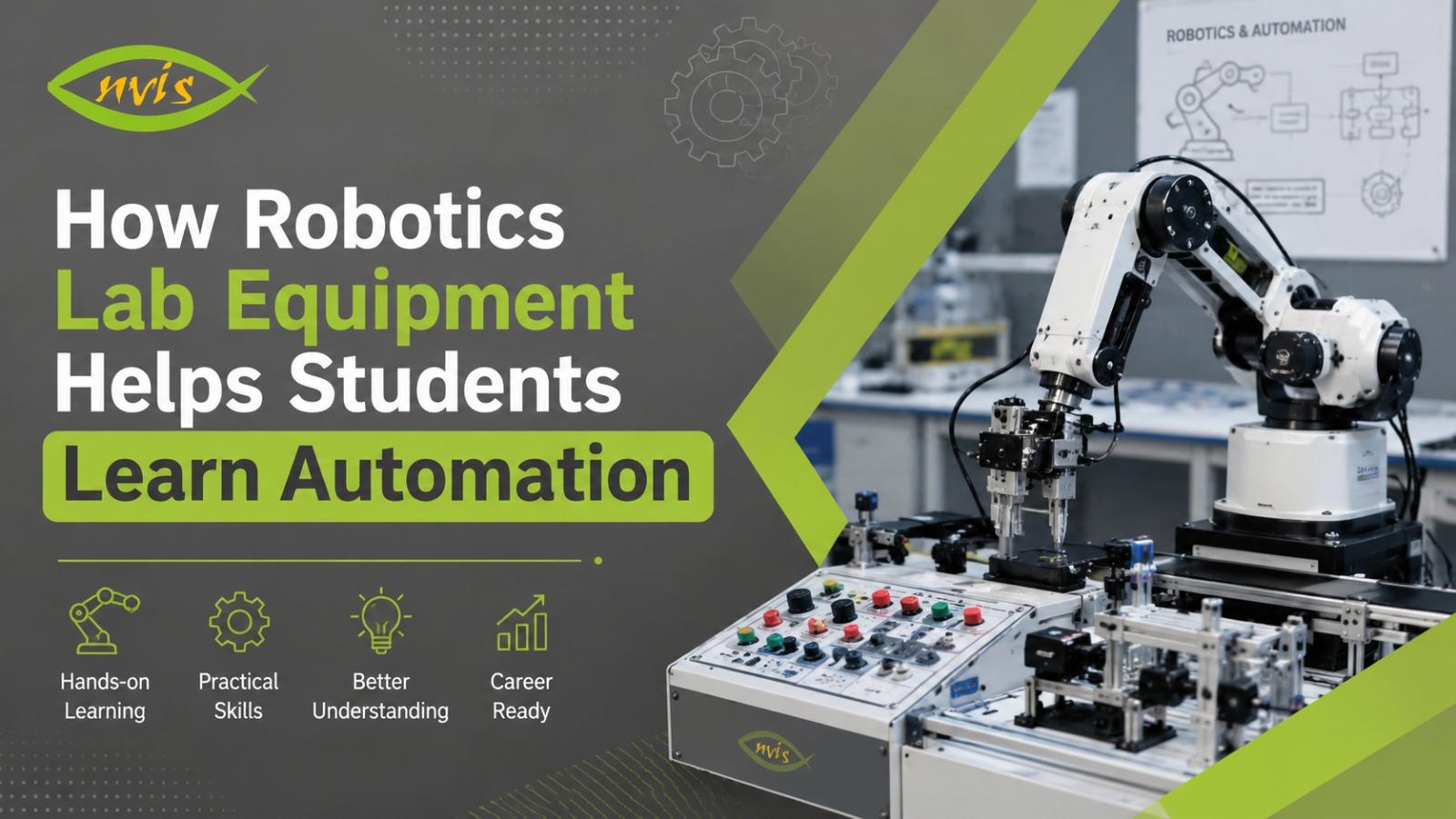
Walk into any well-equipped engineering lab today and you'll notice something that wasn't there a decade ago: rows of small robots, sensor kits, and microcontroller boards sitting alongside the usual textbooks and lab manuals. This shift isn't cosmetic. It reflects a fundamental change in how automation is taught, moving away from pure theory and toward hands-on experimentation with real robotics lab equipment.
Automation used to be something students read about in chapters on industrial control systems, memorized for exams, and rarely touched until their first job. That approach left a gap. Graduates understood the math behind a PID controller but had never tuned one. They could describe a feedback loop but had never watched one fail and had to debug it. Robotics lab equipment closes that gap by putting the theory directly into students' hands, often through something as simple as a robot kit or a robot car built from scratch.
This article looks at why lab-based robotics education matters, what kinds of equipment schools and universities are using, and how tools like robotics kits for engineering students and robot car kits translate abstract automation concepts into skills that actually transfer to the workplace.
Why Hands-On Learning Matters for Automation
Automation, at its core, is about systems that sense, decide, and act with minimal human intervention. That's a difficult concept to internalize from a diagram on a slide. A student can memorize the definition of closed-loop control, but they don't really understand it until a robot they built starts oscillating wildly because they set the gain too high, and they have to figure out why.
This is the value of a lab setting. It turns automation from an abstract subject into a trial-and-error process, which is exactly how automation engineers work in practice. Nobody designs a perfect control system on the first attempt. They build, test, observe failure, adjust, and test again. Robotics lab equipment gives students the sandbox to go through that cycle safely, long before they're responsible for a real industrial system where mistakes are costly.
There's also a motivational element that shouldn't be underestimated. Students who build something that moves, reacts, and completes a task tend to stay more engaged than those working purely from equations. That engagement often carries over into deeper study of the underlying concepts, because now those concepts have a visible, physical consequence.
What Counts as Robotics Lab Equipment
The term "robotics lab equipment" covers a fairly wide range of tools, and what a lab needs depends heavily on the level of the course and the goals of the program. Broadly, it includes:
-
Microcontroller and single-board computer platforms (such as Arduino, Raspberry Pi, or ESP32-based boards) that serve as the "brain" for most student projects
-
Sensors for light, distance, temperature, motion, and orientation, which teach students how machines perceive their environment
-
Actuators, including servo motors, DC motors, and stepper motors, which teach how machines act on decisions
-
Chassis and structural kits, often in the form of a robot car or wheeled platform, used to teach motion control and navigation
-
Power management components, battery packs, and voltage regulators
-
Programming environments and simulation software that let students test logic before deploying it to hardware
-
Diagnostic tools, like multimeters and oscilloscopes, for troubleshooting circuits
None of these pieces teaches automation on its own. The learning happens when students combine them, wire a sensor to a controller, write logic that reacts to sensor input, and drive an actuator based on that logic. That combination is, in miniature, exactly what an industrial automation system does.
Robotics Kits for Engineering Students: Bridging Classroom and Industry
There's an important distinction between the beginner robot kits used in introductory STEM programs and the more advanced robotics kits for engineering students found in university labs and technical programs. The latter are built with a different purpose in mind: preparing students for the kind of systems they'll actually encounter in industry.
These kits typically include:
-
Industrial-grade or industrial-adjacent components, such as PLC-compatible modules or motor drivers similar to those used in manufacturing
-
Support for multiple programming languages (C++, Python, ladder logic) so students aren't locked into a single ecosystem
-
Modular sensor arrays that allow for more complex, multi-input automation projects
-
Compatibility with CAD and simulation tools, letting students design a mechanism digitally before building it physically
-
Documentation and open architecture, so students can modify or extend the kit rather than being limited to prescribed exercises
What makes these kits particularly useful is that they mirror real engineering constraints. Industry automation systems have to account for noise in sensor readings, mechanical tolerances, power fluctuations, and communication delays between components. A well-designed engineering-level robotics kit exposes students to these same imperfections in a controlled setting, so their first encounter with a "messy" real-world signal isn't during a co-op placement or their first job.
Many engineering programs now build entire course sequences around these kits, starting with basic control loops in the first year and progressing to multi-robot coordination, computer vision integration, or autonomous navigation by the final year. That progression matters because automation, as a field, isn't one skill. It's a layered discipline that builds from simple feedback control up through increasingly autonomous decision-making.
How to Choose the Right Equipment for Your Program
There's no single "best" setup, since the right choice depends on the student level, program goals, and available budget. A few practical guidelines tend to hold up across most contexts:
-
Match complexity to student level. An introductory robot kit with limited sensors is more appropriate for a first-year or high school program than a full engineering-grade platform, which can overwhelm beginners and slow down early progress.
-
Prioritize modularity. Equipment that can be reconfigured or expanded (adding sensors, swapping controllers, upgrading motors) extends the useful life of the investment and supports more advanced coursework later.
-
Check software compatibility. Kits that support widely used, well-documented programming environments make it easier for students to find external resources and easier for instructors to build curriculum around.
-
Consider durability. For high-enrollment courses where equipment gets heavy use, ruggedness and ease of repair matter as much as feature sets.
-
Look for a growth path. Programs that anticipate scaling from introductory robot car kits to more advanced robotics kits for engineering students benefit from choosing equipment ecosystems that share components or programming languages, reducing the relearning curve at each stage.
Get in Touch with Nvis Technology
Looking for reliable robotics lab equipment or complete laboratory solutions for your institution? Connect with Nvis Technology to discuss your requirements, get expert guidance, or learn more about our education and technology solutions.
Head Office:
Electronic Complex, Pardesipura, Indore – 452010, India
Phone:
Email:
Branch Offices:
New Delhi, Pune, Hyderabad, and Kochi
International Enquiries:
Have questions about robotics labs, automation training equipment, STEM labs, or other educational technology solutions? Reach out to the Nvis team for assistance.
Visit: Nvis Technology
Contact: Contact Nvis Technology
Final Thoughts
The shift toward hands-on robotics lab equipment reflects something education has been slow to fully embrace: automation is a practiced skill, not just a body of knowledge. Reading about feedback loops and building one that actually works are two very different experiences, and only one of them prepares a student for the reality of engineering work.
Whether it starts with a simple robot kit in a middle school classroom or scales up to advanced robotics kits for engineering students building autonomous navigation systems, the underlying principle stays the same. Students learn automation best when they can watch it succeed, watch it fail, and figure out why. A robot car that veers into a wall teaches a lesson no textbook chapter can fully replicate.
For institutions weighing how to invest in this kind of learning, the equipment itself matters less than how deliberately it's integrated into the curriculum. The best robotics labs aren't necessarily the ones with the most advanced hardware. They're the ones where every kit, every sensor, and every robot car serves a clear purpose in helping students connect what they're building to the automation concepts they're meant to understand.

 English
 Arabic
 Français
 Español
 Português
 Deutsch
 Türkçe
 Dutch
Dutch
 Italiano
 Romaian