


Custom Software Development: The Key to Unlocking Competitive Advantage in the UK Market
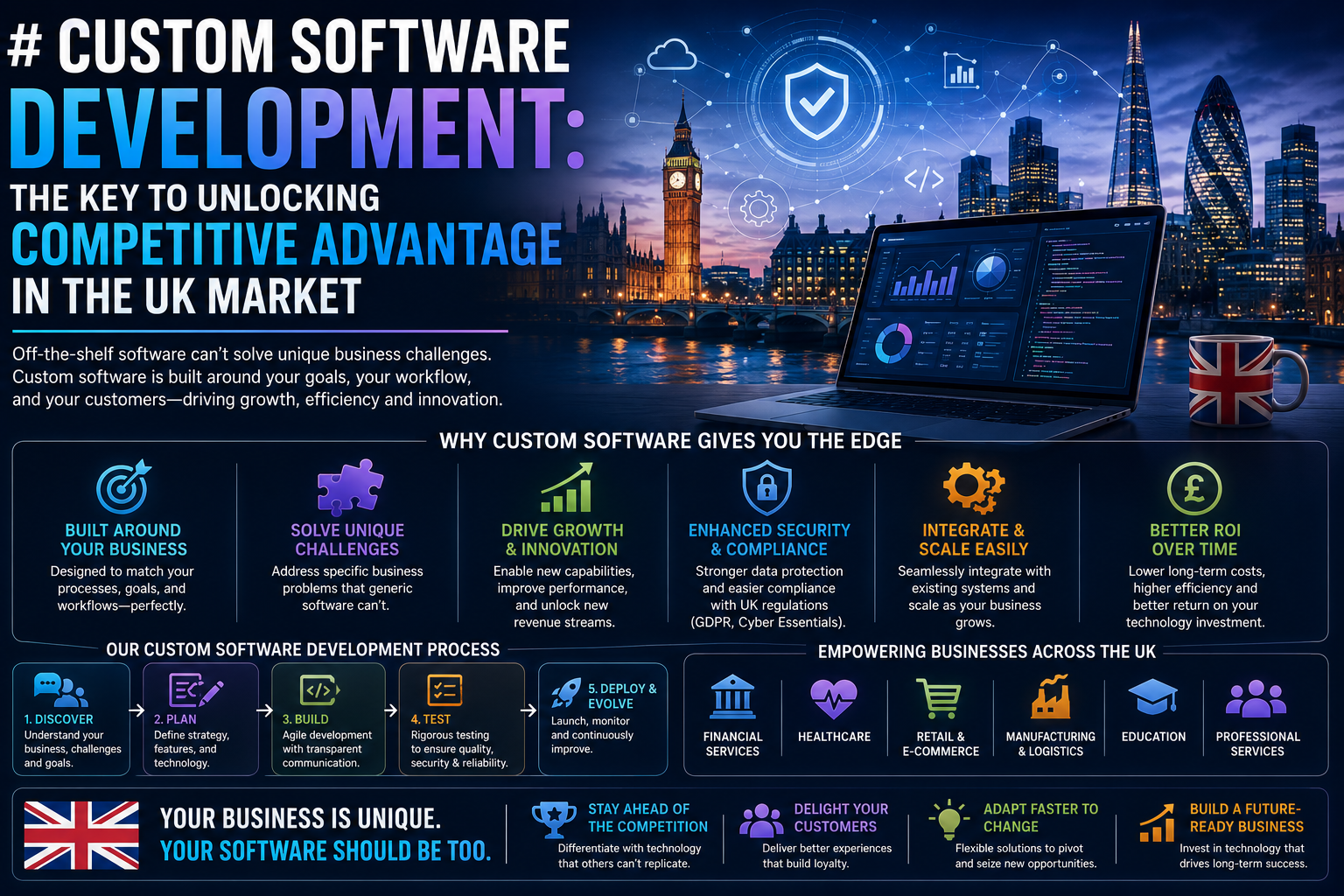
Custom software development is no longer a luxury in today's digital transformation era, where technology drives practically every element of business; it is a need for companies seeking to remain competitive and efficient. Tailor-made solutions are more than simply tools; they are strategic assets that may transform your operations by bringing up opportunities and encouraging innovation.
What is Custom Software?
Custom software development is an IT solution developed specifically for a certain business or user, as opposed to commercial products that are available off the shelf. It is completely customised to the client's specific demands, processes, and company objectives, and is meticulously designed to meet their exact specifications. This custom approach guarantees that the software provides optimal efficiency and flexibility while integrating seamlessly with the business's processes.
Key Features of Custom Software
- Personalisation: Every part of the software is tailored to the user's specific demands, assuring a perfect match.
- Flexibility: Easy to modify and grow as your company's demands change, allowing for long-term adaptability.
- Seamless Integration: Integrates seamlessly with your company's existing systems and technologies, assuring operational continuity.
- Enhanced User Experience: With custom software, businesses can design interfaces and workflows that are intuitive and user-friendly, leading to higher employee productivity and satisfaction.
Getting a competitive edge in the UK market
1. Improved Efficiency and Productivity
By automating repetitive tasks and streamlining processes, custom software can drastically improve operational efficiency. For instance, businesses can eliminate manual data entry or optimise supply chain management, allowing employees to focus on higher-value activities.
2. Better Data Management and Analytics
Custom software may include powerful data management and analytics features that are tailored to a company's specific requirements. This means companies can gather insights that drive decision-making, identify trends, and respond quickly to market changes. In a data-driven environment, the ability to harness information effectively can set a business apart from its competitors.
3. Enhanced Customer Engagement
Today’s consumers expect personalised experiences. Custom software allows businesses to tailor their services and communications, leading to higher customer satisfaction and loyalty. For example, businesses can develop customer relationship management (CRM) systems that track interactions and preferences, enabling more targeted marketing efforts.
4. Innovation and Adaptability
Custom software development encourages innovation. Businesses can experiment with emerging technologies like artificial intelligence and machine learning to produce one-of-a-kind solutions that match market expectations. Moreover, the flexibility of custom software allows organisations to pivot quickly in response to changes in consumer behaviour or market conditions.
Challenges of Custom Software Development
1. Costs and Project Timeline
Custom software development is generally more expensive than off-the-shelf options. These costs can be a significant barrier for many businesses, especially small and medium-sized enterprises. Additionally, accurately estimating the total project budget can be challenging due to the complexity and scope of custom projects. There is also a risk of exceeding the planned timeline for completion, which can lead to increased costs and delays in realising the benefits of the software.
2. Data Security
Ensuring adequate security levels for sensitive data is a critical challenge in custom software development. During the development process, there is a risk of security breaches, which can compromise sensitive information. Moreover, the software needs continuous security updates to protect against emerging threats. This ongoing requirement can be resource-intensive and requires a proactive approach to maintain robust security measures.
3. Integration with Existing Systems
Integrating new custom software with legacy systems can be a complicated and challenging task. There is a risk of data or functionality loss during the migration process, which can disrupt business operations. Additionally, potential conflicts between different systems can arise, requiring careful planning and execution to ensure seamless integration and minimal disruption.
4. Maintenance and Software Development
To stay effective and secure, custom software must be updated and adjusted on a regular basis. This ongoing maintenance can be resource-intensive and may lead to vendor lock-in, where a business becomes overly dependent on the original developer for updates and support. Finding specialists with the necessary skills to maintain and update the custom software can also be challenging, adding to the complexity of long-term maintenance.
5. Regulatory Compliance
Custom software developers have considerable challenges in adapting to changing rules such as GDPR and CCPA. Non-compliance with these regulations can result in financial penalties and damage to a company’s reputation. Additionally, the complexity of regulatory requirements can be even greater for businesses operating internationally, as they must navigate and comply with multiple sets of regulations across different jurisdictions.
Conclusion
The software development industry has advanced significantly over the last decade, as organisations and consumers have become increasingly reliant on electronic gadgets in many parts of their daily lives. Software developers' revenue is expected to climb at a compound annual rate of 3.1% over the five years through 2024-25 to £45.8 billion in UK. Custom software development UK gives businesses that edge by advertising highlights and capabilities that are not accessible in nonexclusive software arrangements. This competitive edge may be the key to staying ahead in the UK market, where development and variations are critical.
 Deutsch
 English
 Arabic
 Français
 Español
 Português
 Türkçe
 Dutch
Dutch
 Italiano
 Russian
 Romaian