


Clinical Data Management Courses: Complete Beginner’s Guide to CDM Skills, Roles and Career Growth
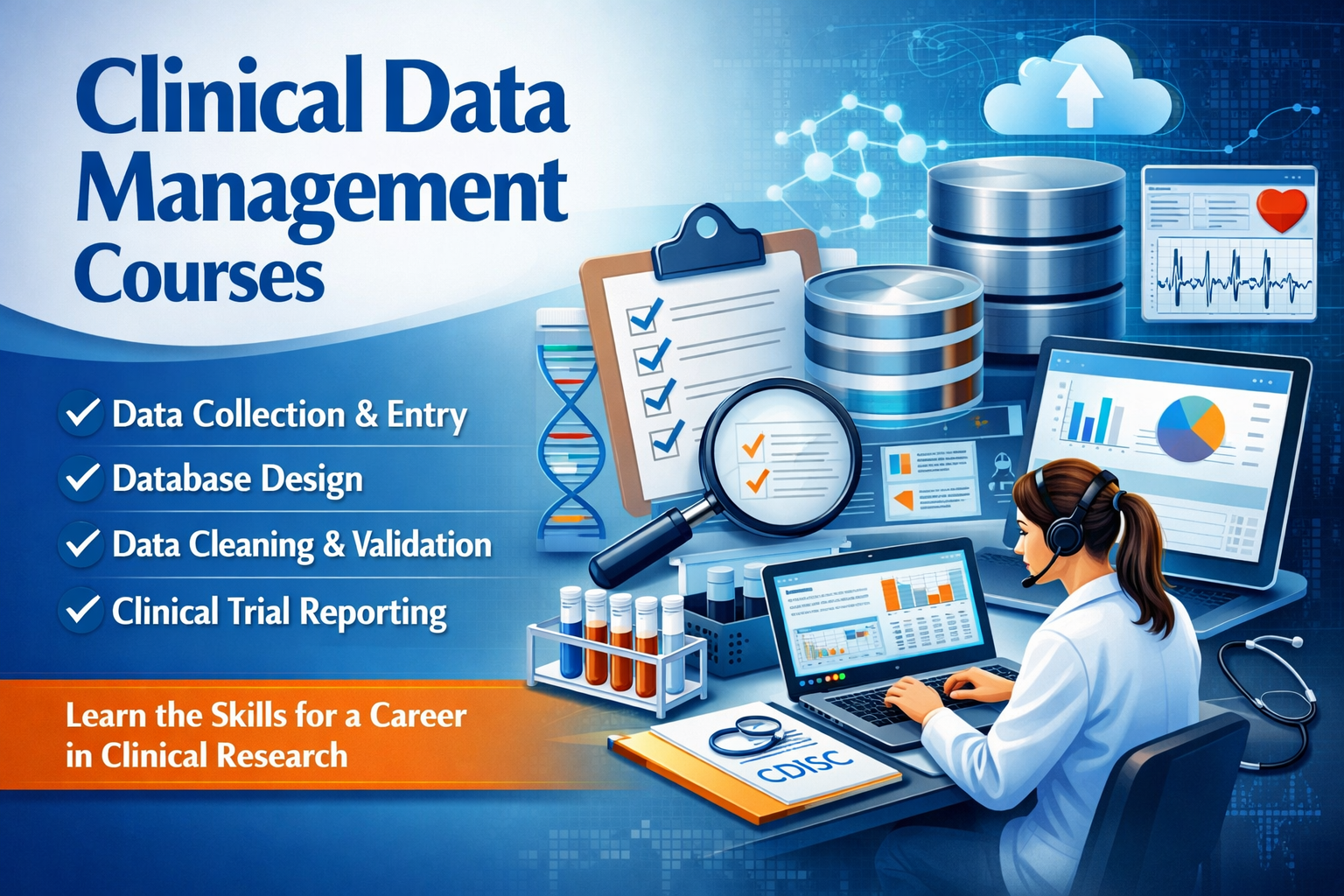
Clinical trials generate large volumes of information, from patient records and laboratory results to safety reports and treatment outcomes. Managing this information accurately is essential for producing reliable clinical research results. A clinical data management course helps students and professionals develop the knowledge and practical skills required to collect, validate, organize, and maintain clinical trial data according to industry standards.
With the expansion of clinical research, pharmaceutical companies, contract research organizations (CROs), and biotechnology companies continue to require trained professionals who understand clinical data processes. This makes Clinical Data Management (CDM) an attractive career option for graduates from life sciences, pharmacy, biotechnology, nursing, and related backgrounds.
What Is a Clinical Data Management Course?
A clinical data management course is a career-oriented training program that introduces learners to the complete lifecycle of clinical trial data. The course generally covers data collection, database design, data validation, discrepancy management, data cleaning, medical coding, query management, and database lock procedures.
Depending on the training institute, clinical data management courses may combine theoretical lessons with practical exercises and real-world clinical trial examples. This approach helps learners understand how CDM teams contribute to the quality and reliability of clinical research.
Why Choose Clinical Data Management as a Career?
Clinical Data Management plays an important role in ensuring that clinical trial data is complete, accurate, consistent, and suitable for analysis. A trained CDM professional can work with clinical research teams, investigators, data managers, biostatisticians, medical coders, and other stakeholders.
Some common career opportunities after completing cdm courses include:
- Clinical Data Management Associate
- Clinical Data Coordinator
- Clinical Data Manager
- Clinical Database Programmer
- Clinical Data Validation Specialist
- Medical Coding Associate
- Clinical Research Associate with data-management exposure
Career progression can depend on educational qualifications, practical knowledge, software skills, certifications, and industry experience.
What Will You Learn in Clinical Data Management Courses?
A well-structured clinical data management course can cover several important areas of clinical research data handling. Typical topics include:
Clinical Trial Fundamentals
Students learn the basic concepts of clinical trials, study phases, protocols, clinical trial documentation, and the roles of different research teams.
Clinical Database Management
Learners are introduced to the principles of designing and maintaining clinical databases. They may also understand forms, fields, data structures, and database specifications used in clinical studies.
Data Validation and Cleaning
Data validation helps identify missing, inconsistent, or incorrect information. Training generally explains validation checks, data discrepancies, edit checks, and query management.
Medical Coding
Many CDM programs introduce medical coding concepts, including the importance of standardized medical terminology and coding systems used in clinical research.
Data Review and Quality Control
Participants learn how data is reviewed for accuracy and consistency. Quality-control practices help reduce errors and improve the reliability of clinical trial datasets.
Database Lock
Database lock is an important stage in the clinical data lifecycle. Students can learn how data cleaning, query resolution, reconciliation, and final review contribute to database lock readiness.
Clinical Data Management Course in Pune
Pune has developed into an important education and technology hub, with opportunities across healthcare, life sciences, biotechnology, and clinical research. For learners looking for a clinical data management course in Pune, classroom and online training options can provide flexible ways to develop industry-focused skills.
When comparing clinical data management courses in Pune, students should evaluate the syllabus, practical training, trainer experience, learning format, software exposure, placement support, and certification options rather than selecting a program based only on price.
Clinical Data Management Course Fees
The clinical data management course fees can vary depending on the institute, course duration, delivery format, curriculum, practical sessions, certification, and additional career-support services. Online, classroom, and advanced certification programs may have different fee structures.
Before enrolling, prospective students should request a complete fee breakdown and check what is included in the program. Comparing curriculum quality and practical exposure alongside fees can help students make a more informed decision.
Who Can Enroll in CDM Courses?
CDM courses are particularly useful for graduates and professionals from fields such as:
- Pharmacy
- Biotechnology
- Microbiology
- Life Sciences
- Biochemistry
- Nursing
- Medicine and allied healthcare
- Clinical research
The exact eligibility criteria vary between institutes, so applicants should verify the requirements before enrollment.
How to Choose the Right Clinical Data Management Course?
Choosing the right program can influence how effectively you develop practical CDM skills. Look for a course that offers a structured curriculum covering the clinical data lifecycle, practical assignments, case studies, industry-relevant tools, and experienced trainers.
It is also useful to examine whether the institute provides interview preparation, resume assistance, career guidance, or placement support. These services can help learners transition from classroom learning toward employment opportunities.
Future Scope of Clinical Data Management
The growing complexity of clinical trials and increasing emphasis on data quality are creating demand for professionals who understand clinical data processes. Modern CDM is also evolving through automation, electronic data capture systems, data standards, analytics, and technology-driven clinical research workflows.
Professionals who continuously develop their knowledge of clinical trial regulations, data standards, technology, and quality practices can strengthen their long-term career prospects.
Conclusion
A clinical data management course can provide a practical foundation for individuals interested in building a career in clinical research and healthcare data management. From clinical database concepts and data validation to medical coding and database lock, the right training program can help learners understand the complete clinical data lifecycle.
For students comparing clinical data management courses, particularly those searching for a clinical data management course in Pune, factors such as curriculum, practical exposure, trainer expertise, course fees, certification, and career support should all be considered before making a decision.

 Arabic
 Français
 Español
 Português
 Deutsch
 Türkçe
 Dutch
Dutch
 Italiano
 Russian
 Romaian