


The Comprehensive Guide to AI Research Paper Helpers: Accelerating Literature Reviews, Analysis, and Academic Writing
Conducting academic research is one of the most intellectually demanding endeavors in higher education and professional science. Scholars, graduate students, and independent analysts must navigate millions of published journal articles, extract complex methodologies, synthesize conflicting findings, and format extensive manuscripts according to rigid citation standards. The sheer volume of published literature creates severe research bottlenecks, turning literature discovery and structural drafting into exhausting, multi-month hurdles.
A Research Paper Helper leverages natural language processing (NLP), semantic search engines, and generative AI to assist researchers across every stage of the academic lifecycle. By functioning as an intelligent research companion, these tools reduce cognitive overload, streamline discovery, and elevate the overall rigor and clarity of scholarly work.
What Is a Research Paper Helper?
A Research Paper Helper is an AI-driven academic assistant engineered to support researchers through discovery, reading comprehension, data synthesis, citation management, and manuscript drafting. Unlike generic conversational chatbots, academic research assistants are trained on scholarly corpora, indexed citation graphs, and peer-reviewed databases.
These platforms operate across two primary domains:
-
Semantic Discovery and Synthesis: Instead of relying solely on exact keyword matches, research helpers use vector embeddings to understand the conceptual intent behind a research query. They identify foundational papers, trace citation trees, map emerging research trends, and synthesize consensus across dozens of studies simultaneously.
-
Writing, Structuring, and Verification: Research helpers assist in organizing complex arguments, converting rough field notes into formal academic prose, ensuring adherence to specific style guides (such as APA, IEEE, or Chicago), and checking for structural clarity and logical coherence.
Core Functionalities of Academic Research Assistants
Modern research helper platforms provide integrated toolsets tailored to the academic workflow:
-
Interactive Document Deep Dives: Users can upload lengthy PDFs and interrogate the text directly. The AI pinpoints specific statistical findings, summarizes research designs, and clarifies mathematical models or dense theoretical frameworks.
-
Automated Literature Matrix Generation: Creating comparative tables across multiple papers is traditionally tedious. A research helper can parse twenty studies at once and generate a structured matrix comparing sample sizes, independent variables, outcomes, and research limitations.
-
Citation and Source Grounding: Premium academic tools cite every generated claim directly back to specific page numbers, DOIs, or paragraph excerpts, eliminating the risk of fabricated citations common in generic AI models.
-
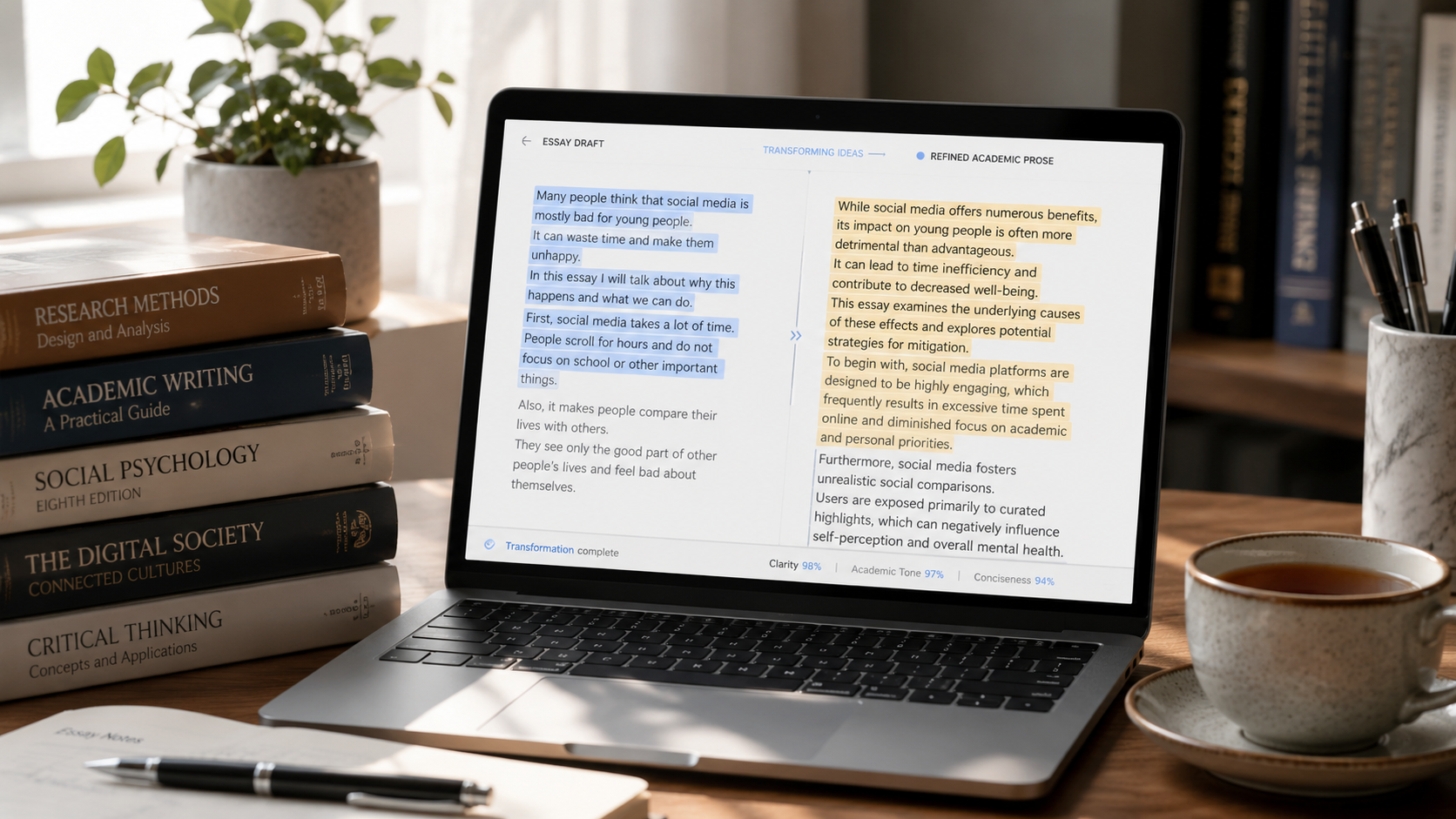
Academic Tone and Argument Polishing: These tools refine rough prose to match formal scholarly standards, eliminating passive ambiguities, conversational fillers, and repetitive transitions.
Key Stages of the Academic Lifecycle Supported by AI
| Research Stage | Traditional Friction | How a Research Paper Helper Solves It |
| Topic Exploration | Endless searching through irrelevant keywords | Semantic concept mapping and research gap identification |
| Literature Review | Reading hundreds of 30-page PDFs manually | Instant extraction of core findings, methods, and limitations |
| Methodology Design | Searching for validated measurement scales | Rapid comparison of standard experimental designs in the field |
| Drafting & Writing | Writer’s block, phrasing issues, disorganized outlines | Structured outlining, paragraph expansion, and clarity refinement |
| Formatting & Referencing | Manual citation styling and reference cross-checking | Automated formatting across thousands of institutional citation styles |
Practical Best Practices for Using a Research Helper
To maintain high academic integrity and extract maximum value from a research paper helper, scholars should follow a structured, human-in-the-loop methodology:
1. Formulate Precise, Hypothesis-Driven Prompts
Avoid vague prompts like "Explain cancer treatments." Instead, formulate specific, structured research inquiries, such as: "Synthesize the reported efficacy and adverse effects of immunotherapy versus standard chemotherapy in treating stage-three non-small cell lung cancer across peer-reviewed clinical trials published between 2020 and 2026."
2. Always Verify Primary Source Materials
Never rely blindly on an automated synthesis for critical empirical claims. Always click through to the linked primary study, verify the statistical confidence intervals, examine sample constraints, and confirm that the paper was published in a reputable, peer-reviewed venue.
3. Use AI for Scaffolding, Not Ghostwriting
An ethical research helper serves to organize thoughts, overcome writer's block, and clarify complex explanations. The original hypotheses, theoretical analysis, experimental execution, and substantive conclusions must originate from the researcher. Use the tool to generate outlines, highlight counterarguments, and refine syntax.
4. Disclose AI Assistance When Required
Academic journals, universities, and granting bodies increasingly require transparent disclosure regarding the use of generative AI and automated research assistants. Ensure compliance with institutional guidelines by detailing tool usage in the methodology or acknowledgments section where appropriate.
Guarding Against Critical Pitfalls
While research paper helpers dramatically improve productivity, uncritical usage introduces potential hazards:
-
Publication Bias and Hallucinations: Even specialized models can misinterpret statistical significance or generate plausible-sounding but erroneous conclusions if trained on incomplete data. Rigorous cross-checking is mandatory.
-
Echo Chambers in Discovery: Algorithmic recommendation engines may repeatedly surface highly cited, mainstream papers while overlooking obscure, groundbreaking work published in niche or regional journals. Combine automated search with manual archival exploration.
-
Plagiarism and Originality Risks: Pasting raw AI outputs directly into a manuscript risks accidental duplication of existing literature phrasing. Always rewrite, synthesize, and internalize arguments in your own scholarly voice.
The Future of Scholarly Research
The integration of artificial intelligence into scientific inquiry represents a fundamental shift in how human knowledge is indexed and advanced. Future research paper helpers will integrate directly with laboratory equipment, real-time data feeds, and open-science repositories, running automated meta-analyses and identifying promising hypotheses before experiments even begin.
By integrating a Research Paper Helper into your daily academic workflow as an intellectual sounding board and organizational tool, you can eliminate administrative overhead, conduct more comprehensive literature reviews, and dedicate your core mental energy to genuine scientific discovery.

 Arabic
 Français
 Español
 Português
 Deutsch
 Türkçe
 Dutch
Dutch
 Italiano
 Russian
 Romaian