


How Feeler Gauges Improve CNC Machine Maintenance
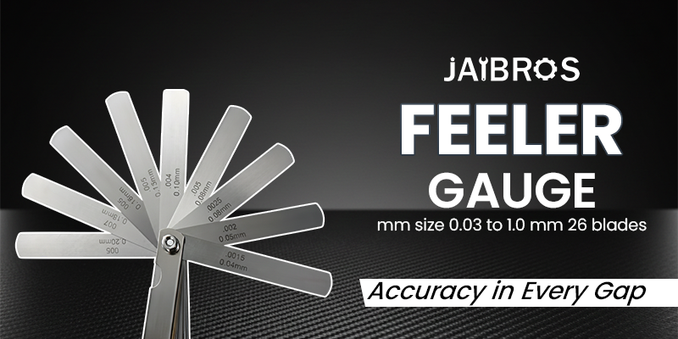
Accuracy in CNC machine work needs not only precision programming and excellent cutting tools but also ensures that machine components have the right clearance. Any variation in the gap that exists between two surfaces affects the accuracy of their alignment, friction, vibrations, and even their wear. Therefore, checking clearances should be done carefully for accuracy.
The feeler gauge offers one of the simplest methods for measuring narrow gaps in machines during the process of their calibration, adjustment, and maintenance. Unlike other complicated measuring instruments, the blades of this tool are designed with known dimensions, which are used to measure the gap and determine if it falls within acceptable limits.
Why Clearance Matters in Precision CNC Machining
Clearance plays an important role in the performance of CNC machines because many mechanical components need a controlled amount of space to move, expand, or operate correctly. If a clearance is too small, friction and heat can increase. If it is too large, unwanted movement and vibration may occur. Therefore, checking clearances should be part of an effective maintenance routine.
A feeler gauge can support these inspections by providing a practical comparison between the actual gap and a known blade thickness. It is particularly useful when the technician needs to make a quick check without removing the complete assembly.
Key applications include:
-
Checking gaps between mating mechanical surfaces.
-
Inspecting fixture and workholding components.
-
Verifying adjustment clearances.
-
Checking selected machine assemblies during maintenance.
-
Identifying changes caused by mechanical wear.
-
Supporting alignment and setup procedures.
Understanding the Least Count of a Feeler Gauge
The feeler gauge least count represents the smallest thickness difference that can be selected from the blades available in a particular set. A set normally contains multiple leaves, and each leaf has a specific thickness. Depending on the design, technicians can use individual blades or combine several blades to reach a required clearance.
Understanding the feeler gauge least count is important when working with small tolerances. If a set has smaller thickness increments, it becomes easier to approach a specific clearance. However, the ideal set is not necessarily the one containing the greatest number of blades. The range and increments should correspond to the measurements normally required for the machine.
Important factors to consider are:
-
Minimum blade thickness.
-
Maximum blade thickness.
-
Thickness increments.
-
Number of blades.
-
Accuracy of blade markings.
-
Material and durability.
-
Ease of blade selection.
The feeler gauge least count should therefore be considered according to the actual maintenance requirement rather than treated as the only factor when selecting a set.
Choosing the Right Sizes and Using Them Correctly
Different applications require different blade ranges. Feeler gauge sizes in mm are available in various combinations, allowing users to select a set according to the clearances they regularly inspect. Thin blades are suitable for very small gaps, while thicker blades can be useful for larger mechanical clearances.
Correct handling is just as important as selecting the appropriate range. The surfaces being checked should be clean, and the blade should be inserted carefully rather than forced into the opening. Excessive force can bend the blade or affect the component being inspected.
For accurate use, technicians should follow these practices:
-
Clean the contact surfaces before inspection.
-
Select a blade close to the expected clearance.
-
Insert the blade gently.
-
Look for slight and consistent resistance.
-
Combine blades when the required thickness is not available individually.
-
Add the thicknesses of combined blades to determine the total value.
-
Record important measurements during scheduled maintenance.
The available feeler gauge sizes in mm should always be compared with the machine manufacturer's recommended clearance range.
Maintenance and Care for Long-Term Accuracy
A measurement tool can only provide dependable results when it is maintained properly. Blades can become bent, scratched, corroded, or contaminated with oil and metal particles during workshop use. These conditions may affect the way a blade fits into a gap and can lead to incorrect conclusions.
Regular care helps maintain the condition of the set and makes inspections more reliable. Technicians should inspect the blades before and after frequent use, particularly when the tool is used in demanding industrial environments.
Good maintenance practices include:
-
Wiping blades after use.
-
Removing metal chips and workshop debris.
-
Checking blades for bending or deformation.
-
Keeping thickness markings readable.
-
Preventing unnecessary exposure to moisture.
-
Storing blades inside their protective holder or case.
-
Replacing damaged or heavily worn leaves.
-
Periodically verifying critical measurements with suitable reference equipment.
Proper storage also prevents individual leaves from becoming mixed up or damaged, making the tool easier to use during future maintenance work.
Factors That Influence the Cost
The feeler gauge price depends on several factors rather than simply the number of blades included in a set. Blade material, thickness range, manufacturing quality, surface finish, protective case, and overall construction can all influence the cost.
For basic maintenance tasks, a standard set may provide sufficient coverage. Industrial workshops with demanding inspection requirements may prefer sets designed for frequent use and greater durability. Therefore, buyers should consider whether the specifications match their application instead of selecting a set based only on the feeler gauge price.
When evaluating different options, consider:
-
Required measurement range.
-
Blade thickness increments.
-
Material quality.
-
Durability.
-
Clarity of markings.
-
Storage and protection.
-
Frequency of workshop use.
-
Compatibility with maintenance requirements.
A suitable set should provide the required range while remaining convenient for technicians to handle and maintain.
How It Supports Preventive CNC Maintenance
Preventive maintenance focuses on identifying potential problems before they interrupt production. Clearance checks can contribute to this process because changes in mechanical gaps may indicate wear, incorrect adjustment, or developing alignment issues.
Using a feeler gauge during scheduled inspections can help technicians compare current conditions with machine specifications or previous maintenance records. If a clearance gradually changes, the information can be investigated before the affected component causes more serious problems.
Key benefits include:
-
Faster routine clearance checks.
-
Early identification of mechanical changes.
-
Support for machine adjustment.
-
Reduced dependence on complicated inspection procedures for basic gap checks.
-
Better maintenance documentation.
-
Improved consistency during repeated inspections.
It is important to remember that this tool does not replace precision measuring instruments. For critical dimensions requiring very high accuracy, technicians should use the measuring equipment specified by the machine or component manufacturer.
Conclusion
Both cutting accuracy and mechanical stability play an important role in precision CNC machining. Correct clearances ensure that the parts work as intended, and inspection can provide valuable information about the modifications made due to wear, improper adjustment, and mechanical stresses.
Using the appropriate tool for clearing checking is a feasible option to include in CNC maintenance processes. When used and kept properly, it allows making accurate and quick inspections and making appropriate maintenance decisions. Jaibros can be taken into consideration when searching for measuring and industrial instruments, but the final decision always should be made according to certain application needs and specifications.
FAQs
1. What is a feeler gauge used for in CNC maintenance?
It is mainly used to check narrow gaps and mechanical clearances between two surfaces. It can help technicians verify whether a clearance is close to the specified value.
2. Why is the least count important?
The least count determines the smallest thickness increment available in a set. Smaller increments can make it easier to check or adjust narrow clearances accurately.
3. Can multiple blades be used together?
Yes. Multiple blades can be combined when a single blade does not provide the required thickness. Their individual thicknesses are added to determine the combined measurement.
4. How should the blades be stored?
They should be cleaned after use and stored in their protective holder or case. This helps prevent bending, corrosion, contamination, and loss of individual blades.
5. Is this tool suitable for every CNC measurement?
No. It is primarily designed for clearance checking. Critical dimensional measurements should be performed using an appropriate precision instrument recommended for the specific application.
 Deutsch
 English
 Arabic
 Français
 Español
 Português
 Türkçe
 Dutch
Dutch
 Italiano
 Russian
 Romaian