


AI Engineer vs Machine Learning Engineer: Which Career Is Right for You?
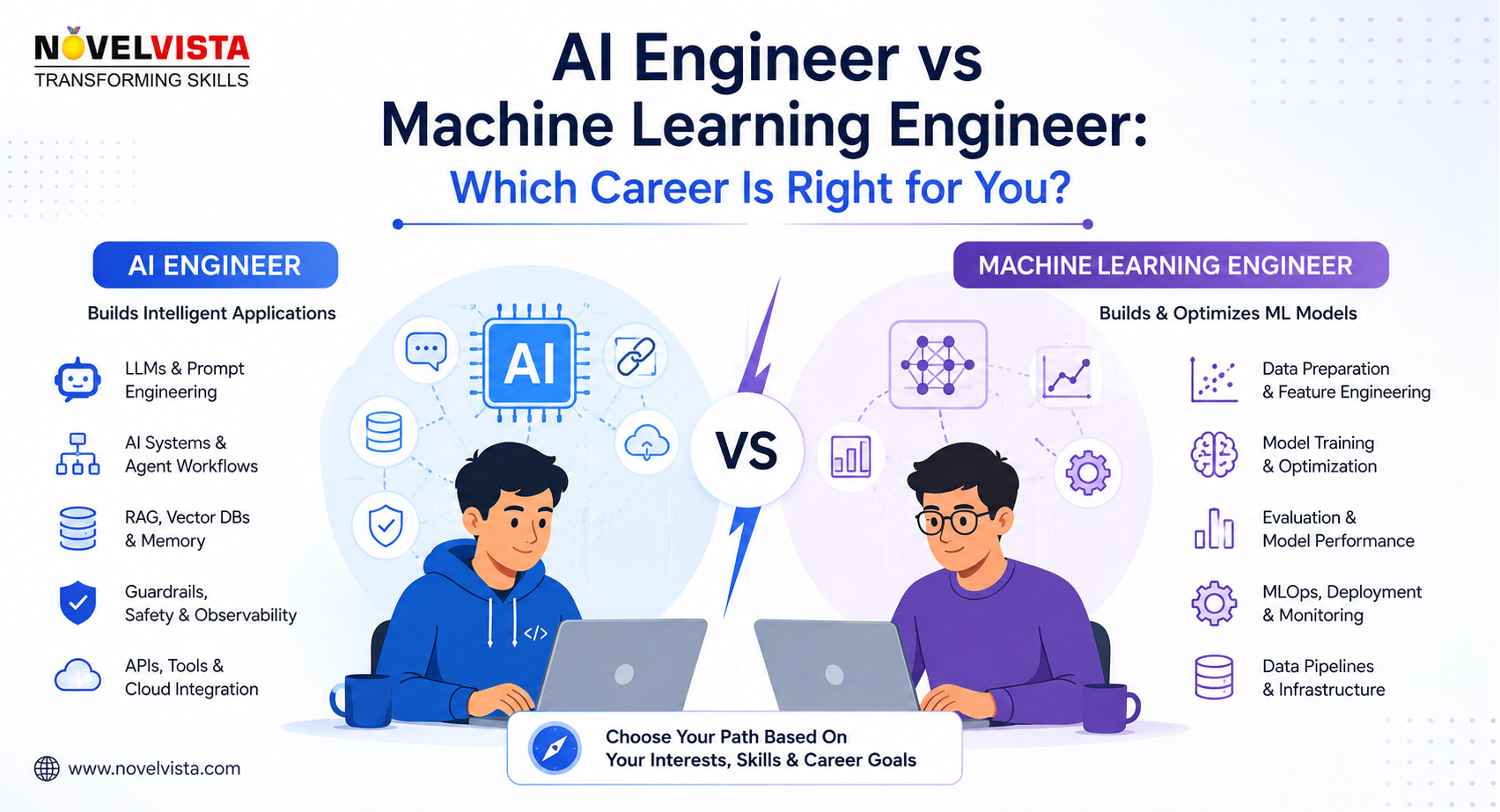
Artificial intelligence is creating a wide range of career opportunities, but the growing number of job titles can make choosing the right path confusing. Two roles that are often compared are AI engineer and machine learning engineer.
Both professionals work with intelligent technologies, data, models, and software systems. However, their responsibilities and day-to-day priorities are not exactly the same. Understanding these differences can help you choose a career that matches your technical interests and long-term goals.
What Is an AI Engineer?
An AI engineering designs, develops, integrates, and deploys applications powered by artificial intelligence. The role has a broad scope and may involve machine learning, natural language processing, computer vision, generative AI, large language models, RAG systems, or AI agents.
AI engineers often focus on building complete, user-facing solutions. Instead of working only on the underlying model, they connect models with databases, APIs, business systems, cloud infrastructure, and application interfaces.
For example, an AI engineer may develop a customer-service assistant that retrieves information from company documents, generates grounded responses, creates support tickets, and transfers complex cases to a human agent.
Common responsibilities include:
- Integrating AI models with applications
- Building RAG pipelines and AI agents
- Connecting models to databases and APIs
- Evaluating AI-generated responses
- Implementing safety and security controls
- Deploying AI applications to cloud platforms
- Monitoring accuracy, latency, usage, and cost
- Improving the overall user experience
What Is a Machine Learning Engineer?
A machine learning engineer focuses primarily on building, training, optimising, deploying, and maintaining machine learning models.
These professionals work closely with data scientists, data engineers, software developers, and business teams. Their goal is to transform data and experiments into scalable machine learning systems that can operate reliably in production.
For example, a machine learning engineer may create a model that predicts whether a customer is likely to cancel a subscription. The engineer prepares the training pipeline, selects features, trains different algorithms, evaluates performance, deploys the best model, and monitors its predictions over time.
Typical responsibilities include:
- Preparing and transforming training data
- Selecting machine learning algorithms
- Training and tuning models
- Developing reusable model pipelines
- Performing feature engineering
- Deploying models into production
- Monitoring model drift and performance
- Automating retraining and version control
Key Differences Between the Two Roles
1. Scope of Work
AI engineering is generally broader. It covers the complete development of AI-powered applications and may use existing foundation models rather than training models from the beginning.
Machine learning engineering has a deeper focus on the model lifecycle. It often involves training models using organisational data and improving their predictive performance.
An AI engineer may use an existing large language model to build an intelligent assistant. A machine learning engineer may build a custom classification or forecasting model from historical data.
2. Model Development
Machine learning engineers regularly train, tune, and optimise models. They compare algorithms, engineer features, manage experiments, and evaluate statistical performance.
AI engineers may also train or fine-tune models, but they frequently work with pre-trained models provided through APIs or open-source platforms. Their work focuses more on orchestration, integration, evaluation, and application design.
3. Types of Projects
Machine learning engineers commonly work on:
- Fraud detection
- Demand forecasting
- Recommendation systems
- Predictive maintenance
- Customer-churn prediction
- Image or text classification
AI engineers frequently build:
- Generative AI assistants
- Intelligent search systems
- RAG applications
- Document-processing solutions
- AI agents and copilots
- Automated decision-support tools
These categories can overlap. The distinction often depends on how a company defines its roles.
4. Required Skills
Both roles require programming, data management, cloud computing, and software-engineering knowledge. Python is widely used in each career.
Machine learning engineers usually need deeper knowledge of:
- Statistics and probability
- Machine learning algorithms
- Feature engineering
- Model tuning and optimisation
- Experiment tracking
- Data and training pipelines
- Model drift and retraining
AI engineers often require stronger skills in:
- Large language models
- Prompt engineering
- Embeddings and vector databases
- RAG architecture
- AI agents and tool calling
- API and business-system integration
- Generative AI evaluation
- AI security and governance
5. Testing and Evaluation
Machine learning engineers evaluate models using metrics such as accuracy, precision, recall, F1 score, mean squared error, or area under the curve. The correct metric depends on the prediction problem.
AI engineers must also evaluate less predictable outputs. For a generative AI application, they may measure relevance, factual accuracy, faithfulness, safety, response quality, latency, and token cost.
Testing whether an AI assistant produces an answer is easy. Determining whether that answer is trustworthy is the harder—and more important—part.
Where Do the Roles Overlap?
The two careers have considerable overlap. Both professionals may deploy models, build APIs, use cloud platforms, work with data pipelines, monitor production systems, and apply MLOps practices.
In smaller companies, one person may perform both roles. In larger organisations, machine learning engineers may concentrate on model development, while AI engineers build broader applications around those models.
Job titles are not always consistent. It is therefore important to read the actual job description instead of relying only on the title.
Which Career Is Right for You?
A machine learning engineering career may be suitable if you enjoy mathematics, statistics, data analysis, model experimentation, and performance optimisation. It is a strong choice for professionals who want to understand how models learn and how their predictions can be improved.
AI engineering may be a better fit if you enjoy software development, system integration, cloud deployment, and building complete AI-powered products. It is particularly relevant for developers interested in generative AI, RAG, agents, and enterprise automation.
Software developers may find AI engineering to be a more direct transition because many of their existing skills apply immediately. Data scientists and professionals with strong mathematical foundations may prefer machine learning engineering.
Final Thoughts
AI engineers and machine learning engineers both play important roles in building intelligent systems. The machine learning engineer focuses more deeply on developing and operating models, while the AI engineer focuses more broadly on turning AI capabilities into useful applications.
Neither career is better than the other. The right choice depends on whether you are more interested in improving the intelligence inside the system or building the complete system around that intelligence. In either case, strong programming skills, practical projects, and continuous learning will help you build a successful career.

 English
 Arabic
 Français
 Español
 Deutsch
 Türkçe
 Dutch
Dutch
 Italiano
 Russian
 Romaian