


Beyond Cybersecurity: How Banks are Turning Digital Risk Into a Continuous Intelligence Advantage
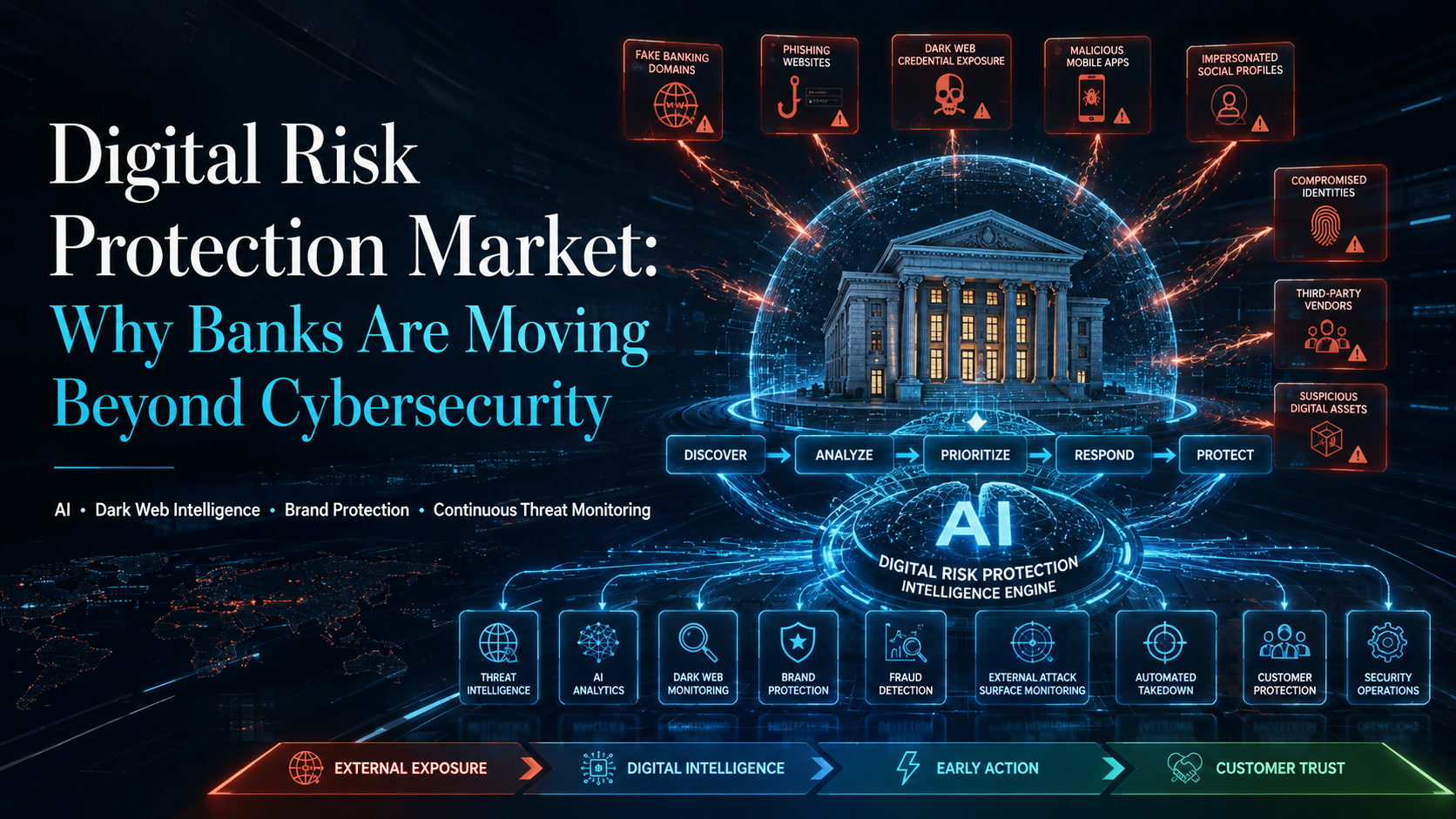
The New Banking Risk Battlefield: Where Trust Meets Technology
Continuous digital risk protection helps banks monitor phishing, impersonation, exposed credentials, malicious domains and dark-web activity alongside conventional cybersecurity.
The Digital Risk Protection Market is entering a more consequential phase as banks expand protection beyond infrastructure they directly control. A modern financial institution operates across mobile applications, websites, payment interfaces, APIs, cloud services, social channels, employee identities, suppliers and customer-facing platforms.
That expansion is fundamentally changing the risk equation.
Firewalls defend network boundaries. Endpoint security protects devices. Identity controls secure accounts. Yet none of these controls alone answers one increasingly important question: What is happening to the bank outside its perimeter right now?
That question is becoming central to modern banking resilience.
Banks need visibility into fake domains, phishing campaigns, impersonation, leaked credentials, malicious applications, counterfeit profiles and exposed information—often before these threats become incidents.
The result is a convergence of cybersecurity, fraud prevention, digital brand protection and customer trust.
Market Context: Why Digital Risk Is Becoming Continuous
Markets Research estimates the global Digital Risk Protection Market at approximately USD 64.4 billion in 2023 and projects USD 157.8 billion by 2028 at a 19.6% CAGR.
Discover emerging business opportunities Download the PDF supported by extensive market research.
These figures point to a broader transformation rather than another incremental security upgrade.
Banks increasingly operate through digital environments that function simultaneously as:
- Customer acquisition channels
- Payment infrastructure
- Communication platforms
- Identity ecosystems
- Data environments
- Targets for impersonation and fraud
The market is being supported by demand for automated threat mitigation, phishing protection, incident response and broader external visibility.
India illustrates the acceleration. The supplied market assessment places the country's market at approximately USD 2.12 billion in 2023 and USD 7.16 billion by 2028, representing a 27.6% CAGR. Its BFSI segment is projected to expand at 24.9% CAGR.
For banking leaders, the implication is significant: digital trust is becoming an operational asset.
The Perimeter Problem: Where Traditional Security Loses Visibility
Traditional cybersecurity can leave visibility gaps when threats originate outside controlled infrastructure through phishing, impersonation, leaked credentials and malicious external assets.
The fundamental challenge is not necessarily insufficient security. It is that digital exposure is expanding faster than traditional security boundaries.
Consider the modern attack sequence:
Fake Domain → Customer Interaction → Credential Theft → Account Compromise → Fraud → Reputation Damage
The fraudulent domain may never interact directly with the bank's internal network.
That creates several operational weaknesses:
- Security teams may discover threats only after customer complaints.
- Fraud and cybersecurity teams may operate independently.
- Brand teams may lack security intelligence.
- Threat intelligence may not reach response teams quickly.
- Manual investigation can consume analyst capacity.
- External assets can change faster than periodic assessments can detect them.
The consequences can extend beyond technical remediation to fraud losses, customer complaints, investigation costs, regulatory exposure and reputational damage.
The strategic challenge is therefore increasingly about visibility and speed.
From Detection to Digital Risk Intelligence
Digital risk protection connects external monitoring, threat intelligence, risk prioritization and automated response to help organizations identify and address threats earlier.
The next-generation model is not simply another monitoring dashboard. It is an intelligence cycle:
DISCOVER → VERIFY → PRIORITIZE → RESPOND → LEARN
Discover: Identify suspicious domains, accounts, applications, credentials and external indicators.
Verify: Determine whether an asset is connected to the bank, its customers, employees or suppliers.
Prioritize: Apply contextual intelligence and risk scoring to distinguish urgent threats from background noise.
Respond: Initiate takedown, investigation, blocking, credential protection or escalation workflows.
Learn: Feed outcomes back into detection and intelligence processes.
This is where automation becomes strategically important. Detecting hundreds of signals is not enough if analysts must investigate every alert manually.
The real objective is fewer alerts, stronger context and better decisions.
This Sample Report is designed to fuel your business growth download it today.
AI Changes the Economics of External Risk
AI can correlate external signals, identify suspicious patterns, prioritize threats and accelerate digital-risk investigations.
Financial institutions encounter enormous volumes of information across:
- Open-web sources
- Social platforms
- Dark-web environments
- Domain registrations
- Mobile applications
- Credential repositories
- Threat-intelligence feeds
- Customer reports
- Third-party ecosystems
The challenge is not collecting everything. It is determining what matters now.
AI can support entity matching, phishing detection, image recognition, anomaly detection, threat classification, risk scoring, investigation summaries and automated prioritization.
That changes the analyst's role. Instead of manually searching across fragmented sources, security professionals can increasingly supervise an intelligence system that surfaces the highest-priority risks.
But automation must not become an excuse for removing accountability. AI should accelerate human judgment rather than eliminate responsibility for consequential decisions.
Where Banks Can Apply Continuous Digital Risk Protection
Banks can apply digital risk protection across phishing defense, brand protection, dark-web intelligence, exposed credentials, mobile applications, supply-chain risk and external threat monitoring.
Phishing and Impersonation
Identify fraudulent websites, domains, social profiles and campaigns designed to imitate legitimate banking services.
Dark-Web Intelligence
Monitor exposed credentials, customer information and compromised data that could enable subsequent attacks.
The supplied research identifies Dark Web Intelligence as the fastest-growing solution-type segment in India.
Brand Protection
Detect unauthorized use of banking brands, digital identities, domains and visual assets.
Mobile Application Protection
Identify suspicious applications designed to imitate legitimate banking applications.
Supply-Chain Protection
Extend external visibility to vendors, partners, technology providers and connected organizations.
Fraud-Cybersecurity Convergence
Connect external threat signals with fraud investigations rather than treating cyber and financial crime as completely separate domains.
This broader application landscape is expanding the strategic role of the Digital Risk Protection Market beyond the traditional CISO function.
From Periodic Security to Continuous Defense
Continuous digital risk protection shifts banking security from periodic assessment and reactive investigation toward persistent monitoring, prioritization and coordinated response.
|
Traditional Security Model |
Continuous Risk Protection |
|
Periodic assessments |
Continuous monitoring |
|
Internal perimeter focus |
External and internal visibility |
|
Manual discovery |
Automated discovery |
|
Alert-heavy workflows |
Risk-prioritized intelligence |
|
Separate cyber and brand teams |
Connected risk operations |
|
Reactive takedown |
Faster response |
|
Static threat intelligence |
Continuously updated intelligence |
|
Limited external context |
Broader ecosystem visibility |
The transformation should not be judged by the number of alerts a platform generates.
A stronger measurement framework asks what the organization can prevent, accelerate and improve.
Business Impact: Measuring the ROI of Earlier Action
Digital risk protection ROI can be measured through reduced investigation time, faster remediation, lower fraud exposure, stronger customer protection and improved operational efficiency.
Banking executives need measurable outcomes from security investments. Relevant KPIs include:
- Mean time to detect external threats
- Mean time to remediate
- Fraudulent assets identified
- Credential exposures discovered
- Takedown time
- Analyst hours saved
- False-positive reduction
- Fraud incidents prevented
- Customer complaints linked to impersonation
- Third-party risk visibility
The most valuable executive question is not simply, “How many threats did we detect?”
It is:
“How much risk did we identify early enough to change the outcome?”
That reframes cybersecurity from a technology expense into a measurable resilience capability.
The Trust Challenge: Privacy, Governance and Resilience
Effective digital risk protection requires data governance, privacy controls, explainable AI, cybersecurity, human oversight and resilient operating processes.
Continuous monitoring creates new responsibilities.
Banks must establish clear answers around:
- What data can be collected?
- How long should sensitive intelligence be retained?
- Who can access it?
- How should customer information be protected?
- How should AI-generated risk scores be validated?
- What happens when automated classification is incorrect?
- How will systems operate during outages?
- How will third-party intelligence be verified?
Technology concentration is another consideration as financial institutions expand their dependence on major technology and AI providers.
The strongest architecture will therefore combine technology capability with governance discipline.
Competitive Advantage: Turning External Visibility Into Action
Banks can gain competitive advantage by connecting digital risk intelligence with fraud, security, brand protection and customer-response workflows.
The Digital Risk Protection Market analysis increasingly points toward convergence.
A connected banking architecture can follow this chain:
External Intelligence
↓
AI Risk Analysis
↓
Security Operations
↓
Fraud Operations
↓
Brand Protection
↓
Customer Protection
↓
Automated Response
Instead of several teams discovering different versions of the same problem, institutions can establish a shared risk picture.
Strategic partnerships can accelerate this model by combining internal expertise with threat intelligence, cloud infrastructure, AI capabilities, managed services and automated response technologies.
The objective is not to outsource trust.
It is to scale trust infrastructure.
2026 Trends: The Digital Risk Race Is Accelerating
Key 2026 trends include AI-driven threat prioritization, dark-web intelligence, automated mitigation, cloud-based protection, brand protection and broader security integration.
AI-Powered Threat Prioritization
AI-driven correlation can help reduce analyst overload.
Dark-Web Intelligence
Credential and sensitive-data exposure monitoring remains strategically important.
Automated Threat Mitigation
Organizations are moving beyond discovery toward faster action.
Brand-Fraud Convergence
Fake banking identities can create both financial and reputational consequences.
Cloud-Based Protection
Cloud delivery can help scale monitoring across distributed digital environments.
Attack-Surface Integration
Digital risk protection is increasingly connected with external attack-surface management and threat intelligence.
AI-Agent Risk
As autonomous AI systems gain access to enterprise tools and data, their identities and permissions become another dimension of digital exposure.
Continuous Risk Scoring
Risk is increasingly evaluated continuously rather than during scheduled reviews.
Strategic Outlook: The Bank That Sees Risk Earlier Wins
The future of banking cybersecurity is moving toward continuous digital risk intelligence that combines external visibility, AI, automated response and human governance.
The Digital Risk Protection Market outlook reflects a deeper shift in financial-sector security.
The old question was:
“How do we protect our network?”
The emerging question is:
“How exposed is our entire digital ecosystem—and what is changing right now?”
That distinction matters because banks now operate through interconnected ecosystems involving customers, employees, applications, cloud platforms, fintech partners, vendors, social channels and digital identities.
The Digital Risk Protection Market growth opportunity therefore extends beyond another cybersecurity category. It represents a move toward continuous digital trust management.
Market estimates vary by scope and methodology, but the supplied assessment points to strong expansion driven by cyber threats, AI-enabled attacks, cloud adoption, dark-web intelligence and automated mitigation.
The strategic equation is simple:
Visibility without action is intelligence.
Action without context is risk.
Continuous intelligence plus disciplined response is digital resilience.
For banking leaders, that is the real opportunity. The institutions that see external risk earlier—and connect that intelligence to decisive action—can strengthen customer trust, operational resilience and long-term competitive advantage.

 English
 Arabic
 Français
 Español
 Deutsch
 Türkçe
 Dutch
Dutch
 Italiano
 Russian
 Romaian