


What Is RAG? A Beginner’s Guide to Retrieval-Augmented Generation
Artificial intelligence tools can answer questions, draft emails, summarize documents, and support everyday work. However, they have an important limitation: they do not automatically know everything about your company, your latest policies, or information published after their training data was collected. They may also produce answers that sound convincing but are incomplete or incorrect.
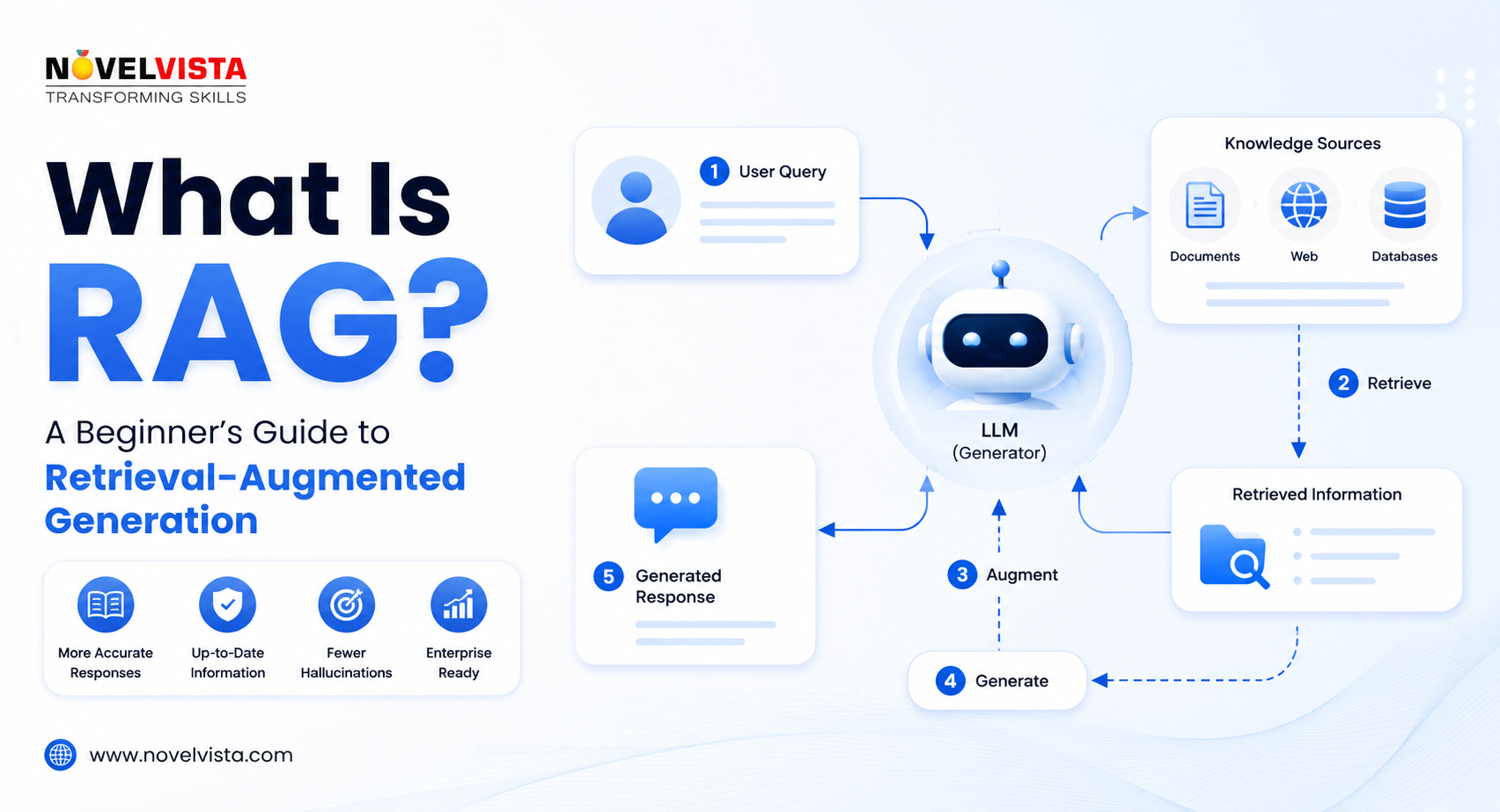
Retrieval-Augmented Generation, commonly called RAG, helps solve this problem. It allows an AI system to search for relevant information from trusted sources before generating an answer. In simple terms, RAG gives an Ai Engineering model the opportunity to ‘look things up’ instead of relying only on what it learned during training.
What does RAG mean?
The name describes two connected processes. ‘Retrieval’ means finding information relevant to a user's question. ‘Augmented generation’ means providing that information to a generative AI model so it can produce a better-informed response.
Imagine asking a new employee about a company's leave policy. If the employee answers from memory, the response might be outdated. If they first check the latest HR handbook and then answer, the response is more likely to be accurate. RAG works in a similar way: it retrieves supporting material first and uses it as context for the final answer.
How does RAG work?
A typical RAG system follows a few basic steps.
First, an organization collects trusted content such as manuals, policies, product documents, knowledge-base articles, reports, or website pages. The content is divided into smaller sections because searching short, focused passages is usually more effective than searching entire documents.
Next, these sections are converted into numerical representations called embeddings. Embeddings help the system recognize meaning and similarity. For example, a question about ‘resetting my password’ can be matched with a document section titled ‘recover account access,’ even when the wording is different.
When a user asks a question, the system searches its knowledge collection for the most relevant sections. Those sections are added to the prompt sent to the language model. The model then generates an answer based on both the question and the retrieved material. Well-designed systems may also show citations or links so users can verify the source.
A practical example
Consider a customer-support chatbot for a software company. A customer asks, ‘Can I cancel my annual subscription and receive a refund?’ A general AI model may provide a broad answer based on common industry practices. Unfortunately, that answer may not match the company's actual terms.
A RAG-enabled chatbot searches the latest cancellation and refund policy, retrieves the relevant paragraph, and prepares an answer grounded in that policy. It may explain the eligibility conditions and link to the original document. The response becomes more useful because it is based on approved business information rather than a guess.
Why are businesses using RAG?
RAG allows organizations to use their own information without retraining an AI model every time a document changes. Updating the knowledge source is usually faster and less expensive than training or fine-tuning a model again.
It can also improve accuracy, provide access to current information, and reduce hallucinations—answers invented by the model when it lacks reliable context. Citations make responses easier to review, which is particularly valuable in regulated or high-risk environments.
Common RAG use cases include internal knowledge assistants, customer service, policy search, technical support, legal document research, product discovery, and employee onboarding.
Is RAG always accurate?
RAG improves AI responses, but it does not guarantee perfection. If the source documents are inaccurate, outdated, poorly organized, or difficult to search, the final answer can still be wrong. The system may retrieve an irrelevant passage, overlook an important document, or misinterpret the context.
That is why effective RAG requires more than connecting an AI model to a folder of files. Teams must prepare content carefully, manage permissions, protect sensitive information, test retrieval quality, evaluate answers, and monitor performance over time. A strong system should also admit when reliable information cannot be found instead of filling the gap with confident-sounding text.
Final thoughts
RAG bridges the gap between a language model's general knowledge and the trusted, current information an organization actually needs. It helps AI provide responses that are more relevant, transparent, and grounded in real sources.
For beginners, the easiest way to understand RAG is to remember one idea: search first, answer second. That simple workflow is becoming a foundation for reliable enterprise AI applications, from support assistants to sophisticated knowledge platforms.

 English
 Arabic
 Français
 Español
 Deutsch
 Türkçe
 Dutch
Dutch
 Italiano
 Russian
 Romaian