


From Phishing to Deepfakes: How AI Is Changing Business Email Compromise
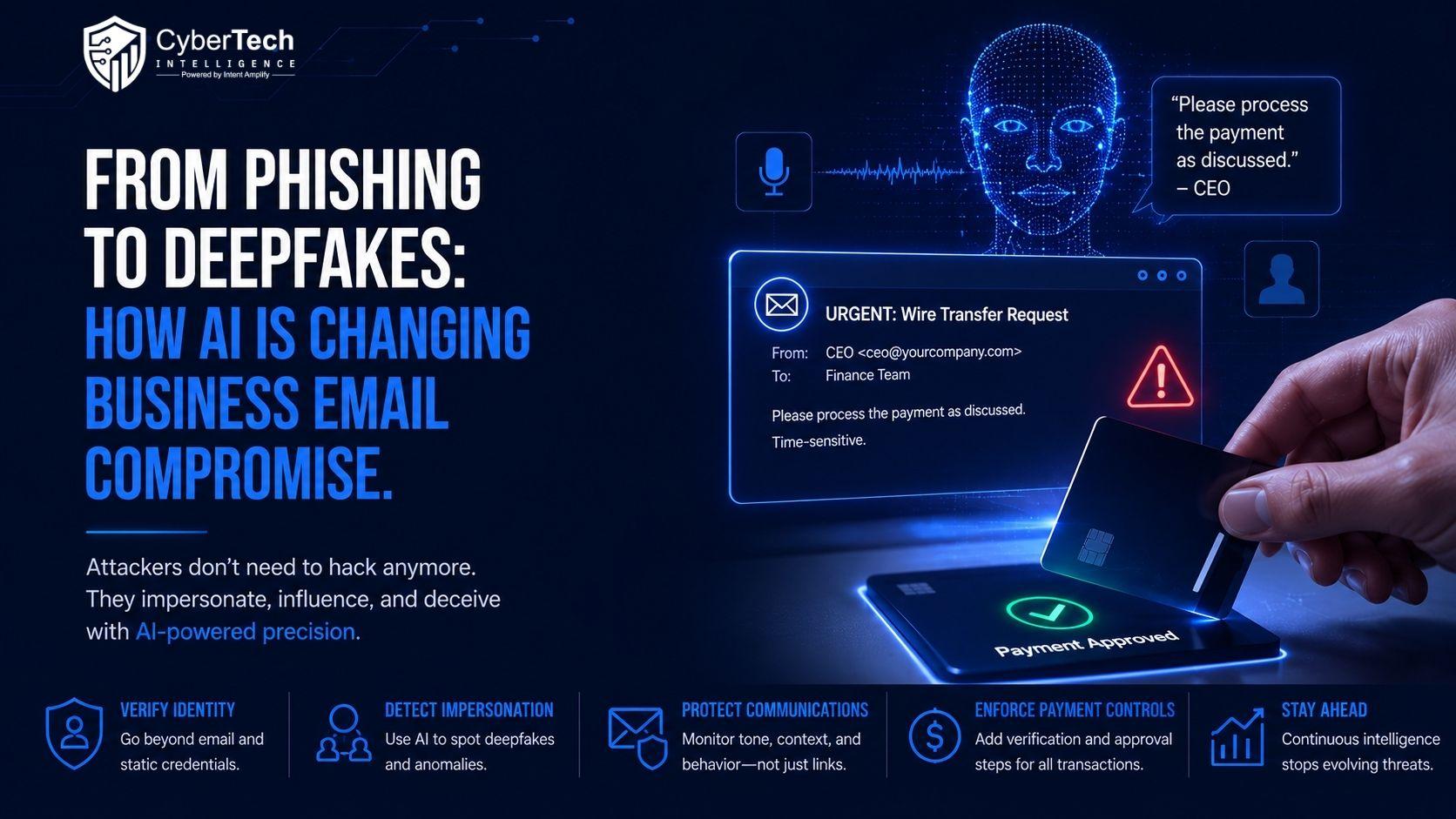
Business email compromise has traditionally depended on a relatively simple weakness: convincing someone that a fraudulent request came from a trusted person.
Artificial intelligence is making that deception harder to recognize.
Attackers can use generative AI to produce more convincing messages, imitate business communication styles, accelerate reconnaissance, and create synthetic voice or video designed to reinforce an impersonation attempt. A suspicious email requesting an urgent payment can potentially be followed by a convincing voice message or virtual interaction appearing to confirm the request.
This changes the security problem.
Organizations can no longer assume that a familiar writing style, recognizable voice, realistic image, or apparently legitimate communication channel provides sufficient proof of identity. As synthetic content becomes easier to produce, business email compromise is evolving into a broader business identity and transaction-verification problem.
For security and finance leaders, the priority is therefore moving beyond detecting phishing messages toward building processes capable of independently verifying high-risk actions.
Why Traditional BEC Defenses Are No Longer Enough
Traditional BEC defenses focus heavily on the communication itself.
Email authentication, spam filtering, anti-phishing technology, domain monitoring, employee awareness, and suspicious-link detection remain important. They can prevent many attacks from reaching employees.
But AI-assisted social engineering can reduce some of the warning signs employees have been trained to recognize.
Poor grammar is no longer a dependable signal. Generic wording can be replaced with context-specific language. Attackers can potentially use publicly available information or compromised communications to understand organizational relationships, job responsibilities, suppliers, executives, and business terminology.
More importantly, the attack may extend beyond email.
An employee who questions an unusual request could receive apparent confirmation through another communication channel. If that confirmation itself can be impersonated, simply asking employees to "verify the request" is no longer enough.
Enterprises need to define how verification must occur.
How AI Is Reshaping Business Email Compromise
AI does not eliminate the fundamentals of BEC. Attackers still need to create trust, establish urgency, and convince someone to perform an action.
What changes is the scale and credibility of the deception.
More Convincing Executive Impersonation
Generative AI can help attackers create messages that appear more polished and contextually appropriate.
Instead of sending obviously fraudulent requests, attackers can construct communications around recognizable business situations such as:
- Urgent invoice approvals
- Changes to supplier payment details
- Confidential acquisitions
- Executive travel
- Contract settlements
- Payroll changes
- Procurement requests
- Sensitive account access
The danger is not simply better-written phishing.
It is the ability to make fraudulent communication fit naturally into existing business workflows.
Voice Cloning Changes the Meaning of Confirmation
Voice has traditionally carried a strong sense of authenticity.
An employee who receives an unusual financial request might call an executive or listen to a voice message before proceeding. Synthetic voice technology challenges that assumption.
When attackers can imitate a person's voice, hearing the supposed requester may no longer provide adequate confirmation for a sensitive transaction.
Organizations therefore need verification mechanisms that do not depend solely on recognizable human characteristics.
Deepfake Video Expands the Impersonation Surface
Video can create an even stronger perception of authenticity.
As synthetic media improves, organizations should prepare for scenarios in which apparent visual confirmation is used to reinforce fraudulent instructions.
This does not mean every video meeting should be treated as fraudulent. It means high-risk actions should not be approved solely because someone appears or sounds legitimate during a digital interaction.
Presence is not the same as authorization.
That distinction should become a core principle of modern BEC defense.
The New Verification Standard for High-Risk Business Actions
If attackers can manipulate the signals employees traditionally use to establish trust, organizations need verification controls that exist independently of those signals.
Separate Communication From Authorization
A request and its authorization should not rely entirely on the same communication channel.
For example, a request to change supplier banking information received by email should be verified through a previously established process rather than by replying to the message or using contact details supplied within it.
This creates friction for attackers without unnecessarily slowing every business transaction.
Require Stronger Controls for High-Risk Transactions
Not every action requires the same level of verification.
Organizations should identify transactions where impersonation could create significant financial or operational impact, including:
- Large payments
- New beneficiary creation
- Bank account changes
- Payroll modifications
- Sensitive data transfers
- Privileged access requests
- Unusual procurement approvals
Higher-risk actions should trigger stronger authentication, independent verification, or multiple approvals.
Introduce Multi-Person Authorization
No single employee should become the final point of failure for high-value transactions.
Multi-person approval can make impersonation attacks significantly more difficult because the attacker must satisfy several independent controls rather than convincing one individual.
The approval process should also verify the transaction itself, not merely confirm that another employee clicked "approve."
Identity Security Must Become Part of BEC Defense
BEC is increasingly connected to identity security.
Compromising a legitimate account can provide attackers with something synthetic media alone cannot: access to trusted enterprise systems and existing conversations.
Once inside an account, an attacker may be able to observe communication patterns, identify financial workflows, understand reporting relationships, and send requests from legitimate infrastructure.
Organizations should therefore connect BEC prevention with broader identity controls.
Important capabilities include:
- Multi-factor authentication
- Conditional access
- Privileged access controls
- Session monitoring
- Impossible-travel and anomalous-login detection
- Rapid account containment
- Identity behavior analytics
- Strong account recovery processes
The goal is to detect not only fraudulent messages but also situations where a trusted identity begins behaving in an untrusted way.
Behavioral Signals Can Add Context to Financial Verification
Traditional financial controls frequently evaluate whether a user has permission to act.
Modern verification should also consider whether the action makes sense.
A payment request may deserve additional scrutiny when the amount, destination, timing, device, location, beneficiary, or approval sequence differs significantly from established behavior.
This creates an opportunity to combine cybersecurity telemetry with business context.
Rather than asking only:
"Is this the authorized user?"
organizations can also ask:
"Is this a reasonable action for this user, under these circumstances?"
That additional layer becomes increasingly valuable when visual and conversational signals can be artificially reproduced.
Industry Spotlight: Business Services
Business Services organizations often operate through extensive networks of customers, suppliers, consultants, contractors, and professional partners.
That creates a large volume of legitimate financial communication.
Invoice approvals, banking changes, client requests, procurement activity, and executive instructions can move rapidly across email and collaboration platforms. An attacker does not necessarily need to compromise a financial application if they can manipulate the human process surrounding it.
AI-assisted impersonation increases this risk by making fraudulent communication more believable.
Business Services organizations can strengthen resilience by establishing independent supplier verification, separating payment requests from authorization, applying stronger controls to banking changes, and ensuring finance teams know exactly how suspicious transactions should be escalated.
Industry Spotlight: Technology & Telecommunications
Technology & Telecommunications organizations often combine distributed workforces, cloud infrastructure, contractors, international vendors, and fast-moving operational environments.
These characteristics can create opportunities for sophisticated impersonation.
An unusual request may appear plausible when executives travel frequently, teams collaborate remotely, and employees regularly interact with people they have never met in person.
AI-generated communication can exploit that environment.
Organizations should therefore ensure that financial authorization, privileged access, supplier changes, and sensitive data requests depend on established enterprise controls rather than familiarity with an individual's email, voice, or appearance.
Why Finance and Security Teams Need a Shared BEC Strategy
BEC often crosses organizational boundaries.
Security teams manage identity, email protection, authentication, threat detection, and incident response. Finance teams control payment workflows, supplier records, approvals, and financial reconciliation.
Attackers exploit the space between them.
A mature AI-BEC strategy should therefore connect cybersecurity signals with financial controls.
Security teams should understand which financial actions represent the greatest business risk. Finance teams should understand how identity compromise and synthetic impersonation can affect the reliability of communication.
Together, they can define escalation procedures for suspicious transactions and determine when additional verification is required.
This collaboration also improves incident response.
If a suspicious payment request appears, the organization should be able to determine quickly whether it represents an isolated phishing attempt, a compromised identity, a fraudulent supplier change, or part of a broader intrusion.
Building an AI-Ready BEC Defense Strategy
Organizations should not respond to deepfakes by treating every communication as inherently untrustworthy.
Instead, verification should become proportional to business risk.
A practical strategy should include:
- Map high-risk financial workflows. Identify where a successful impersonation could create significant loss.
- Define trusted verification paths. Establish how sensitive requests must be independently confirmed.
- Strengthen enterprise identity controls. Protect the accounts attackers could use to make fraudulent requests more credible.
- Require additional approval for exceptional transactions. Unusual payments and beneficiary changes should receive greater scrutiny.
- Monitor behavioral anomalies. Combine identity and transaction context to identify activity inconsistent with normal patterns.
- Prepare employees for multimodal deception. Awareness programs should cover synthetic voice and video alongside traditional phishing.
- Test the process. BEC exercises should evaluate whether employees follow verification procedures when a request appears to come from a convincing executive or trusted partner.
- Connect finance and cybersecurity response plans. Both teams should know what happens when a suspicious request is identified.
For organizations reassessing how identity compromise affects enterprise trust, CyberTech Intelligence's Identity Security coverage provides further insight into protecting access and strengthening identity-driven security strategies.
The Future of Business Email Compromise
The term "business email compromise" may eventually describe only part of the threat.
Attackers are increasingly able to operate across email, messaging platforms, voice communications, video interactions, compromised identities, and legitimate collaboration environments.
The attack is becoming less about compromising an inbox and more about compromising trust.
That will require security programs to evolve accordingly.
Future BEC resilience will increasingly depend on combining:
- Identity security
- Transaction verification
- Behavioral analytics
- Communication security
- Risk-based authentication
- Financial controls
- Synthetic media awareness
- Cross-functional incident response
Organizations should expect impersonation techniques to continue improving.
Their verification standards need to improve with them.
Final Thoughts
AI is making one of the fundamental assumptions behind business communication increasingly unreliable: that seeing, hearing, or reading something familiar is enough to establish authenticity.
It is not.
A polished email can be generated. A voice can be cloned. Video can be manipulated. A legitimate account can be compromised.
The answer is not to eliminate trust from business operations. It is to stop treating familiarity as proof.
Organizations that separate communication from authorization, strengthen identity controls, introduce independent verification for high-risk transactions, and connect finance with cybersecurity will be better positioned to withstand the next generation of BEC.
In an environment where almost any digital interaction can potentially be imitated, the strongest defense is a business process that requires attackers to prove what they cannot simply generate: legitimate authorization.

 English
 Arabic
 Español
 Português
 Deutsch
 Türkçe
 Dutch
Dutch
 Italiano
 Russian
 Romaian