


Butterfly Control Valve Actuator Types and Selection Guide
Introduction
We are a leading control valve manufacturer in China, providing high-quality valves and control actuators designed to meet the unique needs of various industries.
In today’s industrial landscape, butterfly valves are essential components for regulating flow within pipelines across various industries, including water treatment, chemical processing, power generation, and HVAC systems. The efficiency and performance of a butterfly valve are influenced not only by the valve body itself but also by the actuator that operates it. The actuator is crucial in opening, closing, or throttling the flow through the valve, and choosing the right actuator is critical for system performance, safety, and reliability.
This guide provides a comprehensive overview of the main types of butterfly valve actuators, factors to consider when selecting an actuator, and the ideal applications for each type. Whether you’re an engineer designing a new system or a maintenance professional replacing an actuator, this guide will help you make an informed decision.
Butterfly Control Valve: The Role of the Actuator
The actuator in a butterfly valve is responsible for controlling the movement of the valve's disc, allowing or restricting fluid flow. The actuator connects to the valve shaft and manipulates the disc's position, which is crucial for controlling the fluid flow in the pipeline. Actuators range from simple manual devices to more complex automated units such as electric or pneumatic actuators.
Key Considerations in Selecting a Butterfly Valve Actuator
When choosing the appropriate actuator for a butterfly valve, several key factors must be taken into consideration:
-
Frequency of Operation
-
Manual Actuator: Suitable for occasional use, like emergency shutdowns.
-
Automated Actuators: Ideal for processes requiring frequent or continuous operation.
-
-
Valve Size and Torque Requirement
-
Larger valves need more torque to operate. Manual actuators may become impractical for big valves, necessitating a gearbox or automated actuator.
-
-
System Pressure and Media Type
-
Hydraulic Actuators: Best for high-pressure or harsh media.
-
Pneumatic Actuators: Suitable for medium to high-pressure applications.
-
-
Response Time
-
Pneumatic Actuators: Offer the fastest response time, ideal for rapid opening/closing.
-
Electric Actuators: Provide slower operation but better precision.
-
-
Power Source Availability
-
Manual Actuators: Do not require external power.
-
Electric/Pneumatic Actuators: Require an external power source.
-
-
Environmental Conditions
-
Electric Actuators: Not suitable for wet or hazardous environments.
-
Pneumatic and Hydraulic Actuators: Work better in harsh conditions like moisture or hazardous areas.
-
-
Cost
-
Manual Actuators: The most affordable option, ideal for simple setups.
-
Electric/Pneumatic/Hydraulic Actuators: More expensive but offer enhanced control and automation.
-
Types of Butterfly Valve Actuators
1. Manual Actuator
-
Description: Operates via handwheels, levers, or gearboxes, with manual effort to move the valve.
-
Key Features:
-
No external power required
-
Simple installation and maintenance
-
Suitable for infrequent use
-
Lever/gear options available
-
-
Applications:
-
Water supply systems
-
HVAC systems
-
Agricultural irrigation
-
Emergency shut-off situations
-
-
Advantages:
-
Low cost, simple construction
-
Fail-safe operation
-
Ideal for isolated/remote locations
-
-
Disadvantages:
-
Requires human intervention
-
Not suitable for automation or large systems
-
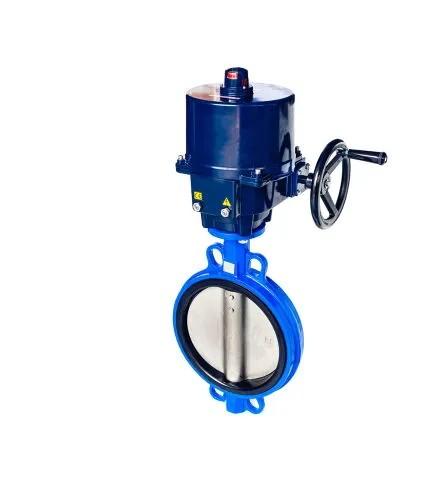
2. Electric Actuator
-
Description: Uses motors powered by AC/DC to drive the valve open or closed.
-
Key Features:
-
Ideal for automated systems
-
Precise flow control and modulation
-
Can integrate with control systems for feedback
-
-
Applications:
-
Water treatment
-
Food and beverage processing
-
Pharmaceutical production
-
Building management systems
-
-
Advantages:
-
Accurate, programmable
-
Low noise operation
-
Excellent for continuous operation and feedback control
-
-
Disadvantages:
-
Slower response time
-
Not suitable in wet/explosive environments
-
Higher initial cost
-
3. Pneumatic Actuator
-
Description: Uses compressed air to operate a piston or diaphragm that moves the valve.
-
Key Features:
-
Fast, repeatable motion
-
Available in double-acting or spring-return configurations
-
Compatible with positioners and limit switches
-
-
Applications:
-
Chemical processing
-
Oil and gas pipelines
-
Power plants
-
Fire protection systems
-
-
Advantages:
-
Rapid response
-
Compact design
-
Suitable for hazardous environments
-
Easy integration with control systems
-
-
Disadvantages:
-
Requires clean, dry air
-
Noise can be an issue without silencers
-
Air leaks can reduce efficiency
-
4. Hydraulic Actuator
-
Description: Uses pressurized hydraulic fluid to operate the valve, ideal for heavy-duty applications.
-
Key Features:
-
High torque output
-
Reliable under high-pressure conditions
-
Available in linear or rotary designs
-
-
Applications:
-
Marine and offshore platforms
-
Mining operations
-
Heavy-duty water control systems
-
Steel and paper manufacturing
-
-
Advantages:
-
Suitable for large valves
-
Can handle extreme pressure and temperature
-
Smooth, powerful operation
-
-
Disadvantages:
-
Expensive and complex installation
-
Requires hydraulic fluid maintenance
-
Potential for fluid leaks
-
Actuator Selection Summary Table
| Actuator Type | Power Source | Best For | Response Time | Automation | Cost | Harsh Environments |
|---|---|---|---|---|---|---|
| Manual | None | Small, rarely operated valves | Slow | No | Low | Good (basic use) |
| Electric | Electricity | Precise control, indoor use | Moderate | Yes | Medium | Poor (wet/explosive) |
| Pneumatic | Compressed Air | Fast operation, automation | Fast | Yes | Medium-High | Excellent |
| Hydraulic | Hydraulic Fluid | High torque, large valves | Fast | Yes | High | Excellent |
Conclusion
Selecting the right actuator for your butterfly valve depends on several factors, including valve size, system pressure, environmental conditions, and budget. Manual actuators are cost-effective and ideal for simple, infrequent operations, while electric, pneumatic, and hydraulic actuators offer enhanced control, precision, and automation for more demanding applications.
-
Pneumatic actuators are great for fast operations and automation in hazardous environments.
-
Electric actuators are best for precise control in well-maintained environments.
-
Hydraulic actuators are essential for large valves and heavy-duty operations.
By considering these factors carefully, engineers and facility managers can ensure their butterfly valve systems deliver optimal performance, safety, and longevity.Know more about Google SEO Directory

 English
 Arabic
 Français
 Español
 Português
 Deutsch
 Dutch
Dutch
 Italiano
 Russian
 Romaian