


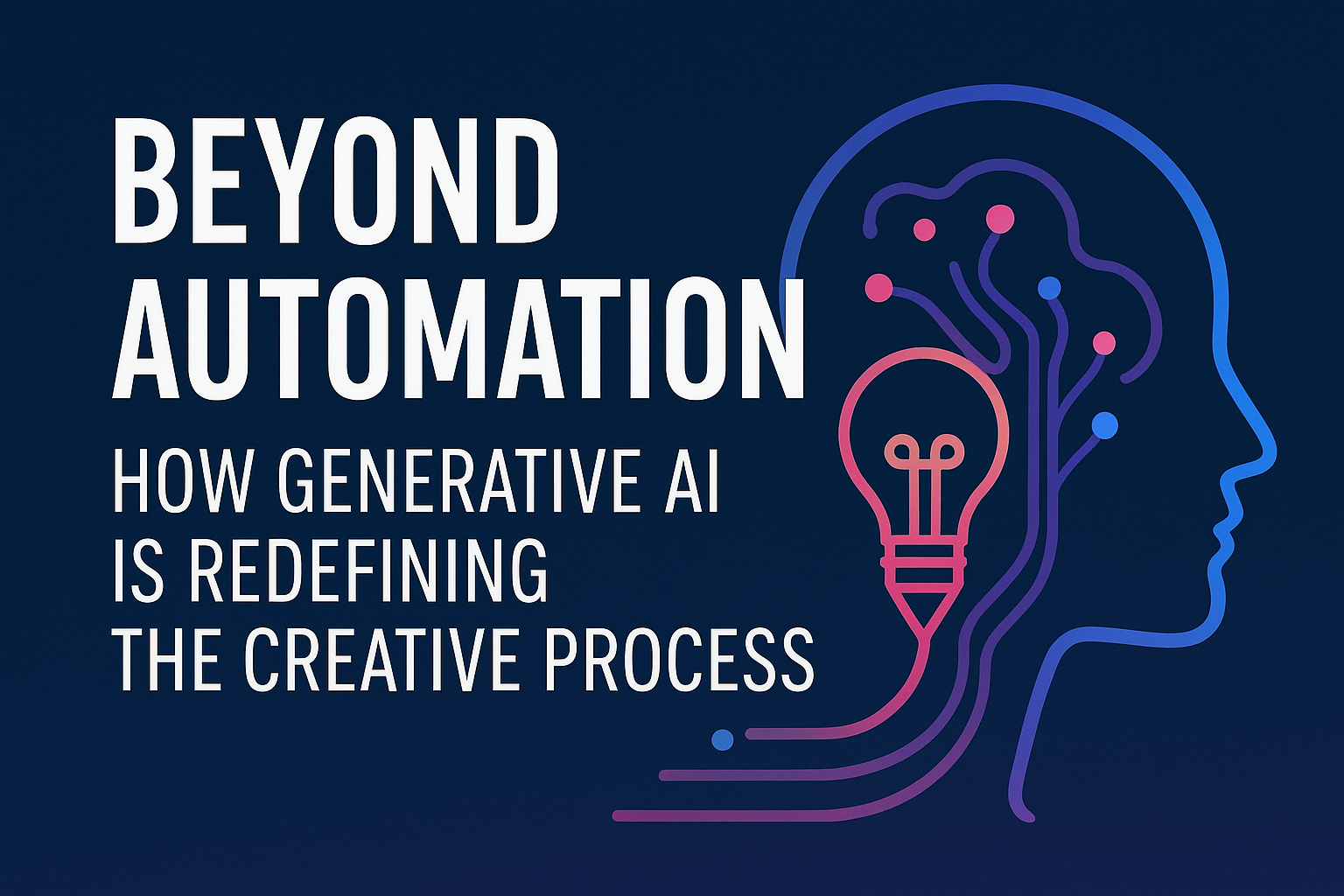
Beyond Automation: How Generative AI is Redefining the Creative Process

Introduction: When Creation Meets Code
For decades, the creative process was considered uniquely human—a mix of intuition, emotion, and experience that no machine could mimic. But the rise of Generative AI has challenged that assumption. From writing music and designing visuals to composing entire marketing campaigns, AI tools are no longer assistants—they’re collaborators.
Generative AI doesn’t just automate creativity; it reshapes how we think, design, and produce ideas. The real revolution lies not in replacing humans, but in amplifying our creative potential.
From Automation to Co-Creation
Early artificial intelligence focused on efficiency—repetitive tasks, pattern recognition, and optimization. Today’s generative systems like GPT-4, DALL·E, and Midjourney are designed differently. They generate new ideas, not just execute commands.
This marks a major shift:
- Automation made things faster.
- Generation makes things new.
Artists use AI to spark inspiration, writers overcome creative blocks with AI-generated prompts, and designers explore thousands of visual variations in seconds. The result isn’t about replacing originality—it’s about expanding the creative canvas.
“Generative AI doesn’t create for us; it creates with us. It’s an extension of imagination, not a substitute for it.” — Nate Patel
How Generative AI Fuels Creativity
Generative AI models are trained on massive datasets—art, text, music, code—and use pattern recognition to create something unique. The technology blends human intent with machine creativity to produce results that surprise even their creators.
Some key applications include:
1. Content Creation and Ideation
Writers and marketers now use AI tools to brainstorm, draft, and optimize copy. Instead of starting from scratch, AI can generate a first draft, helping professionals focus on strategy and storytelling.
2. Visual Arts and Design
Artists use platforms like RunwayML and Midjourney to explore visual styles and compositions that would take hours—or days—by hand. The AI acts as a co-artist, providing inspiration or accelerating iteration.
3. Music and Audio
From AI-generated soundtracks to personalized playlists, tools like AIVA and Soundful allow creators to compose music tailored to mood, emotion, or even brand identity.
4. Product and UX Design
Designers are leveraging generative algorithms to explore new product concepts, architectures, and user experiences. AI helps simulate possibilities that humans might overlook.
Each of these examples reflects a deeper truth: AI’s value isn’t in producing art autonomously—it’s in enhancing human imagination.
Read More: Beyond Automation: How Generative AI is Redefining the Creative Process

 English
 Arabic
 Français
 Español
 Português
 Deutsch
 Türkçe
 Italiano
 Russian
 Romaian