


Cement Bricks: Types, Composition and Manufacturing Process
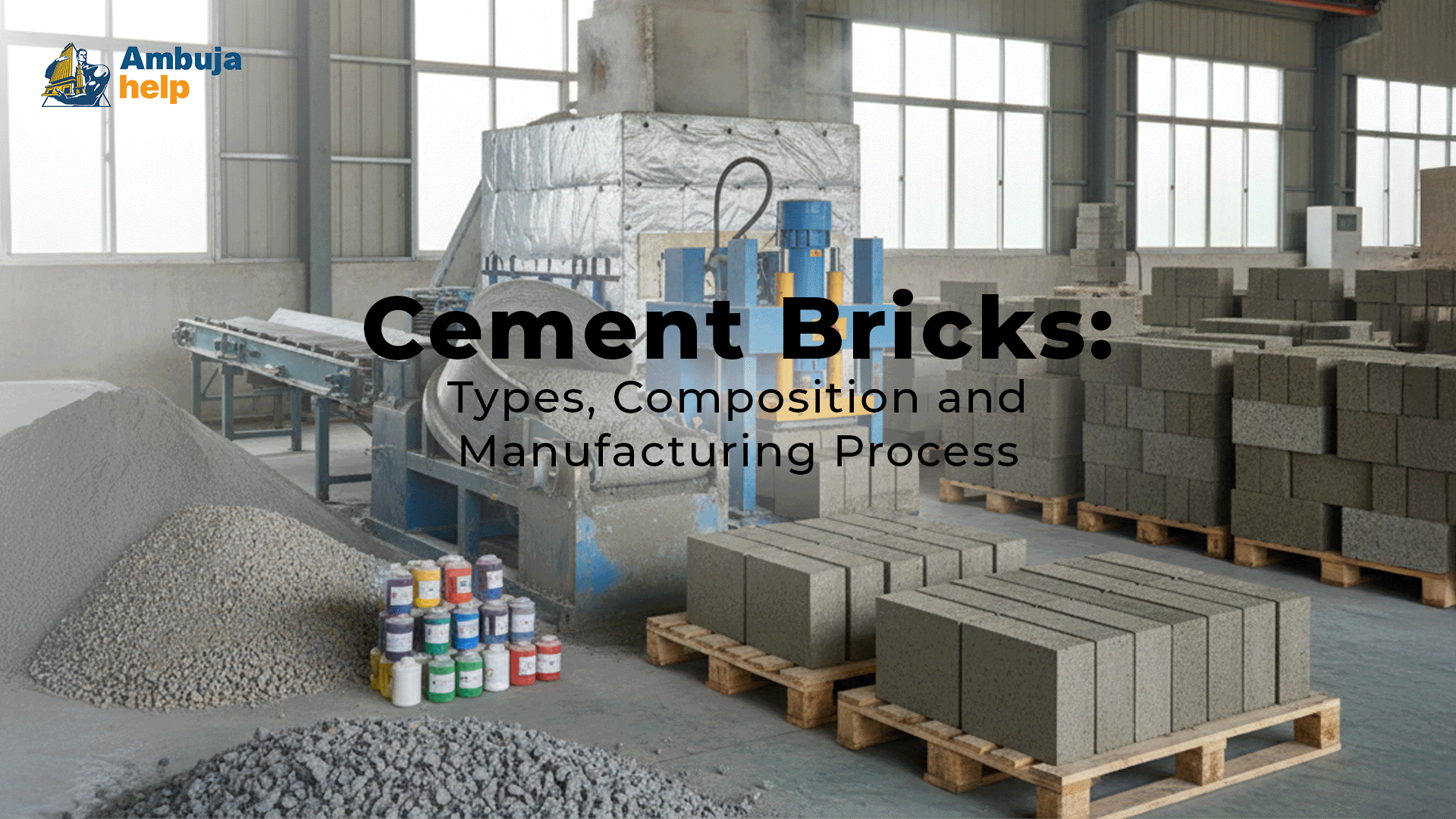
In modern construction, cement bricks have become one of the most widely used building materials for their durability, strength, and versatility. From residential homes to large commercial buildings, these bricks offer a reliable and sustainable solution for modern building needs. Understanding their types, composition, and manufacturing process can help builders, engineers, and homeowners make informed choices during project planning and cost estimation.
Understanding Cement Bricks and Their Role in Construction
Cement bricks, also referred to as concrete bricks, are made from a blend of cement, sand, aggregates, and water. They come in various sizes and shapes, designed to suit a wide range of building and decorative purposes. Compared to traditional clay bricks, they offer greater uniformity, high compressive strength, and enhanced resistance to environmental wear.
They are a preferred choice in projects where durability, faster construction, and sustainability are key requirements. Their uniformity ensures correct alignment, reducing the need for extensive plastering, while their composition allows for improved thermal insulation and fire resistance.
Types of Cement Bricks
Cement bricks can be categorised into several types depending on their structure, manufacturing process, and intended application. Each type has distinct characteristics that make it suitable for specific construction needs.
|
Type of Cement Brick |
Description |
Common Uses |
|
Solid Cement Bricks |
Dense and compact with no cavities. Offer high compressive strength and excellent durability. |
Foundations, load-bearing walls, and columns. |
|
Hollow Cement Bricks |
Contain voids to reduce weight and enhance insulation. Offer cost efficiency and ease of handling. |
Partition walls and non-load-bearing structures. |
|
Fly Ash Bricks |
Made from fly ash, cement, and additives, an eco-friendly alternative that reduces energy consumption during production. |
Residential and commercial buildings promoting sustainability. |
|
Interlocking Bricks |
Feature interlocking designs that fit together without mortar, ensuring faster construction and stability. |
Pavements, landscaping, and modular walls. |
The choice of brick type depends on factors like location and design preferences. Tools such as a building construction cost calculator can help estimate expenses more accurately based on the type of brick selected and its application.
Composition of Cement Bricks
The strength and performance of cement bricks depend on the quality and proportion of their ingredients. The core composition generally includes four key components:
|
Component |
Function in Brick |
|
Cement |
Acts as the binding material, hardening through hydration to give the brick its strength and stability. |
|
Sand |
Fills voids between particles and provides bulk and uniformity, improving density and reducing shrinkage. |
|
Aggregates |
Typically, crushed stone or gravel is used to enhance load-bearing capacity and structural integrity. |
|
Water |
Initiates the hydration process, allowing cement to bond with sand and aggregates. |
Additives for Enhanced Properties
To improve performance, certain additives are often included in the mix:
|
Additive |
Purpose |
|
Fly Ash |
Enhances strength and reduces water demand, improving workability. |
|
Plasticisers |
Increase workability, allowing better moulding and surface finish. |
|
Accelerators/Retarders |
Adjust the setting time to suit production speed or working conditions. |
|
Pigments |
Add aesthetic value by imparting colour to the bricks. |
These additives ensure that the final product meets the structural and aesthetic expectations required in diverse construction projects.
Manufacturing Process of Cement Bricks
The manufacturing of cement bricks follows a systematic process to ensure uniform quality and durability. Below are the key stages involved:
1. Preparation of Raw Materials
High-quality cement, sand, and aggregates are selected and tested for consistency. Each ingredient is proportioned precisely according to the desired brick strength and size.
2. Mixing and Blending
The materials are batched and thoroughly mixed using mixers to achieve a uniform consistency. Additives like fly ash or pigments are added at this stage to enhance specific properties.
3. Moulding and Compaction
The prepared mix is poured into steel or plastic moulds shaped according to brick dimensions. Compaction is achieved using vibrators or hydraulic presses to eliminate air gaps, ensuring high density and structural integrity.
4. Curing and Drying
After moulding, the bricks are cured to allow hydration and strength development. Common methods include water curing, steam curing, or moist curing in controlled chambers. Once cured, the bricks are air-dried to remove residual moisture.
5. Quality Control
Finished bricks undergo testing to ensure they meet the required standards for strength, water absorption, and dimensional accuracy. Any deviations are corrected immediately to maintain production quality.
Applications of Cement Bricks
Cement bricks are used across various sectors of the construction industry due to their versatility:
|
Sector |
Application |
|
Residential Construction |
Walls, foundations, and paving for houses. |
|
Commercial Buildings |
Structural walls, partitions, and facades. |
|
Infrastructure Projects |
Retaining walls, road edging, and utility structures. |
|
Landscaping |
Garden walls, walkways, and outdoor seating structures. |
Advantages and Limitations
Like any building material, cement bricks have both strengths and limitations:
|
Advantages |
Disadvantages |
|
Long-lasting and weather-resistant |
Heavier than clay bricks, increasing handling costs |
|
Excellent compressive strength |
May absorb moisture if not properly cured |
|
Fire and pest-resistant |
Can be brittle under excessive load |
|
Environmentally sustainable |
Production requires significant energy |
|
Cost-effective and uniform in shape |
Requires skilled handling during transport |
Optimising Costs and Efficiency
Accurate planning and budgeting are essential in construction. Using a building construction cost calculator can assist homeowners, architects, and contractors in estimating total project expenses based on parameters such as material quantity, type of cement brick, labour cost, and design complexity. This not only ensures financial clarity but also supports efficient resource management during the entire building process.
Conclusion
In today’s construction landscape, cement bricks play an indispensable role by combining strength, sustainability, and affordability. Their diverse types and compositions make them suitable for a wide range of applications, from strong structural walls to aesthetically pleasing outdoor designs. As manufacturing techniques evolve, these bricks continue to set benchmarks for efficiency and environmental responsibility, shaping the foundation of modern, durable, and sustainable architecture.
 Deutsch
 English
 Arabic
 Français
 Español
 Português
 Türkçe
 Dutch
Dutch
 Italiano
 Russian
 Romaian