


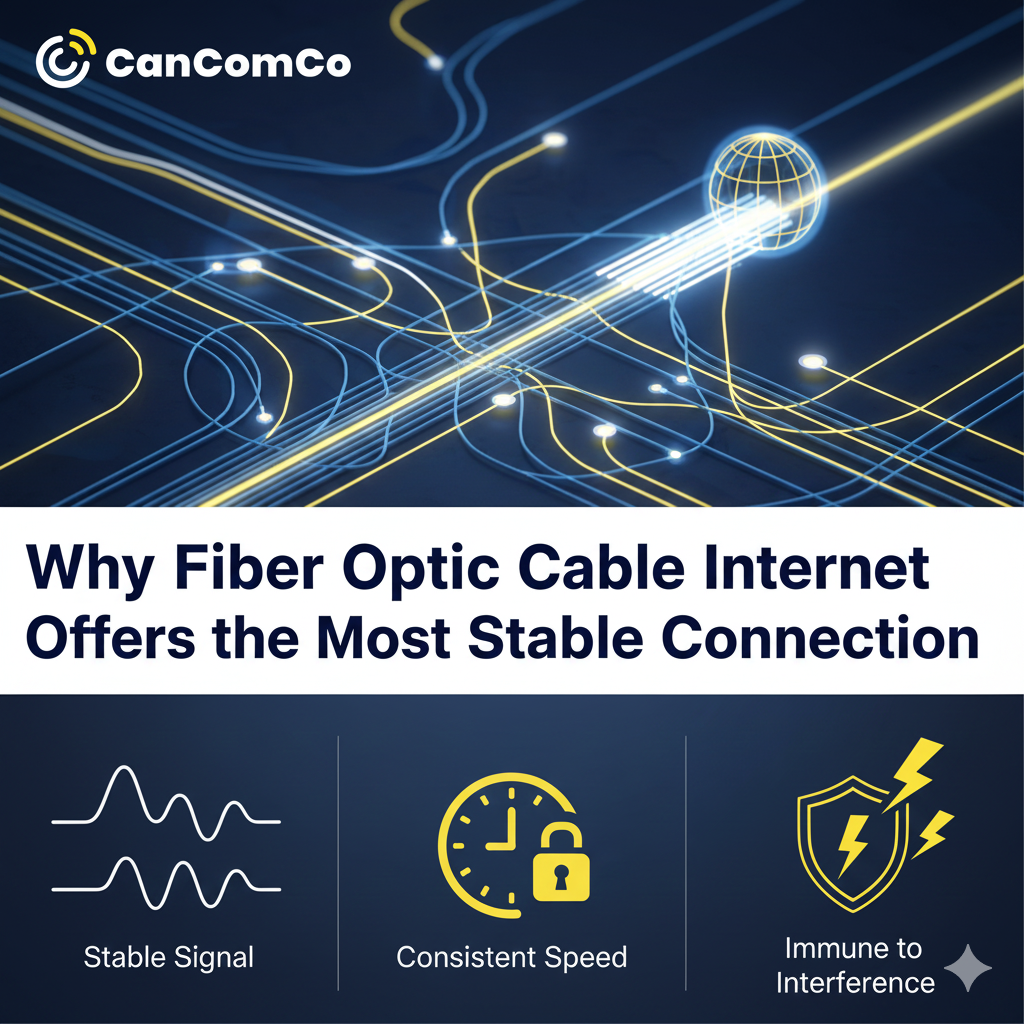
Why Fiber Optic Cable Internet Offers the Most Stable Connection.
In today's fast-paced digital economy, an unstable internet connection is more than just an inconvenience it's a liability. For business owners and IT professionals, connectivity that is prone to slowdowns, latency spikes, and intermittent outages can directly impact productivity and profitability.
While many internet service providers for business still rely on legacy copper-based systems, fiber optic cable internet has emerged as the clear leader in stability and reliability. This isn't just a marketing claim; it's a technical fact rooted in the physics of how fiber transmits data.
The Fundamental Difference: Light vs. Electricity
The core reason for fiber's superior stability lies in the medium it uses for data transmission.
-
Traditional (Copper/Coaxial) Internet relies on electrical signals traveling over metallic wires.
-
Fiber Optic Cable Internet uses incredibly thin strands of glass or plastic to transmit data as pulses of light.
This switch from electricity to light fundamentally solves the most common stability problems plaguing copper-based networks.
Three Pillars of Fiber Optic Stability
1. Immunity to Electromagnetic Interference (EMI)
The most significant stability advantage of optic fibre internet is its complete resistance to electromagnetic interference.
-
The Copper Problem: Copper wires, being metallic conductors, are highly susceptible to noise and interference from nearby power lines, heavy machinery, radio waves, and even lightning strikes. This interference corrupts the electrical data signal, leading to signal degradation, slow speeds, and packet loss (unstable connection).
-
The Fiber Solution: Since fiber cables transmit light, they are non-conductive and immune to all forms of EMI. This means the digital signal remains clean and intact from the source to your office, offering unparalleled reliability and consistent performance, even when running alongside heavy power infrastructure.
2. Zero Signal Degradation Over Distance (Low Attenuation)
Stability requires a strong, consistent signal regardless of the distance from the provider's central office.
-
The Copper Problem: Electrical signals weaken significantly as they travel along a copper wire, a phenomenon called attenuation. To compensate, copper-based networks require frequent signal boosting, which introduces potential failure points and limits the maximum achievable speed and distance. The connection becomes less stable the farther you are from the exchange.
-
The Fiber Solution: Light pulses travel through the glass strands with minimal signal loss over incredibly long distances (up to 100 miles or more without active boosting). For a business, this translates to a connection that is unaffected by location, ensuring the speed and quality you pay for are the speeds you receive consistently.
3. Resistance to Network Congestion
In shared networks like traditional cable broadband, the stability of your connection depends on the usage of your neighbors especially during peak hours.
-
The Copper Problem: Cable broadband uses a shared local loop. If multiple nearby businesses are all uploading large files or hosting high-definition video calls simultaneously, the available bandwidth is split, leading to severe slowdowns and instability for everyone.
-
The Fiber Solution: True optic fibre internet connections (Fiber-to-the-Premises or FTTP) often provide a dedicated path from the network node directly to your business. Fiber's vastly higher bandwidth capacity, coupled with this dedicated or less shared infrastructure, minimizes the impact of peak-hour traffic. The stability of your connection remains high, guaranteeing the high-speed, symmetrical upload and download speeds essential for cloud-based collaboration, VoIP, and video conferencing.
The Business Impact: Reliability Translates to ROI
For internet service providers for business, stability is the ultimate selling point because it directly affects a company's bottom line.
| Business Function | Instability Risk (Copper) | Fiber Optic Stability Benefit |
| Cloud Computing | Slow, interrupted uploads/downloads; data synchronization errors. | Consistent, symmetrical speeds ensure instantaneous cloud access and backup. |
| VoIP/Video Conferencing | High latency (delay) and packet loss resulting in choppy audio/video calls. | Reduced latency ensures crystal-clear, real-time communication without interruptions. |
| Real-time Transactions | Risk of transaction failure during payment processing or high-frequency trading. | Near-zero downtime and dedicated bandwidth prevent bottlenecks during critical operations. |
In short, by eliminating the physical and logistical vulnerabilities inherent in copper wires, fiber optic cable internet provides the necessary foundation for modern business operations. It’s an investment in a resilient, future-proof network that ensures you can focus on growth, not troubleshooting connectivity issues.

 Arabic
 Français
 Español
 Português
 Deutsch
 Türkçe
 Dutch
Dutch
 Italiano
 Russian
 Romaian